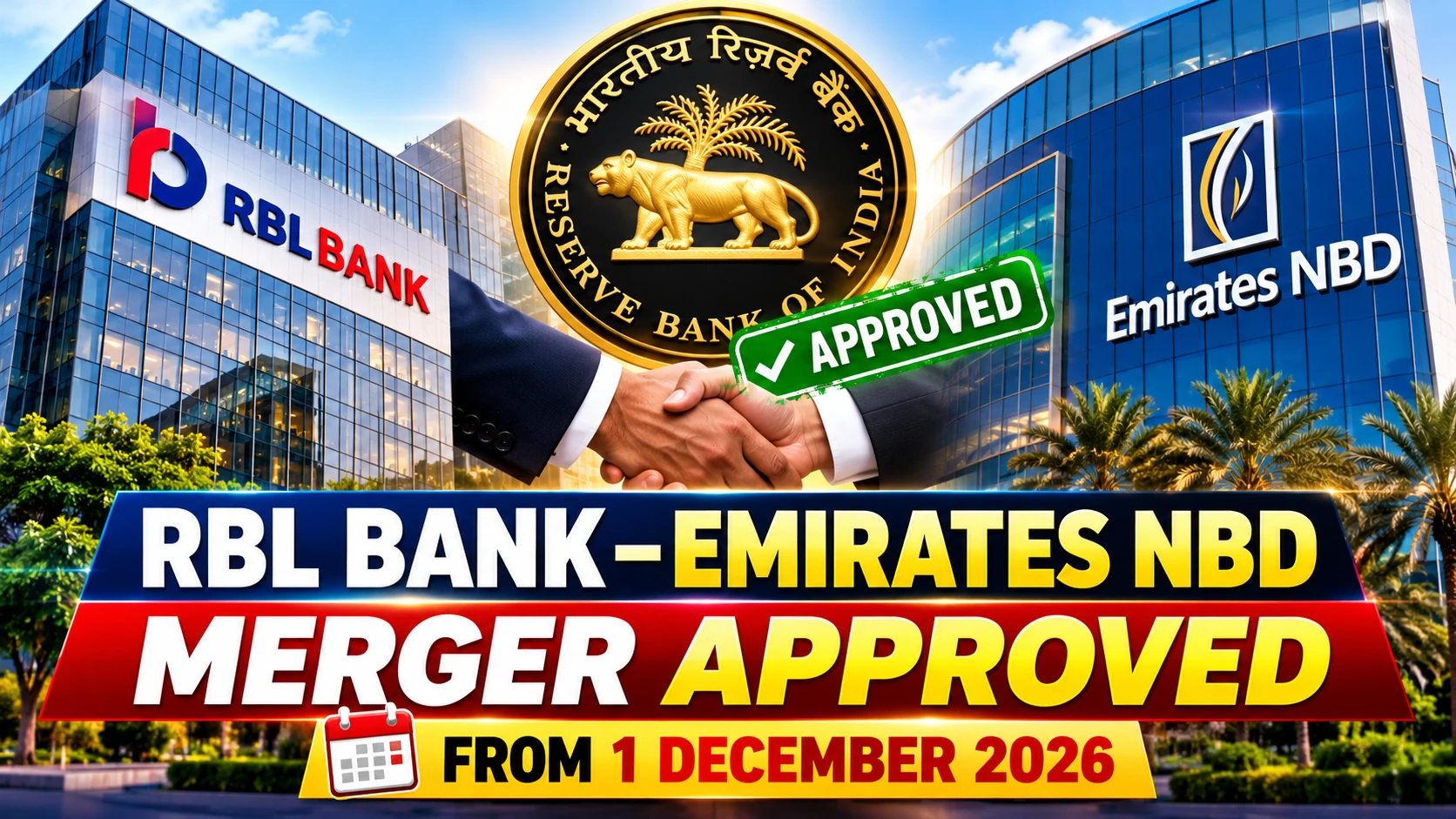
RBL Bank–Emirates NBD Merger News: The Reserve Bank of India (RBI) has approved the merger of Emirates NBD Bank’s Indian branches with RBL Bank Limited, marking an important development in India’s banking sector. The amalgamation will become effective on December 1, 2026, when Emirates NBD’s three Indian branches will begin operating as branches of RBL Bank.
The decision follows Emirates NBD’s acquisition of a 60% stake in RBL Bank through an investment of approximately ₹26,000 crore earlier this year.
The development has attracted attention from banking customers, investors, and financial market observers. But what exactly has the RBI approved, and will existing customers need to change their bank accounts?
Here is a detailed explanation of the merger, its timeline, and its potential impact.
🏦 RBI Approves RBL Bank and Emirates NBD Branch Merger
On October 16, 2026, the Reserve Bank of India approved the Scheme of Amalgamation involving the Indian branches of Emirates NBD Bank P.J.S.C. and RBL Bank Limited.
The approval was granted under Section 44A(4) of the Banking Regulation Act, 1949.
Under the approved arrangement, Emirates NBD’s Indian branches will be transferred to RBL Bank, which will serve as the receiving bank.
The RBI has specified December 1, 2026, as the effective date.
This means Emirates NBD’s existing Indian branch operations will become part of RBL Bank’s domestic banking network.
Importantly, the announcement concerns the merger of Emirates NBD’s Indian branches into RBL Bank, not the worldwide merger of the two banking companies.
The distinction matters because Emirates NBD will continue to operate its international banking business separately.
🏦 RBL Bank–Emirates NBD Merger 2026
RBI Approval, Investment and Key Details
| Regulator | Reserve Bank of India |
|---|---|
| Approval Date | 16 October 2026 |
| Receiving Bank | RBL Bank Limited |
| Transferring Operations | Emirates NBD Indian Branches |
| Branch Locations | Mumbai, Chennai, Gurugram |
| Legal Basis | Banking Regulation Act, Section 44A(4) |
| Customer Account Changes | Follow official bank notifications |
💰 Emirates NBD’s ₹26,000 Crore Investment in RBL Bank
The branch merger follows a major investment agreement between the two financial institutions.
In October 2025, Emirates NBD announced plans to acquire a controlling stake in RBL Bank.
The transaction was completed on June 18, 2026, when the Dubai-based banking group invested approximately $2.75 billion, equivalent to around ₹26,000 crore.
Following the capital infusion, Emirates NBD acquired approximately 60% of RBL Bank’s expanded share capital.
The investment made Emirates NBD the controlling shareholder and promoter of the Indian private-sector lender.
Why Is This Investment Important?
The transaction represents one of the largest foreign investments in India’s banking industry.
It provides RBL Bank with substantial additional capital that can support future business development.
The bank may use its stronger financial position to expand lending operations, improve digital banking infrastructure, develop new products, and strengthen customer services.
Emirates NBD, meanwhile, gains access to an established Indian banking platform and a broader domestic customer base.
The arrangement creates opportunities for both institutions to combine their respective strengths.
📍 Which Emirates NBD Branches Will Merge With RBL Bank?
Emirates NBD currently operates three branches in India.
These are located in:
- Mumbai, Maharashtra
- Chennai, Tamil Nadu
- Gurugram, Haryana
All three branches are included in the approved amalgamation.
From December 1, 2026, they will operate as branches of RBL Bank.
Emirates NBD entered India’s banking market with its first branch in Mumbai in 2017 before expanding to Gurugram and Chennai.
The integration will bring these operations under RBL Bank’s existing domestic banking structure.
For RBL Bank, the merger offers an opportunity to strengthen relationships with customers involved in international trade, corporate banking, and cross-border financial services.
👥 What Will Happen to Existing Bank Customers?
One of the biggest questions surrounding the RBL Bank–Emirates NBD merger concerns its impact on customers.
The RBI has confirmed the branch amalgamation and its effective date. However, the announcement does not provide every operational detail affecting individual customer accounts.
Will Existing RBL Bank Accounts Change?
The approval does not itself announce any mandatory account-number changes for existing RBL Bank customers.
Customers should continue following their bank’s official instructions.
If any changes become necessary, the bank would need to communicate the relevant requirements through its customer service channels.
Will Emirates NBD Customers Need New Account Details?
Customers of Emirates NBD’s Indian branches may receive instructions about operational changes associated with the integration.
These could concern account servicing, branch arrangements, or other banking procedures.
However, customers should not assume that account numbers, IFSC codes, debit cards, or other banking details will automatically change on December 1.
Specific changes should be confirmed through official bank communications.
What About Fixed Deposits and Loans?
The RBI’s approval establishes the legal framework for transferring the Indian branch business.
It does not, by itself, announce revised interest rates or new terms for every existing deposit and loan.
Customers with fixed deposits, savings accounts, or outstanding loans should review any notices issued by their bank.
They should also avoid acting on unverified messages claiming that urgent account changes are required.
🌍 Why Is Emirates NBD Expanding Its Presence in India?
India represents an important market for Emirates NBD because of its growing economy, corporate banking opportunities, and financial connections with the United Arab Emirates.
The partnership with RBL Bank could help Emirates NBD expand its presence without building an entirely new domestic banking network.
RBL Bank already has an established branch network and experience serving Indian retail and corporate customers.
Emirates NBD brings international banking expertise and connections across markets in the Middle East and beyond.
Together, these capabilities could support business opportunities in several areas.
Potential Areas of Growth
International trade finance: Businesses involved in imports and exports may benefit from improved access to cross-border banking services.
Corporate banking: The partnership could strengthen services for Indian companies with international operations.
NRI banking: The institutions may develop additional financial services for non-resident Indians, particularly those living in Gulf countries.
Digital banking: Additional capital may support technology investment and improvements in banking infrastructure.
These are potential business opportunities rather than guaranteed benefits for individual customers.
📅 RBL Bank–Emirates NBD Merger Timeline
The merger follows several important developments.
October 18, 2025: Emirates NBD and RBL Bank announced their strategic investment agreement.
January 20, 2026: The Competition Commission of India announced approval of the proposed acquisition.
May 2026: RBL Bank confirmed that the necessary regulatory and government approvals for the strategic investment had been received.
June 18, 2026: Emirates NBD completed its investment and acquired a 60% stake in RBL Bank.
October 16, 2026: The RBI approved the amalgamation of Emirates NBD’s Indian branches with RBL Bank.
December 1, 2026: The approved branch merger is scheduled to take effect.
This timeline shows that the ownership transaction and the branch amalgamation are separate stages of the wider strategic arrangement.
📈 What Does the Merger Mean for India’s Banking Sector?
The RBL Bank–Emirates NBD transaction highlights the growing importance of international investment in India’s financial services industry.
A major foreign banking group acquiring a controlling stake in an Indian private-sector bank is a significant development.
The additional capital could strengthen RBL Bank’s ability to compete, expand its operations, and invest in customer-facing technology.
At the same time, integrating Emirates NBD’s Indian branches could create operational efficiencies and strengthen international banking capabilities.
However, the long-term results will depend on how effectively the banks integrate their operations, manage risks, and deliver their business strategy.
Investors should also remember that regulatory approval does not guarantee future profitability or share-price gains.
❓ Frequently Asked Questions
1. Has the RBI approved the RBL Bank–Emirates NBD merger?
Yes. On October 16, 2026, the RBI approved the amalgamation of Emirates NBD’s Indian branches with RBL Bank Limited.
2. When will the RBL Bank and Emirates NBD merger take effect?
The approved branch merger will become effective on December 1, 2026.
3. How much did Emirates NBD invest in RBL Bank?
Emirates NBD invested approximately ₹26,000 crore, or around $2.75 billion, and acquired a 60% stake in RBL Bank in June 2026.
4. Which Emirates NBD branches are included?
The three Indian branches located in Mumbai, Chennai, and Gurugram are included in the amalgamation.
5. Will RBL Bank customers need to change their account numbers?
No automatic account-number change has been announced in the reported RBI approval. Customers should rely on official bank notifications for any account-specific instructions.
✅ Conclusion
The RBL Bank–Emirates NBD merger marks another important step in the partnership between the Indian private-sector lender and the Dubai-based banking group.
With RBI approval secured, Emirates NBD’s three Indian branches are scheduled to become part of RBL Bank from December 1, 2026.
The development follows a major ₹26,000 crore investment that gave Emirates NBD a controlling stake in RBL Bank.
For customers, the most important point is to distinguish the confirmed branch merger from possible operational changes that have not yet been announced.
The partnership could create new opportunities in domestic banking, international trade finance, and financial services, but its full impact will become clearer as the integration progresses.
Customers should follow official bank communications for the latest information about their accounts and banking services.