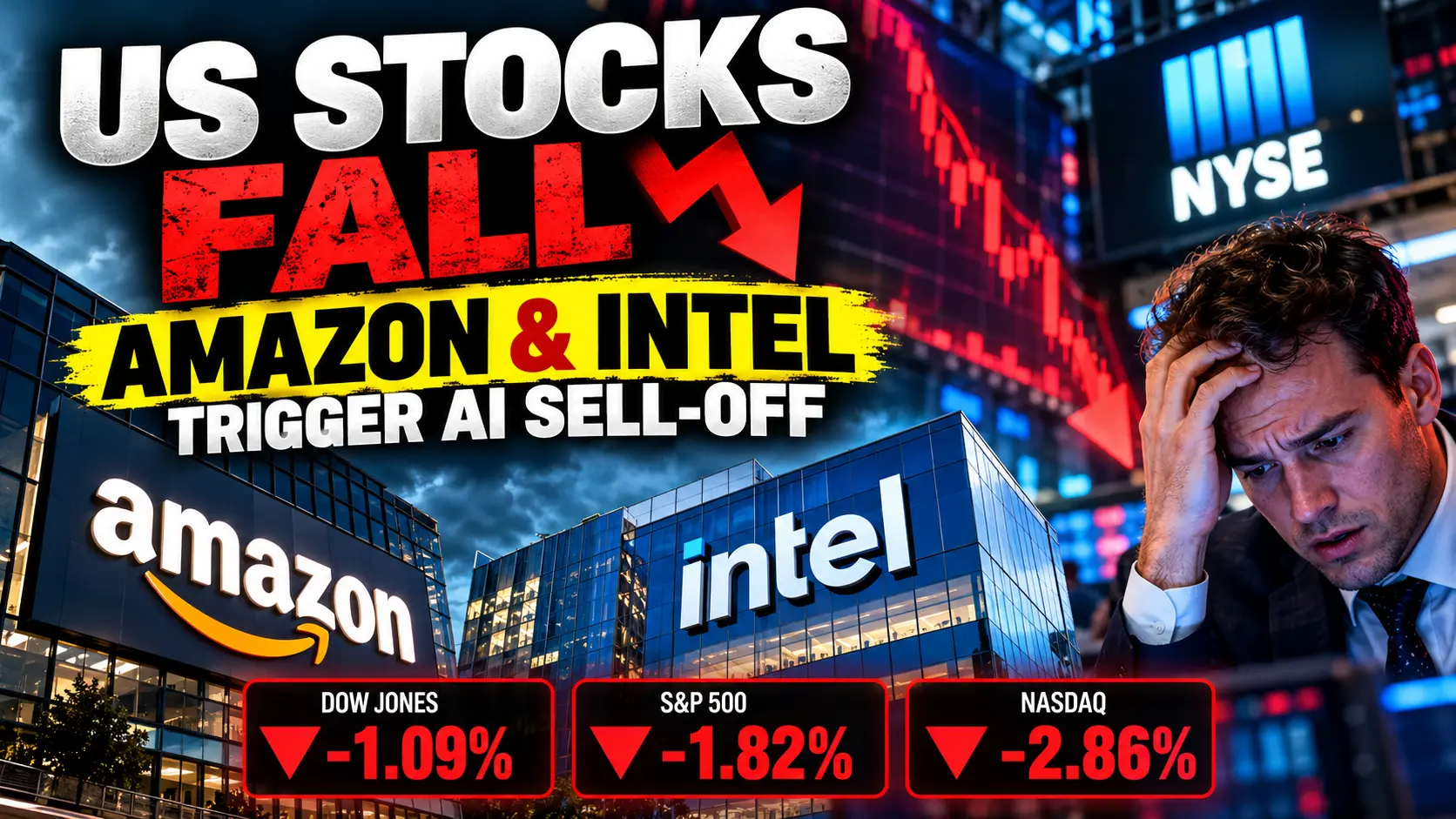
US Stocks Fall: The US stock market experienced a sharp decline on October 30, 2026, as disappointing earnings reactions from Amazon and Intel intensified concerns about artificial intelligence (AI) spending, technology stock valuations, and the profitability of the AI boom. Investors increasingly questioned whether the enormous investments flowing into AI infrastructure would generate sufficient returns to justify current expectations.
The sell-off hit technology shares particularly hard, pushing the Nasdaq Composite down nearly 2.9%. The S&P 500 fell approximately 1.8%, while the Dow Jones Industrial Average declined about 1.1%. The declines highlighted a growing challenge for Wall Street: even companies with substantial growth opportunities can disappoint investors when expectations become exceptionally high.
Why Did US Stocks Fall?
The latest market decline reflected a combination of disappointing corporate earnings, concerns about capital expenditure, and growing uncertainty surrounding AI profitability.
Technology companies have invested heavily in data centers, specialized chips, cloud infrastructure, and AI software. Investors initially welcomed these investments because they promised faster growth and new revenue opportunities.
However, markets are increasingly focused on whether companies can convert that spending into sustainable profits and positive cash flow.
When businesses report weaker-than-expected results or provide cautious forecasts, investors may reconsider how much they are willing to pay for their shares.
Amazon and Intel became central to this reassessment. Their latest financial updates raised different concerns, but both reinforced questions about the outlook for major technology companies.
📉 US Stock Market Decline
Major US stock indexes recorded losses on October 30, 2026, amid concerns about AI spending and technology valuations.
Data date: October 30, 2026.
Unit: Percentage change in index closing value.
Method: Bar lengths represent the magnitude
of each decline relative to the largest decline shown.
Disclaimer: Historical market performance
does not predict future returns.
Amazon Earnings Raise Questions About AI Spending
Amazon remains a major force in e-commerce and cloud computing through Amazon Web Services (AWS). Its cloud business also provides infrastructure that businesses use to develop and operate AI applications.
Despite these long-term opportunities, investors are closely examining the financial consequences of Amazon’s expanding infrastructure investments.
Building AI data centers requires substantial spending on computing equipment, networking systems, electricity, and facilities. These investments can support future revenue growth, but the benefits may take time to materialize.
Amazon’s financial results intensified concerns about the scale of its spending commitments and the pressure on free cash flow.
Free cash flow measures the cash a company generates after capital expenditures. It helps investors assess how much money remains available for debt repayment, acquisitions, dividends, share repurchases, and other corporate priorities.
Heavy investment can reduce free cash flow even when a business continues to grow. However, prolonged cash outflows can concern investors if the expected returns remain uncertain.
For Amazon, the central question is whether AI-related infrastructure spending will strengthen its competitive position enough to justify the financial commitment.
Strong cloud demand could support future profitability. Nevertheless, investors want clearer evidence that expanding AI capacity will translate into attractive returns.
Intel Stock Declines as Investors Assess Its Outlook
Intel faced a different challenge. The semiconductor company reported results that failed to satisfy market expectations, while its outlook raised concerns about near-term business conditions.
Intel operates in a competitive semiconductor industry where demand, manufacturing costs, product development, and market share can significantly influence profitability.
Artificial intelligence has created new opportunities for chipmakers, particularly in data centers. However, AI-related growth does not eliminate challenges in other markets, including personal computers.
Investors must evaluate whether gains in one business segment can offset weakness elsewhere.
Intel’s shares plunged approximately 28.6% on October 30 after the company issued a disappointing profit outlook, contributing to pressure across technology stocks.
The reaction illustrates how quickly investor sentiment can change when future expectations deteriorate.
For semiconductor companies, revenue growth alone may not be enough to support higher valuations. Investors also consider margins, manufacturing efficiency, competitive positioning, and the ability to convert sales into earnings.
Intel’s future performance will depend partly on its ability to execute its business strategy while navigating changing demand and intense industry competition.
AI Investments Face a New Test on Wall Street
The latest sell-off does not necessarily mean that artificial intelligence is losing its long-term economic importance.
AI could continue transforming software development, customer service, scientific research, manufacturing, healthcare operations, and enterprise productivity.
However, technological progress and investment returns are two different things.
A technology can be revolutionary while some companies investing in it still deliver disappointing financial results. Investors may also pay too much for a promising business if its share price already reflects years of expected growth.
This distinction is becoming increasingly important as technology companies commit billions of dollars to AI infrastructure.
Investors are now examining several questions:
- How quickly can AI products generate meaningful revenue?
- Will customers pay enough to support the cost of developing and operating AI systems?
- Can companies improve productivity and operating margins?
- How long will infrastructure investments take to generate returns?
- Could competition reduce future pricing power?
Companies that demonstrate strong demand, disciplined spending, and sustainable profitability may attract greater investor confidence.
Conversely, businesses that increase spending without producing convincing financial results could face greater scrutiny.
What the Market Decline Means for Technology Stocks
The October 30 sell-off demonstrated how closely connected major technology companies have become to broader market performance.
When investors reduce exposure to large technology stocks, the effects can extend beyond individual companies. Semiconductor manufacturers, cloud infrastructure providers, data center suppliers, and other businesses associated with AI may also experience selling pressure.
This relationship can amplify market volatility.
The Nasdaq Composite, which has substantial exposure to technology and growth-oriented companies, is particularly sensitive to changes in investor expectations about future earnings.
The S&P 500 can also experience pressure when its largest technology constituents decline.
However, investors should distinguish between a broad market downturn and a permanent deterioration in business fundamentals. A sharp decline in share prices does not automatically establish that a company has become less valuable over the long term.
Equally, a previous record high does not guarantee that a stock will recover quickly.
Investors need to examine earnings quality, debt levels, cash flow, competitive advantages, and valuations before drawing conclusions.
What Should Investors Watch Next?
Several developments could influence the direction of US stocks in the coming weeks.
1. Corporate earnings forecasts
Investors will look for evidence that companies can meet or exceed future earnings expectations. Forward guidance may influence share prices as much as historical results.
2. AI capital expenditure
Technology companies’ spending plans will remain important. Investors will want to understand whether new infrastructure investments are supported by realistic demand forecasts.
3. Free cash flow
Businesses that generate healthy cash flow while funding growth may be better positioned to withstand uncertainty. Companies facing sustained cash outflows could encounter additional scrutiny.
4. Interest rates and economic conditions
Interest rates affect borrowing costs and the valuation of future earnings. Changes in inflation, economic growth, and monetary policy could influence investor appetite for growth stocks.
5. Market breadth
Investors should monitor whether selling remains concentrated in technology shares or spreads across other industries. Broader participation in a decline could signal a more widespread shift in market sentiment.
These indicators can help investors understand whether the sell-off represents a temporary adjustment in expectations or a more persistent reassessment of technology valuations.
Is the AI Boom Coming to an End?
The recent decline is not sufficient evidence that the AI boom has ended.
Artificial intelligence continues to offer significant commercial opportunities, but the market is reassessing how those opportunities should be valued.
During periods of strong enthusiasm, investors may focus primarily on future growth. As expectations rise, even impressive business performance can disappoint if it falls short of forecasts.
This creates a more demanding environment for companies seeking to justify premium valuations.
The next phase of AI investment may depend less on ambitious announcements and more on measurable financial results, including revenue growth, operating efficiency, margins, and cash generation.
For investors, the distinction between promising technology and attractive stock valuation remains essential.
Frequently Asked Questions (FAQ)
1. Why did US stocks fall on October 30, 2026?
US stocks declined after earnings developments involving Amazon and Intel intensified concerns about AI spending, technology valuations, and the ability of companies to generate adequate returns from major investments.
2. Why did Intel stock plunge?
Intel shares fell sharply after the company issued a disappointing profit outlook, raising concerns about its near-term business performance and industry conditions.
3. How did the Nasdaq perform?
The Nasdaq Composite fell approximately 2.9% on October 30, 2026, making it the weakest performer among the three major US indexes discussed here.
4. Does the AI stock sell-off mean artificial intelligence is a bad investment?
Not necessarily. AI may create substantial long-term economic value, but individual companies can still be overvalued or struggle to earn sufficient returns on their investments.
5. What should investors examine during a technology stock sell-off?
Investors can examine earnings forecasts, free cash flow, capital expenditure, debt, competitive advantages, interest rates, and share valuations. Investment decisions should reflect individual financial circumstances and risk tolerance.
Conclusion
The October 30 US stock market decline highlighted growing investor scrutiny of AI-related spending and technology company valuations. Amazon’s investment commitments and Intel’s disappointing outlook contributed to concerns about whether the sector can consistently deliver the returns investors expect.
Artificial intelligence may remain an important driver of economic and business innovation. However, long-term success will depend on more than technological progress: companies must also demonstrate sustainable earnings, responsible capital allocation, and effective cash management.
For investors, the key lesson is to distinguish between enthusiasm for an emerging technology and the financial performance of the businesses developing it.
Financial disclaimer: This article is for informational and educational purposes only. It is not personalized financial, investment, or trading advice. Market prices can change rapidly, and investors should conduct independent research before making financial decisions.