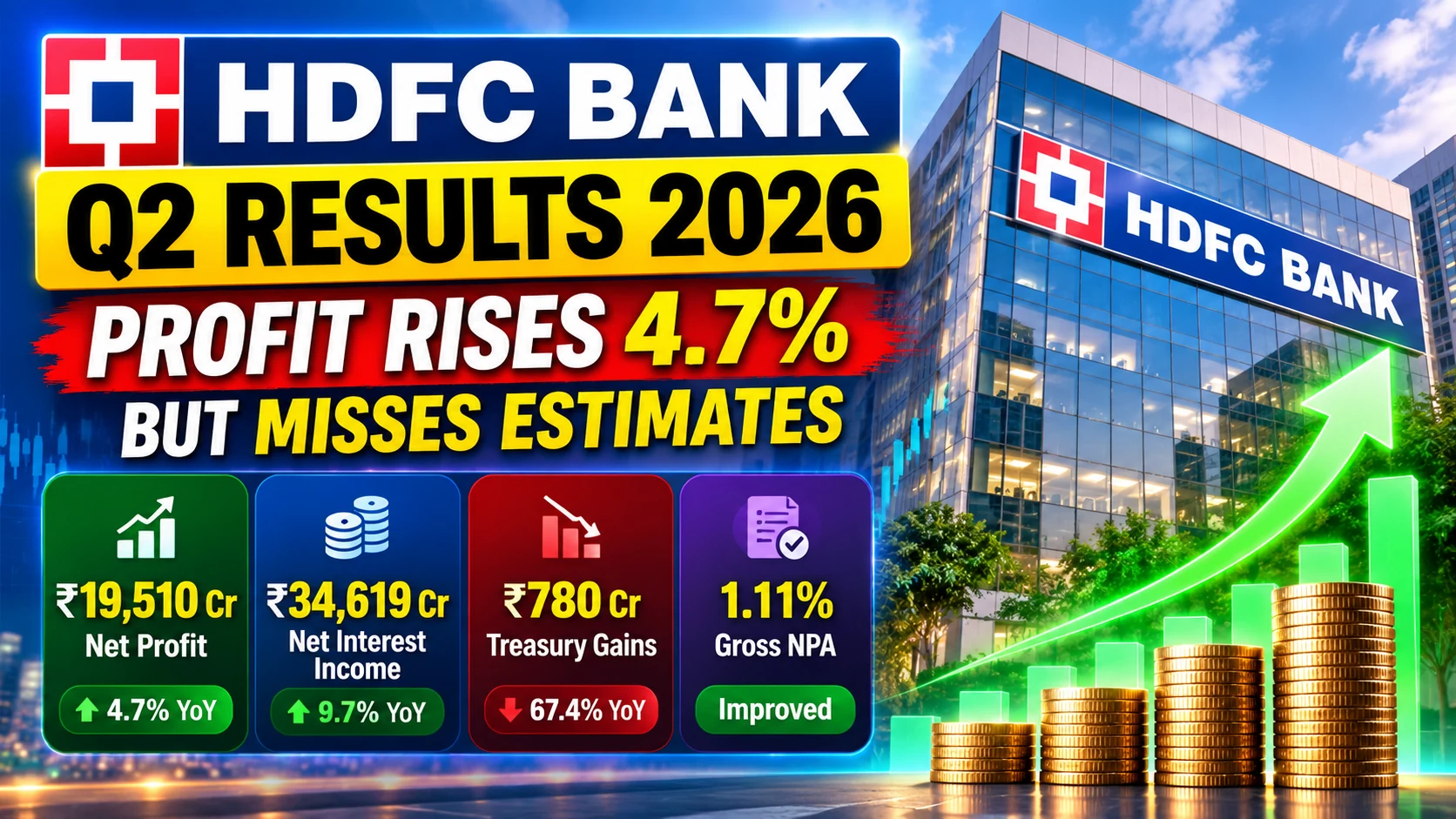
HDFC Bank Q2 Results 2026: India’s largest private-sector lender reported a 4.7% year-on-year increase in standalone net profit to approximately ₹19,510 crore for the quarter ended September 30, 2026. However, the earnings narrowly missed analyst expectations as a sharp decline in treasury trading gains restricted overall profitability.
The bank’s core lending business continued to expand, supported by higher interest income, strong deposit growth, and improving asset quality. The results present a mixed picture for investors, with encouraging operational performance alongside pressure on margins and non-interest income.
📊 HDFC Bank Q2 FY27 Results: Key Financial Highlights
HDFC Bank announced its July–September 2026 quarterly results on October 17, reporting moderate profit growth despite stronger performance in its lending operations.
The major financial highlights include:
- 💰 Standalone net profit: ₹19,510 crore, up 4.7% year-on-year.
- 📈 Net interest income: ₹34,619 crore, increasing 9.7%.
- 🏦 Total deposits: ₹33.27 lakh crore, up 18.8%.
- 💳 Gross advances: ₹32.20 lakh crore, rising 16.3%.
- 📉 Treasury trading gains: ₹780 crore, down from ₹2,390 crore.
- ✅ Gross NPA ratio: Improved to 1.11%.
- 📊 Net interest margin: 3.16% on total assets.
These figures indicate that HDFC Bank maintained substantial business growth, although weaker treasury performance affected its reported earnings.
📊 HDFC Bank Q2 FY27 Results
Financial Performance Dashboard | July–September 2026
📈 Year-on-Year Growth Comparison
Bar scale: 20% growth equals full width. Values represent year-on-year percentage growth.
Source: HDFC Bank Q2 FY27 reported financial results, October 17, 2026. Figures rounded.
💰 HDFC Bank Net Profit Rises 4.7% but Misses Estimates
HDFC Bank’s standalone net profit increased from approximately ₹18,641 crore in the corresponding quarter last year to ₹19,510 crore in Q2 FY27.
The improvement reflects continued growth in the bank’s underlying operations.
However, the result was slightly below the LSEG analyst estimate of approximately ₹19,526 crore reported by Reuters.
The difference was relatively small, suggesting that the bank’s performance remained broadly close to market expectations.
The more important issue was the contrast between stronger core interest income and slower overall profit growth.
Excluding treasury trading gains, the bank reported approximately 12.6% year-on-year growth in profit after tax.
This distinction suggests that underlying banking operations performed better than the headline profit growth rate alone might indicate.
📉 Treasury Trading Gains Fall Sharply
One of the biggest developments in HDFC Bank’s September-quarter results was the substantial decline in treasury trading income.
Treasury gains fell to approximately ₹780 crore from ₹2,390 crore in the same quarter last year.
That represents a decline of about 67.4%.
Treasury income can fluctuate depending on bond-market movements, interest rates, investment valuations, and trading conditions.
A reduction in such gains can significantly affect a bank’s reported earnings, even when its regular lending business remains healthy.
HDFC Bank’s total other income also declined 3.6% year-on-year to approximately ₹13,831 crore.
The sharp treasury decline therefore helps explain why overall profit increased more slowly than net interest income.
🏦 Net Interest Income Grows 9.7%
HDFC Bank’s net interest income, commonly known as NII, rose 9.7% to approximately ₹34,619 crore.
Net interest income represents the difference between interest earned on loans and investments and interest paid on deposits and borrowings.
It is an important measure of a bank’s core lending profitability.
The increase suggests that HDFC Bank continued to generate higher income from its banking activities.
However, stronger interest income did not eliminate all profitability concerns.
⚠️ Net Interest Margin Declines to 3.16%
The bank reported a net interest margin of 3.16% on total assets, compared with 3.26% in the preceding quarter.
A lower margin indicates that the spread earned from interest-generating activities has narrowed.
For banks, this can happen when deposit and funding costs rise faster than returns on loans and investments.
Even when loan volumes increase, weaker margins can limit the benefits of business expansion.
Investors will therefore monitor whether HDFC Bank can stabilize its margins in the coming quarters.
📈 HDFC Bank Loan and Deposit Growth Remains Strong
Despite the pressure on reported earnings, HDFC Bank continued to expand its balance sheet.
Total deposits reached approximately ₹33.27 lakh crore, representing 18.8% year-on-year growth.
Gross advances increased 16.3% to around ₹32.20 lakh crore.
Importantly, deposits grew faster than advances during the period.
This is significant because deposit mobilization remains a major priority for Indian banks competing to finance loan growth.
A stronger deposit base can improve funding flexibility and reduce dependence on more expensive sources of borrowing.
HDFC Bank’s reported credit-to-deposit ratio stood at approximately 96%.
Although the ratio remains elevated, the faster growth in deposits is an encouraging development.
The bank must continue balancing credit expansion with stable funding and profitability.
✅ HDFC Bank Asset Quality Improves
Another positive development in the quarterly results was the improvement in asset quality.
The gross non-performing asset ratio declined to 1.11% as of September 30, 2026.
This compares with 1.17% in the preceding quarter and 1.24% a year earlier.
The net NPA ratio also improved to approximately 0.37%.
A lower NPA ratio generally indicates that a smaller proportion of the loan portfolio is classified as non-performing.
However, investors should consider these improvements alongside changes in provisions and the overall loan book.
HDFC Bank’s provisions and contingencies increased approximately 2.1% year-on-year to ₹3,574 crore.
The combination of improving asset quality and higher provisions demonstrates why several financial indicators must be examined together rather than in isolation.
👔 HDFC Bank Leadership Changes: Anup Bagchi to Become CEO
The quarterly earnings announcement also comes during an important leadership transition.
Anup Bagchi, a veteran of the ICICI Group, is scheduled to take over as HDFC Bank’s Managing Director and Chief Executive Officer on October 27, 2026.
His appointment represents a significant development for the institution, bringing an external banking executive into its top leadership position.
Meanwhile, Deputy Managing Director Kaizad Bharucha is set to step down at the end of December 2026 after more than three decades of association with the bank.
These changes arrive as HDFC Bank focuses on strengthening profitability, managing funding costs, and maintaining growth.
Investors will closely observe how the incoming leadership approaches these priorities.
📊 What Do HDFC Bank Q2 Results Mean for Investors?
HDFC Bank’s latest results contain both positive developments and areas requiring attention.
On the positive side, net interest income increased, deposits expanded faster than loans, and asset quality improved.
These indicators support the view that the bank’s core operations remain resilient.
However, declining treasury gains, slower headline profit growth, and pressure on net interest margins remain important concerns.
The earnings announcement alone does not establish whether HDFC Bank shares will rise or fall.
Stock-market performance also depends on valuations, investor expectations, economic conditions, and management guidance.
For long-term investors, the more meaningful question is whether HDFC Bank can convert its expanding business into stronger and more consistent profitability.
🔎 What Should Investors Watch Next?
The coming quarters will be important for evaluating HDFC Bank’s financial progress.
Three areas deserve particular attention.
Net interest margins: Stabilizing margins could support stronger profitability from the bank’s expanding loan portfolio.
Deposit growth: Continued deposit mobilization will remain essential for funding future lending activity.
Asset quality: Maintaining low bad-loan ratios while controlling provisions will be important for sustainable earnings.
Investors should also watch the incoming CEO’s strategic priorities and the bank’s ability to improve operating efficiency.
❓ HDFC Bank Q2 Results 2026: Frequently Asked Questions
1. What is HDFC Bank’s net profit in Q2 FY27?
HDFC Bank reported standalone net profit of approximately ₹19,510 crore for the quarter ended September 30, 2026, representing 4.7% year-on-year growth.
2. Why did HDFC Bank’s profit growth remain modest?
A sharp decline in treasury trading gains and weaker overall non-interest income limited profit growth despite stronger net interest income.
3. How much did HDFC Bank’s net interest income increase?
Net interest income increased 9.7% year-on-year to approximately ₹34,619 crore in Q2 FY27.
4. What is HDFC Bank’s gross NPA ratio?
The gross non-performing asset ratio improved to 1.11% as of September 30, 2026, compared with 1.17% in the previous quarter.
5. Who is the new CEO of HDFC Bank?
Anup Bagchi is scheduled to become HDFC Bank’s Managing Director and CEO on October 27, 2026.
📝 Conclusion: Strong Banking Growth Meets Profitability Challenges
HDFC Bank’s Q2 FY27 results highlight the difference between business expansion and overall earnings performance.
While standalone net profit increased 4.7% to ₹19,510 crore, the sharp decline in treasury gains prevented stronger headline growth.
Nevertheless, rising interest income, healthy deposit expansion, and improving asset quality provide encouraging signs.
The bank’s next challenge will be converting these operational strengths into more consistent profitability while navigating margin pressure and leadership changes.
For investors, the key indicators to watch are net interest margins, deposit growth, treasury income, and asset quality in the quarters ahead.