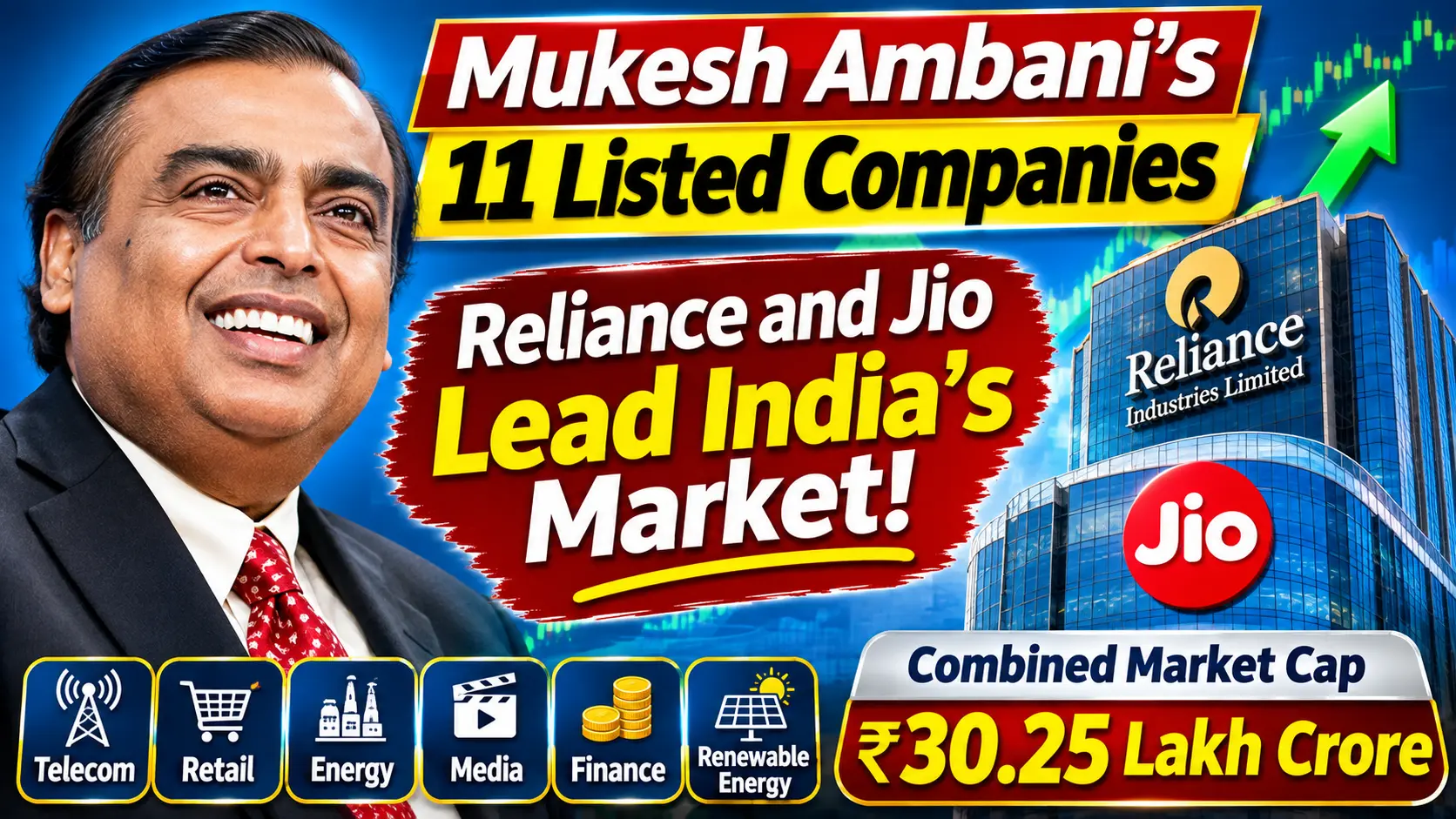
Mukesh Ambani’s 11 Listed Companies: India’s stock market has witnessed a significant shift following the stock market debut of Jio Platforms. The company, associated with billionaire businessman Mukesh Ambani’s Reliance Group, has secured the second position among India’s most valuable listed companies, behind Reliance Industries.
Following Jio Platforms’ listing on October 28, 2026, the combined market capitalisation of 11 Reliance-linked listed companies reached an estimated ₹30.25 lakh crore, equivalent to approximately $318 billion. This development has strengthened the group’s position in India’s corporate landscape and drawn attention to its diverse business interests.
From telecommunications and retail to energy, financial services, media, and renewable energy, Reliance-linked businesses operate across several important sectors. Here is a closer look at the 11 listed companies, their businesses, and the significance of the latest market developments.
Mukesh Ambani’s 11 Listed Companies: Complete List
The following 11 companies were identified in the reported list of Reliance-linked listed businesses.
| No. | Company | Main Business |
|---|---|---|
| 1 | Reliance Industries Limited | Energy, petrochemicals, retail and telecommunications |
| 2 | Jio Platforms Limited | Digital services and telecommunications technology |
| 3 | Jio Financial Services Limited | Financial services |
| 4 | Network18 Media & Investments Limited | Media and broadcasting |
| 5 | Just Dial Limited | Local search and business discovery |
| 6 | Sterling and Wilson Renewable Energy Limited | Solar energy engineering and infrastructure |
| 7 | Hathway Cable & Datacom Limited | Cable television and broadband |
| 8 | DEN Networks Limited | Cable television and distribution |
| 9 | Reliance Industrial Infrastructure Limited | Industrial infrastructure services |
| 10 | GTPL Hathway Limited | Cable television and broadband services |
| 11 | Infomedia Press Limited | Printing and publishing-related activities |
Note: This list follows the companies identified in the referenced report. The companies differ in ownership structure, business operations, and their relationship with the broader Reliance ecosystem.
Why Are Reliance Industries and Jio Platforms India’s Top Two Companies?
The biggest development is the emergence of Reliance Industries and Jio Platforms as the first- and second-ranked companies by market capitalisation, respectively.
According to reported figures for October 28, 2026, Reliance Industries had a market capitalisation of approximately ₹15.68 lakh crore, while Jio Platforms was valued at around ₹13.05 lakh crore.
These valuations placed both companies ahead of other major Indian businesses, including Bharti Airtel, HDFC Bank, ICICI Bank, and Tata Consultancy Services.
The change followed Jio Platforms’ stock market listing, which gave public-market investors a separate way to value its digital and telecommunications business.
Previously, much of Jio’s business value was reflected within Reliance Industries, its parent company. A separate listing allows investors to assess Jio Platforms using its own share price, financial performance, growth prospects, and business risks.
However, the market capitalisation of a newly listed company can change quickly as investors react to financial results, market conditions, and expectations about future growth.
Mukesh Ambani’s Listed Companies: Market Overview
Reliance Industries and Jio Platforms occupied the top two positions in India’s market capitalisation rankings following Jio Platforms’ stock market debut in October 2026.
Market Capitalisation Comparison
| Company | Market Cap | Share of Combined Value |
|---|---|---|
| Reliance Industries | ₹15.68 lakh crore | |
| Jio Platforms | ₹13.05 lakh crore | |
| Other 9 Companies | ₹1.52 lakh crore |
Key Details of Jio Platforms’ IPO
| Listing Date | October 28, 2026 |
|---|---|
| IPO Issue Price | ₹1,119 per share |
| First-Day Closing Price | Approximately ₹1,419 |
| IPO Size | Approximately ₹30,213 crore |
| Market Ranking | Second among India’s listed companies |
Disclaimer: Figures are historical reported estimates following the October 28, 2026 listing and are not live market data. Market capitalisation changes with share prices. Combined group figures may include overlapping ownership claims arising from cross-holdings.
Jio Platforms IPO: Why the Listing Matters
Jio Platforms’ stock market debut was one of the most significant developments in India’s equity market in 2026.
The company’s initial public offering raised approximately ₹30,213 crore. Its shares were offered at an issue price of ₹1,119 and closed at around ₹1,419 on the first trading day, representing a gain of approximately 26.8% over the issue price.
The IPO attracted substantial investor interest, reflecting expectations surrounding India’s telecommunications and digital-services industries.
Jio’s business extends beyond mobile connectivity. Its broader digital ecosystem includes platforms and services associated with communications, applications, cloud computing, enterprise technology, and other digital activities.
For investors, a separate listing creates greater transparency around the company’s standalone market valuation.
Nevertheless, a strong debut does not guarantee future share-price gains. Investors must also consider earnings growth, competition, capital expenditure, regulation, and the valuation at which a stock trades.
Reliance Industries: The Group’s Largest Listed Business
Reliance Industries remains the largest company in the Reliance ecosystem by market capitalisation.
Its business portfolio spans several major industries, including oil and gas, petrochemicals, retail, telecommunications, and digital services.
This diversification gives Reliance exposure to both established industrial activities and consumer-facing growth businesses.
Its energy and petrochemical operations are connected to industrial demand, refining economics, and global commodity prices. Its retail operations depend on consumer spending, supply chains, and competition. Its telecommunications and digital businesses are influenced by subscriber growth, data usage, pricing, and technological investment.
The combination of these activities makes Reliance Industries a complex business rather than a company dependent on a single source of revenue.
For shareholders, the key question is how effectively the company can grow its different businesses while managing investment requirements, competition, and financial risks.
How Much Is the Combined Value of the 11 Companies?
The combined market capitalisation of the 11 Reliance-linked listed companies was estimated at ₹30.25 lakh crore following Jio Platforms’ debut.
However, the two largest companies accounted for almost all this reported value.
Based on the reported figures, Reliance Industries represented approximately ₹15.68 lakh crore, while Jio Platforms contributed around ₹13.05 lakh crore.
Together, their market capitalisation was approximately ₹28.73 lakh crore.
The remaining nine companies collectively contributed around ₹1.52 lakh crore.
These figures illustrate how heavily the group’s total listed market value is concentrated in Reliance Industries and Jio Platforms.
Importantly, the combined figure is an aggregate of the market capitalisations of separately listed companies. It does not automatically represent the group’s net economic value because cross-holdings between companies may result in overlapping ownership claims.
Market capitalisation is also different from the personal wealth of Mukesh Ambani. His personal wealth depends on his ownership interests and other assets, together with liabilities and changes in market prices.
What Does This Mean for Investors?
The listing of Jio Platforms has created a new opportunity for investors to evaluate Reliance’s digital business separately.
It may help investors compare Jio Platforms with telecommunications and technology companies, while also assessing Reliance Industries as a diversified conglomerate.
However, investors should avoid treating market capitalisation rankings as a direct measure of whether a stock is cheap or expensive.
A company with a large market capitalisation may already have substantial growth expectations reflected in its share price. Conversely, a smaller company may offer opportunities but could also carry higher risks.
Before investing in any Reliance-linked stock, investors should examine:
- Revenue and profit growth.
- Debt levels and cash flow.
- Business valuation relative to earnings.
- Competition and regulatory risks.
- Capital expenditure requirements.
- Corporate governance and ownership structures.
- Long-term business prospects.
Share prices fluctuate, and historical performance does not guarantee future returns.
Conclusion: Reliance and Jio Strengthen Their Market Positions
The listing of Jio Platforms has reshaped the rankings of India’s most valuable listed companies, placing Reliance Industries and Jio Platforms in the first and second positions.
The combined market capitalisation of 11 Reliance-linked listed companies reached an estimated ₹30.25 lakh crore following the listing. The development highlights the scale of the group’s presence across energy, retail, telecommunications, finance, media, and other businesses.
For investors, the most important takeaway is not simply the size of the combined valuation. It is the opportunity to evaluate Jio Platforms independently while continuing to assess Reliance Industries as a diversified business.
Going forward, company earnings, business expansion, competition, and market conditions will help determine whether these valuations can be sustained.
As always, investors should base decisions on financial analysis, risk tolerance, and investment objectives rather than rankings or headlines alone.
Frequently Asked Questions (FAQs)
1. How many listed companies are associated with Mukesh Ambani’s Reliance Group?
The referenced report identifies 11 Reliance-linked listed companies, spanning sectors such as energy, telecommunications, finance, media, infrastructure, and renewable energy.
2. Which are the two most valuable Reliance-linked listed companies?
Reliance Industries Limited ranked first, followed by Jio Platforms Limited, based on the reported market capitalisations following Jio Platforms’ October 2026 listing.
3. What was the combined market capitalisation of the 11 companies?
Their combined market capitalisation was estimated at ₹30.25 lakh crore, or approximately $318 billion, following Jio Platforms’ stock market debut.
4. Why was Jio Platforms listed separately?
A separate listing gives investors an independent market price for the business and allows them to assess its financial performance, growth prospects, and risks separately from Reliance Industries.
5. What is the difference between market capitalisation and Mukesh Ambani’s personal wealth?
Market capitalisation is the total market value of a company’s outstanding shares. Personal wealth is an estimate of an individual’s assets and ownership interests after accounting for relevant liabilities. The two measures are not interchangeable.
6. Does a high market capitalisation mean a stock is a good investment?
Not necessarily. Market capitalisation indicates a company’s equity market value, but investment decisions also require analysis of earnings, valuation, debt, growth prospects, competition, and risk.
7. Will Reliance Industries and Jio Platforms remain India’s top two companies?
Their future rankings will depend on changes in share prices and the market capitalisations of competing companies. The positions reported after the October 2026 listing are not guaranteed to remain unchanged.