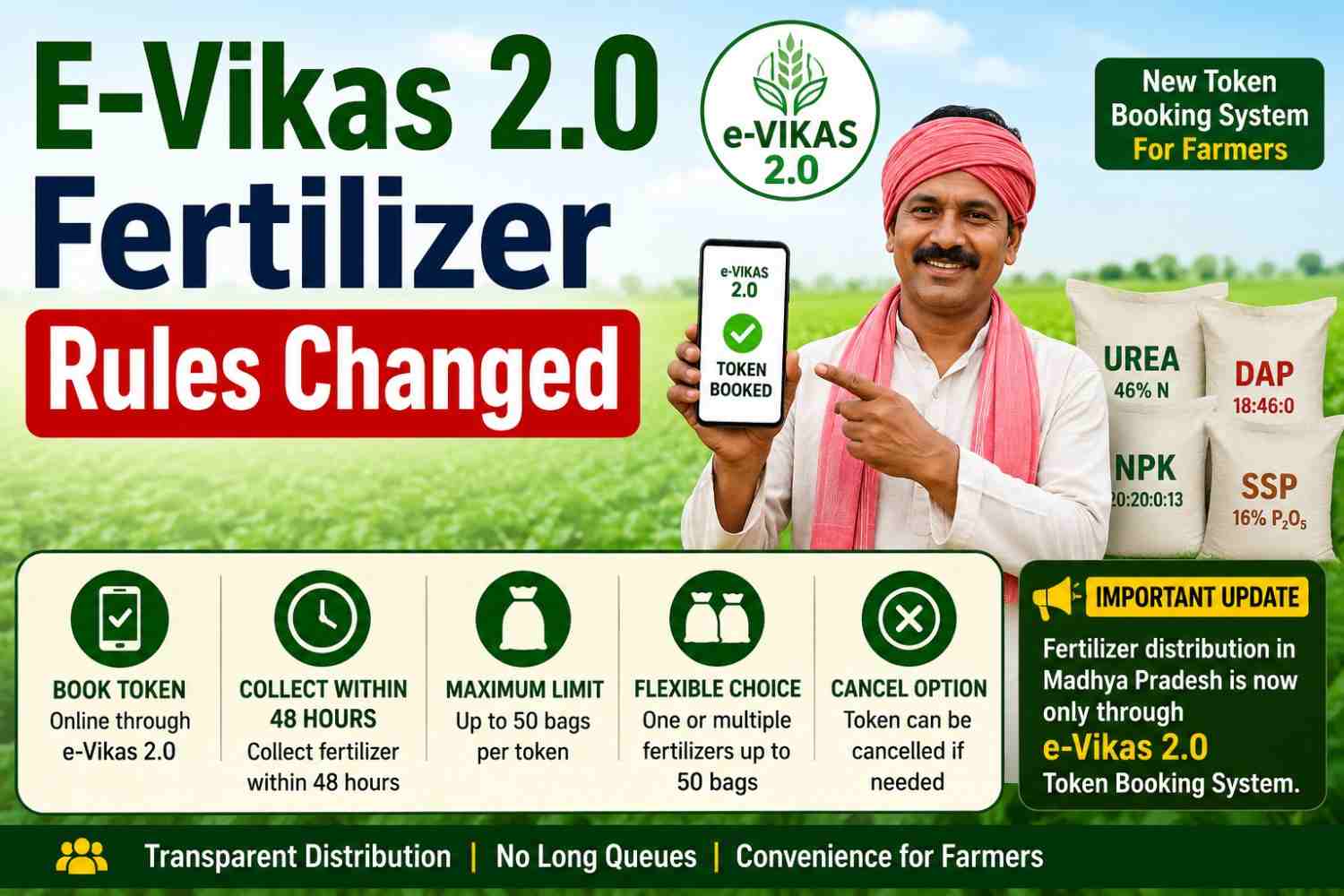
E-Vikas 2.0 Fertilizer Rules: The Madhya Pradesh government has introduced important changes to the fertilizer distribution system, affecting farmers in Sagar and other districts across the state.
Under the updated e-Vikas 2.0 system, farmers can obtain fertilizers such as Urea, DAP, NPK and SSP by booking an e-token. The new arrangement is intended to make fertilizer distribution more transparent and convenient while reducing the need for farmers to wait in long queues.
In Sagar district, the system has already been implemented, according to Dr. Rakesh Tripathi, Deputy Director of Agriculture, Sagar.
🔔 Key Highlights for Farmers
- 📱 Fertilizer distribution will operate through e-Vikas 2.0 e-token booking.
- ⏰ Fertilizer booked through a token must be collected within 48 hours.
- 🚜 Farmers can obtain fertilizer according to their requirements.
- 🔄 A booked token can also be cancelled.
- 🧺 A maximum limit of 50 fertilizer bags has been set.
- 🌾 Farmers can choose one fertilizer or a combination of different fertilizers within the 50-bag limit.
- 📦 Around 32,000 tonnes of fertilizer is currently available in Sagar district, according to the agriculture official quoted in the report.
📱 What Is the E-Vikas 2.0 Fertilizer Distribution System?
The e-Vikas 2.0 fertilizer distribution system is the updated mechanism being used to manage fertilizer allocation through e-token booking.
Instead of depending on physical queues at fertilizer distribution points, farmers can book a token and then visit the designated center to collect their fertilizer.
The government has introduced the updated system after issues were experienced under the previous arrangement. The department says improvements have been made to address earlier difficulties and irregularities.
🚜 E-Vikas 2.0 Implemented in Sagar District
Dr. Rakesh Tripathi, Deputy Director of Agriculture in Sagar, said that e-Vikas 2.0 has been implemented in the district.
Farmers can collect fertilizer after booking an e-token through the system.
According to the figures provided by the official, fertilizer distribution in Sagar over the previous three months reached approximately:
👨🌾 Farmers served: 106,000
📦 Fertilizer distributed: 47,000 metric tonnes
The distribution system had temporarily operated in a hybrid mode because of technical difficulties. Following improvements, the government has decided to implement the updated system fully.
⏰ Fertilizer Must Be Collected Within 48 Hours
One of the most important e-Vikas 2.0 rules concerns the validity period for fertilizer collection.
After successfully booking a token, a farmer will have 48 hours to collect the fertilizer from the relevant distribution center.
This gives farmers a defined window in which to visit the center instead of waiting indefinitely in queues.
Farmers who no longer require the booked fertilizer will also have the option to cancel their token.
🧺 Maximum Fertilizer Limit: 50 Bags
Another major change is the maximum quantity allowed under the system.
A farmer can obtain a maximum of 50 bags of fertilizer within the prescribed limit.
There is also flexibility in choosing the fertilizer.
For example, a farmer may collect:
- 50 bags of one type of fertilizer, or
- A combination of Urea, DAP, NPK, SSP or other available fertilizers totaling up to 50 bags.
This allows farmers to select fertilizer based on their crop requirements rather than being restricted to only one type.
📦 32,000 Tonnes of Fertilizer Available in Sagar
Farmers in Sagar have also received an update regarding the district’s fertilizer stock.
According to Dr. Rakesh Tripathi, approximately 32,000 tonnes of fertilizer is currently available in Sagar district.
Of this:
🌱 Urea Stock: 17,000 Metric Tonnes
Around 17,000 metric tonnes of Urea is available.
Stocks of NPK and SSP are also available, while DAP is available at some locations, according to the information provided.
Actual availability can therefore vary depending on the distribution center and fertilizer type.
🏪 Where Can Sagar Farmers Collect Fertilizer?
After booking the required e-token, farmers can obtain fertilizer through their applicable nearby distribution point.
These may include:
- 🏢 Double-lock fertilizer distribution centers
- 🤝 Cooperative societies
- 🏪 Authorized private firms
Farmers should check the distribution-center information associated with their token before traveling for collection.
📲 How Does E-Vikas 2.0 Fertilizer Token Booking Work?
Based on the new distribution process described by the department, the basic process is straightforward:
Step 1: Use the e-Vikas system for fertilizer token booking.
Step 2: Select the required fertilizer and applicable distribution center based on the options available in the system.
Step 3: Complete the e-token booking.
Step 4: Check the token and fertilizer collection details.
Step 5: Visit the designated fertilizer center and collect the fertilizer within 48 hours.
Farmers should rely on the information displayed through the official system and instructions issued by the local agriculture department, particularly because stock can vary by location.
🌧️ Fertilizer Demand May Rise After Rainfall
Madhya Pradesh, including Sagar district, has been receiving good rainfall. Fertilizer demand is expected to increase as weather conditions allow farmers to resume field operations.
Farmers growing crops such as maize and paddy may require fertilizer application during this period.
This makes an efficient distribution mechanism particularly important when demand increases.
Under the earlier hybrid arrangement, farmers sometimes had to wait in queues to purchase fertilizer. The e-Vikas 2.0 token system is intended to make the process more organized by allowing farmers to book before visiting the distribution point.
❓ Frequently Asked Questions About E-Vikas 2.0
1. What is e-Vikas 2.0?
E-Vikas 2.0 is the updated fertilizer distribution system being implemented in Madhya Pradesh. It enables farmers to use an e-token-based process to obtain fertilizer from designated distribution centers.
2. Is e-token booking required for fertilizer in Sagar?
According to the new system described by the Agriculture Department, fertilizer distribution in Sagar is being carried out through e-Vikas 2.0 e-token booking.
3. How long is an e-Vikas fertilizer token valid?
After booking a token, farmers have 48 hours to collect their fertilizer from the applicable center.
4. What is the maximum number of fertilizer bags a farmer can obtain?
The maximum limit under the new system is 50 bags.
5. Can farmers buy different fertilizers within the 50-bag limit?
Yes. Farmers may obtain one type of fertilizer or a combination of different fertilizers, subject to the total maximum limit of 50 bags and availability.
6. Can an e-Vikas 2.0 token be cancelled?
Yes. The updated system allows farmers to cancel their booked token if required.
7. Which fertilizers are available in Sagar?
The reported stock includes Urea, NPK and SSP, while DAP is available at some locations. Availability can vary between distribution centers.
8. How much fertilizer stock is available in Sagar?
According to the agriculture official cited in the report, approximately 32,000 tonnes of fertilizer is currently available in Sagar district, including around 17,000 metric tonnes of Urea.
9. Where can farmers collect fertilizer?
Depending on the token and local availability, fertilizer can be collected through applicable double-lock distribution centers, cooperative societies and authorized private firms.
🌾 What Sagar Farmers Should Know
The implementation of e-Vikas 2.0 for Sagar fertilizer distribution represents an important change in how farmers obtain Urea, DAP, NPK and SSP.
The most important rules to remember are the 48-hour collection period and the maximum 50-bag limit. Farmers can also select a combination of fertilizers according to their requirements, subject to stock availability.
With around 32,000 tonnes of fertilizer reported to be available in Sagar, the administration expects the token-based system to make distribution more organized as fertilizer demand increases following the rains.
Farmers should verify the latest token, stock and distribution-center information through official government channels before visiting a fertilizer center.