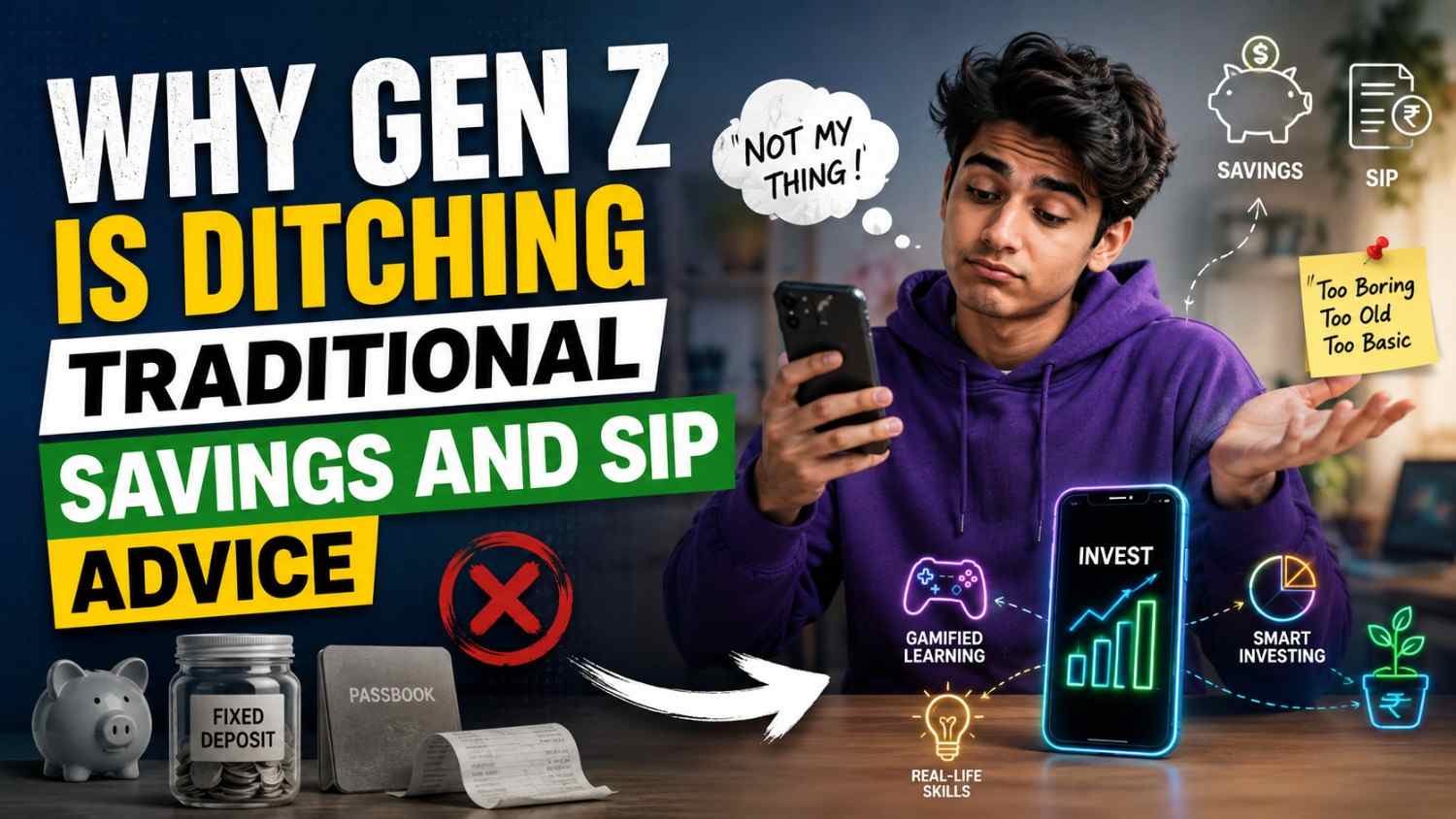
Why Gen Z Is Ditching Traditional Savings and SIP Advice: India’s next big financial literacy challenge may not simply be teaching young people what a SIP, mutual fund or savings plan is. The bigger challenge could be getting Gen Z interested enough to learn about them.
As younger Indians spend more time consuming visual, interactive and bite-sized digital content, experts believe traditional approaches to personal finance education may need an overhaul.
One solution attracting attention is gamified financial learning—allowing people to understand money through decisions, scenarios and consequences rather than relying entirely on classroom-style explanations.
📊 Why Financial Literacy Matters for Young Indians
The World Economic Forum has identified financial literacy as an important area for India’s younger generation. According to the figures cited in the original report, only 27% of Indian adults are financially literate, compared with 52% in advanced economies.
The gap highlights a broader challenge.
Teaching people definitions of financial products may not be enough. Financial education also needs to help people understand how money decisions affect their everyday lives.
For Gen Z in particular, experts argue that the format of financial education may be almost as important as the information itself.
💰 Why Traditional Savings and SIP Lessons May Struggle
For decades, financial education has generally revolved around familiar principles: save regularly, control unnecessary spending, invest for the long term and understand products such as mutual funds and SIPs.
These principles remain important. But the way they are communicated may not always match how younger audiences consume information.
“Finance is not necessarily difficult; the way we explain it often makes it feel difficult,” Mahek Tomer, Creator, Founder and CEO of India’s Future Investors, told NDTV.
That distinction could be crucial.
Instead of asking young people simply to study concepts such as savings, investing and mutual funds, financial education could put them inside realistic situations where those concepts have consequences.
🎮 Can Gamification Make Finance Easier to Understand?
Gamification is increasingly being discussed as one possible way to make financial education more interactive.
The idea isn’t necessarily to turn investing into entertainment.
Instead, learners could be presented with realistic financial situations and asked to make decisions.
For example, imagine receiving a limited monthly budget and having to decide between:
- paying essential expenses,
- buying something you want,
- building an emergency fund,
- saving toward a goal, and
- investing part of the remaining money.
Every decision could produce a different outcome.
This allows learners to see how financial choices can affect future goals without risking real money.
“For me, gamification is not about making money a game. It is about letting people make decisions, see the consequences and learn from them,” Tomer said.
🧠 Learning From Financial Mistakes Without Losing Real Money
This may be one of the most useful aspects of simulated financial learning.
Making a poor financial decision in real life can have consequences. Making the same mistake inside a carefully designed educational simulation provides an opportunity to understand what went wrong.
A learner could see what happens when they consistently overspend, fail to maintain emergency savings or delay long-term investing.
Conversely, they could see how disciplined budgeting and regular investing may influence hypothetical long-term outcomes.
The objective is therefore not simply to tell users what they “should” do with money. It is to demonstrate how different decisions can lead to different results.
📱 Financial Education Could Move Beyond Finance Apps
Gamified financial literacy does not have to be restricted to dedicated personal finance applications.
Professor Abhinav Tripathi, a financial expert and educator who teaches at a Ghaziabad-based university, believes similar concepts could be incorporated into mainstream entertainment and digital content.
Reality-show formats, for example, could introduce challenges based on budgeting and financial decision-making.
Quizzes could test practical money-management skills.
OTT programmes and storylines could illustrate how saving, spending and investing decisions affect characters over months or years.
The underlying concept is straightforward: take financial education to the formats and platforms where younger audiences already spend their time.
📺 Why Gen Z May Need a Different Financial-Literacy Strategy
Gen Z has grown up in a digital environment dominated by smartphones, social platforms, streaming services and interactive experiences.
That creates a different educational environment from the one experienced by previous generations.
A long lecture explaining compound growth may struggle to hold attention. An interactive scenario demonstrating the potential difference between starting early and delaying an investment could make the concept easier to understand.
Similarly, explaining budgeting through definitions may feel abstract, while asking someone to manage a simulated monthly salary can make trade-offs immediately visible.
The financial principle does not necessarily change.
The method of teaching it does.
📈 SIPs Still Matter—But Communication May Need to Change
The debate does not necessarily suggest that systematic investment plans or traditional savings principles have become irrelevant to Gen Z.
Rather, experts are questioning whether conventional methods of explaining these concepts are sufficiently engaging.
A Systematic Investment Plan (SIP) is a method of investing a fixed amount periodically in a mutual fund scheme. It can help investors develop investment discipline, although mutual fund returns are market-linked and are not guaranteed.
For a first-time investor, however, terminology involving NAVs, asset allocation, compounding and market volatility can initially feel overwhelming.
Interactive education could potentially bridge that gap by introducing concepts gradually through practical situations.
⚡ From Passive Financial Education to Active Learning
The larger change being proposed is a transition from passive learning to active financial decision-making.
Traditional model:
Read → Memorise → Understand
Interactive model:
Choose → Experience → Observe → Learn
The second approach gives users immediate feedback.
If a learner spends too much in a simulated scenario, they may discover that they cannot meet an emergency expense later.
If they save consistently, they can observe how a financial cushion develops.
If they invest regularly in a hypothetical market simulation, they can learn that investment values can rise and fall rather than assuming returns are guaranteed.
This experiential approach could make abstract financial principles more tangible.
🔑 Key Takeaways
Traditional savings and investing principles are unlikely to disappear, but the way they are taught may evolve significantly.
Gen Z’s preference for visual, interactive and digital content is encouraging educators to explore new approaches to financial literacy in India.
Gamified learning could allow young people to practise budgeting, saving and investment decisions in simulated environments before dealing with real money.
Finance education could also expand beyond specialist apps into quizzes, entertainment formats, social content and OTT storytelling.
Most importantly, the emerging approach focuses less on memorising financial terminology and more on understanding the consequences of everyday money decisions.
❓ Frequently Asked Questions
What is financial literacy?
Financial literacy is the ability to understand and effectively use financial concepts such as budgeting, saving, borrowing, investing and managing money.
What is a SIP?
A Systematic Investment Plan (SIP) allows an investor to invest a fixed amount at regular intervals in a mutual fund scheme. SIPs encourage regular investing, but returns depend on market performance and are not guaranteed.
Why is financial literacy important for Gen Z?
Young adults increasingly make financial decisions involving digital payments, credit, savings and investments. Understanding basic financial concepts can help them make more informed decisions and recognise financial risks.
What is gamification in financial education?
Gamification uses interactive elements such as challenges, simulations, rewards, quizzes and decision-based scenarios to help people learn financial concepts through participation rather than passive instruction.
Can games really teach people about saving and investing?
Well-designed simulations can demonstrate the consequences of budgeting, spending, saving and hypothetical investment decisions. However, they should complement reliable financial education rather than replace professional financial advice.
🌟 The Future of Financial Literacy Could Be Experiential
The financial principles Gen Z needs to understand are not necessarily new. Saving, budgeting, responsible spending and long-term investing remain fundamental personal-finance concepts.
What may need to change is how those lessons are delivered.
As younger audiences increasingly gravitate toward interactive and visual experiences, financial education may have to become more practical, relatable and participatory.
“The goal is to transform financial literacy from something people are told about into something they actively experience,” Tripathi said.
That shift—from simply explaining money to allowing people to experience financial decision-making—could become an important part of India’s next phase of financial literacy.
Disclaimer: This article is for educational and informational purposes only and should not be considered financial or investment advice. Mutual fund investments are subject to market risks.