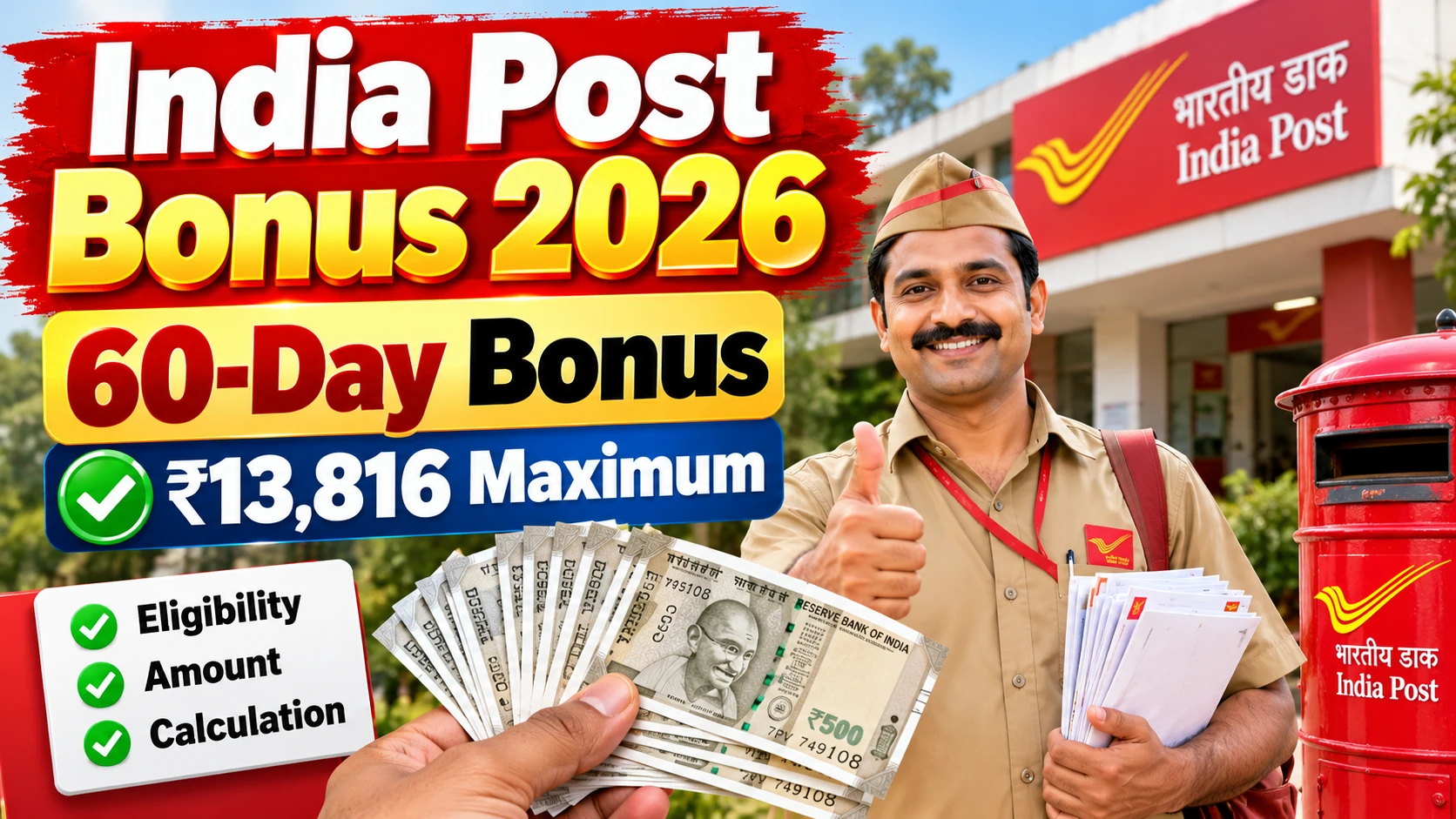
India Post Bonus 2026: The Central Government has announced a major festive-season benefit for eligible postal employees, approving a 60-day Productivity Linked Bonus (PLB) for the financial year 2025–26. Under the Department of Posts order dated October 16, 2026, qualifying regular employees may receive a maximum bonus of approximately ₹13,816, depending on their eligible salary and service conditions.
The announcement also covers Gramin Dak Sevaks (GDS) and certain casual labourers under separate payment provisions. Here is everything employees need to know about eligibility, bonus calculations, salary limits and the government’s latest decision.
🎉 India Post Bonus 2026: What Has the Government Announced?
The Ministry of Communications, through the Department of Posts, has sanctioned a Productivity Linked Bonus equivalent to 60 days of eligible emoluments for the accounting year April 1, 2025, to March 31, 2026.
The decision was communicated through an official order issued on October 16, 2026.
The announcement follows the government’s decision to provide a 78-day productivity-linked bonus to eligible railway employees.
For postal workers, the bonus provides additional financial support during the festive season.
However, the amount employees receive will depend on their employment category, eligible earnings, attendance and applicable service rules.
📊 India Post Bonus 2026
Estimated 60-day bonus for eligible regular postal employees at different monthly calculation amounts.
Note: Illustrative amounts for qualifying regular employees. Actual payments depend on eligibility, service records and applicable government rules.
💰 How Much Bonus Will Postal Employees Receive?
One of the biggest questions is how much money eligible postal employees can receive.
According to the government’s calculation rules, the monthly emoluments ceiling for the regular postal employees’ bonus is ₹7,000.
The bonus is calculated using the following formula:
Bonus = Average Monthly Eligible Emoluments × 60 ÷ 30.4
Here, 60 represents the number of bonus days, while 30.4 represents the average number of days in a month.
Example: Maximum Bonus Calculation
For an eligible employee whose average monthly emoluments reach the ₹7,000 ceiling:
₹7,000 × 60 ÷ 30.4 = ₹13,815.79
After rounding, the maximum calculated bonus becomes approximately ₹13,816.
Importantly, ₹13,816 is not a guaranteed payment for every postal employee. The actual amount may be lower depending on individual eligibility and service records.
👨💼 Who Is Eligible for the India Post 60-Day Bonus?
The government’s announcement covers three major categories of postal workers.
1. Regular Departmental Employees
Eligible regular employees include:
- Multi-Tasking Staff (MTS)
- Group C employees
- Non-gazetted Group B employees
Their bonus is calculated using eligible emoluments, subject to the prescribed monthly ceiling.
2. Gramin Dak Sevaks (GDS)
Regularly engaged Gramin Dak Sevaks are eligible for an ex-gratia bonus under the order.
For GDS employees, the calculation considers Time Related Continuity Allowance (TRCA) and applicable Dearness Allowance.
The ₹7,000 monthly calculation ceiling also applies to the relevant GDS earnings.
3. Eligible Casual Labourers
The order additionally provides for ad-hoc bonus payments to qualifying full-time casual labourers, including those with temporary status.
However, their calculation differs from that of regular employees and GDS workers.
Eligibility depends on specific attendance and service-duration conditions.
📊 India Post Bonus 2026: Employee-Wise Comparison
| Employee Category | Bonus Provision | Calculation Basis |
|---|---|---|
| MTS Employees | 60-day PLB | Eligible emoluments, capped at ₹7,000 monthly |
| Group C Employees | 60-day PLB | Eligible emoluments, capped at ₹7,000 monthly |
| Non-gazetted Group B | 60-day PLB | Eligible emoluments, capped at ₹7,000 monthly |
| Gramin Dak Sevaks | Ex-gratia bonus | TRCA plus DA, subject to applicable ceiling |
| Eligible Casual Labourers | Ad-hoc bonus | Notional monthly wages of ₹1,200, subject to rules |
The comparison shows why employees should not assume that every category receives the same payment.
🧮 India Post Bonus Calculation: Understand With Examples
The government’s formula makes it possible to estimate the bonus using average eligible monthly earnings.
For example, an employee with average eligible emoluments of ₹5,000 would have a calculated bonus of approximately ₹9,868.
At ₹6,000, the calculated amount rises to approximately ₹11,842.
At the maximum ₹7,000 calculation ceiling, the figure reaches approximately ₹13,816.
These are illustrative calculations for qualifying regular employees with the full 60-day entitlement. Actual payments may differ because of leave, service history or other applicable conditions.
Employees should also remember that the ₹7,000 figure is a bonus calculation ceiling, not a new salary limit or salary increase.
🏤 Special Bonus Rules for Gramin Dak Sevaks
Gramin Dak Sevaks are an important part of India’s postal network, particularly in rural areas.
Under the latest order, eligible GDS employees will receive an ex-gratia payment calculated using their average monthly TRCA and corresponding Dearness Allowance.
For employees who served throughout the accounting year, the relevant monthly earnings are averaged over the prescribed period.
Where the combined monthly amount exceeds ₹7,000, the calculation is restricted to the applicable ceiling.
GDS employees who worked for only part of the year may receive a proportionate bonus according to the department’s rules.
This means that two GDS employees may receive different amounts even though both fall under the same bonus announcement.
📋 What Are the Rules for Casual Labourers?
Eligible full-time casual labourers are covered under separate ad-hoc bonus provisions.
The order specifies a notional monthly wage of ₹1,200 for the calculation.
Qualifying workers generally must have completed at least three consecutive years of service, working a minimum of 240 days per year.
For offices following a five-day working week, the corresponding requirement is 206 days per year.
The order also requires the relevant eight-hour working-day conditions to be satisfied.
For a full-year qualifying calculation, ₹1,200 multiplied by 60 and divided by 30.4 produces approximately ₹2,368.
The actual payment depends on the applicable daily-rate calculation and qualifying days worked.
📅 Will Retired Postal Employees Receive the Bonus?
The government order also addresses employees who left service during the relevant accounting year.
Certain employees who retired, resigned, left service or proceeded on deputation between April 1, 2025, and March 31, 2026, may remain eligible.
Their entitlement will be determined according to the applicable calculation provisions.
Periods of extraordinary leave or other service interruptions may affect the amount payable.
Therefore, former employees should verify their individual eligibility rather than assuming they are automatically excluded.
🪔 Why Is the Bonus Announcement Important?
The announcement comes during a period when many households face additional festive expenses.
A bonus can help eligible employees manage shopping, travel, family celebrations and other financial commitments.
The decision is also significant because the Department of Posts operates an extensive network of postal services across urban and rural India.
For qualifying workers, the payment represents an annual employment benefit calculated under the government’s prescribed rules.
However, the announcement should not be confused with a permanent salary increase or an additional monthly allowance.
❓ India Post Bonus 2026: Frequently Asked Questions
1. How many days of bonus has India Post announced for 2026?
The government has approved a Productivity Linked Bonus equivalent to 60 days of eligible emoluments for the accounting year 2025–26.
2. What is the maximum India Post bonus amount?
For qualifying regular employees, the maximum calculated amount is approximately ₹13,816, based on the ₹7,000 monthly calculation ceiling.
3. Are Gramin Dak Sevaks eligible for the bonus?
Yes. Regularly engaged Gramin Dak Sevaks are covered under ex-gratia bonus provisions, subject to applicable service and calculation rules.
4. Will every postal employee receive ₹13,816?
No. The amount depends on employment category, eligible earnings, service duration and other conditions.
5. Are casual postal workers eligible?
Certain full-time casual labourers and temporary-status casual labourers qualify for an ad-hoc bonus if they meet the required service and attendance conditions.
6. When was the India Post bonus order issued?
The Department of Posts issued the relevant order on October 16, 2026, for the accounting year 2025–26.
7. When will the bonus be credited?
The announcement confirms the bonus sanction, but it does not establish one universal bank-credit date for every employee. Workers should check departmental payroll communications for payment updates.
✅ Final Words
The India Post Bonus 2026 announcement brings positive news for eligible postal employees ahead of the festive season.
With a 60-day Productivity Linked Bonus and a calculated maximum of approximately ₹13,816 for qualifying regular staff, the decision provides an additional financial benefit to thousands of potential recipients across different employee categories.
Gramin Dak Sevaks and eligible casual labourers are also covered under separate provisions.
Employees should carefully check their category, service records and applicable calculation rules to understand their actual entitlement.
The key takeaway: The government has approved the bonus, but the final payment amount will depend on individual eligibility rather than being identical for every postal worker.