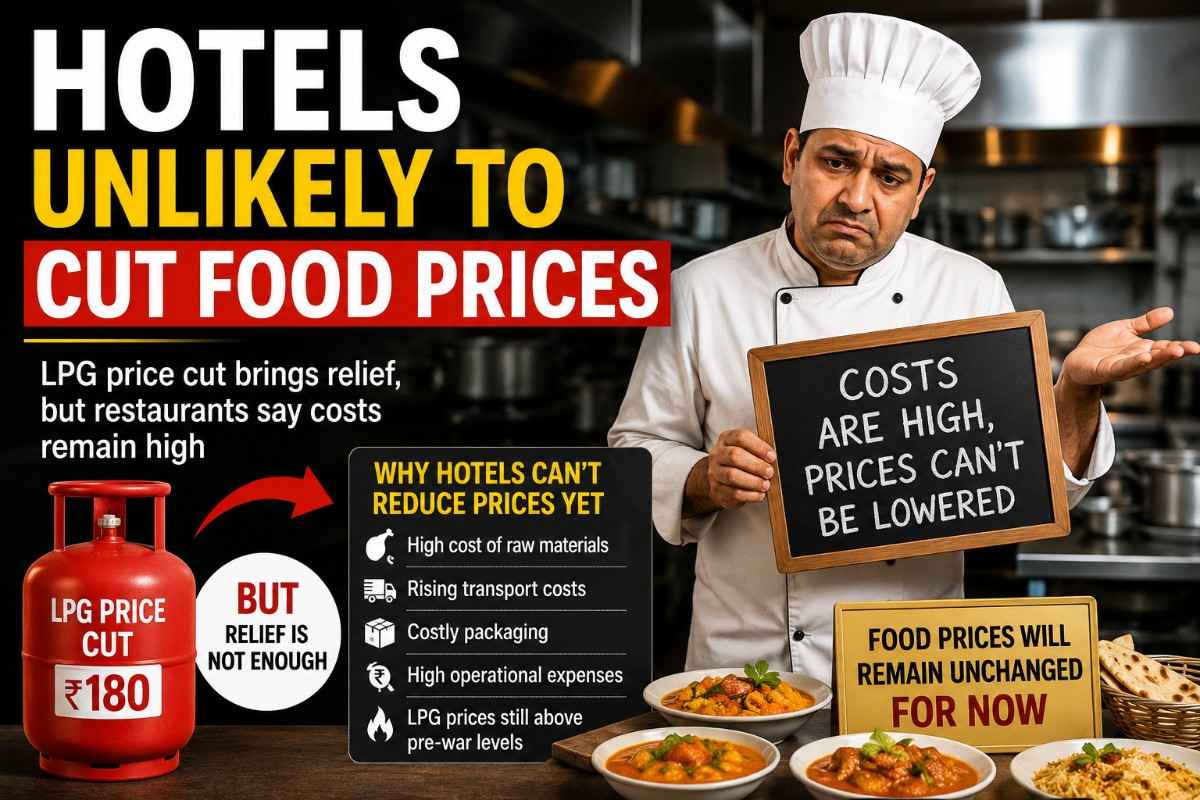
Hotels Unlikely to Cut Food Prices : The government’s decision to reduce the price of a 19.2-kg commercial LPG cylinder by around ₹180 from July 1, 2026, has offered some financial relief to hotels, restaurants and cafes across India. However, industry leaders say customers should not expect lower food prices anytime soon.
Hotel owners argue that while the LPG price cut is welcome, it is too small to offset the sharp rise in cooking gas, food ingredients, transport and packaging costs witnessed during the recent West Asia conflict.
🔥 LPG Price Cut Falls Short of Industry Expectations
Oil marketing companies reduced the price of commercial LPG cylinders by approximately ₹177-₹180, depending on the city.
While the announcement has been welcomed, hotel associations say the industry had expected a much larger reduction of nearly ₹500 per cylinder.
G.K. Shetty, President of the Karnataka State Hotels’ Association, said hotels in Bengaluru received a reduction of ₹177 per 19.2-kg cylinder, which is significantly lower than expected.
“Crude oil prices have almost returned to February 2026 levels. We expected a bigger reduction and hope another rollback happens after July 15. Commercial LPG should come down to around ₹2,000 per cylinder by the end of the month.”
🍽️ Restaurant Food Prices to Remain Unchanged
Despite the LPG price reduction, restaurant owners across the country have made it clear that menu prices are unlikely to be revised immediately.
According to industry representatives, cooking gas is only one part of their operating expenses.
Restaurants continue to face rising costs due to:
- 🍗 Higher chicken and meat prices
- 🌾 Costlier rice, dal and vegetables
- 🚚 Increased transportation expenses
- 📦 Expensive packaging materials
- 👨🍳 Rising employee wages
- ⚡ Higher utility and operational costs
As long as these expenses remain elevated, hotels say reducing food prices is not financially viable.
🌧️ Chennai Hotels Call It “A Little Relief”
M. Ravi, President of the Chennai Hotels Association, described the LPG price cut as:
“A little relief, like a summer rain.”
He added that commercial LPG prices should return to pre-war levels, especially when essential commodities such as rice and dal continue to become more expensive.
🍗 Dindigul Thalappakatti: LPG Alone Won’t Reduce Costs
Sathish D. Nagasamy, Managing Director of Dindigul Thalappakatti, said LPG prices remain much higher than normal.
According to him, restaurants are also dealing with rising prices of chicken and other raw materials.
“Only when these costs come down will the reduction truly benefit the hotel industry. All product prices are interconnected with LPG costs.”
📈 Mumbai Restaurants Say Cut Makes “Hardly Any Difference”
Restaurant owners in Mumbai believe the latest reduction is too small to impact business costs.
One restaurant owner explained that commercial LPG prices had increased by nearly ₹1,300 per cylinder over recent months.
“A reduction of about ₹180 hardly makes any difference. Large hotel chains may benefit, but mid-sized restaurants—which make up the majority of the industry—will continue to struggle.”
Owners also remain cautious because uncertainty surrounding the West Asia conflict could push fuel prices higher again.
🚛 Transport and Packaging Costs Still High
According to Jegan Damodarasamy, CEO of the Sree Annapoorna Group in Coimbatore, LPG prices had nearly doubled during the crisis.
Although commercial cylinder supplies have improved over the past few weeks, he says hotels continue to face elevated costs elsewhere.
These include:
- 📦 Packaging materials
- 🚛 Transportation
- 🚚 Logistics
- Raw material procurement
“The LPG reduction is only about 10% after prices had risen nearly 100%. We need all related costs to come down before hotels can reduce menu prices.”
He added that restaurants would only consider lowering food prices once commercial LPG stabilises near ₹2,000 per cylinder.
☕ Kolkata Restaurants Welcome the Relief
Piyush Kankaria, Chairman of the National Restaurant Association of India (Kolkata Chapter), called the move a much-needed relief.
He said restaurants have been struggling with high operating costs for several months.
“Fuel accounts for nearly 15% of kitchen expenses. This reduction eases immediate pressure, helps restaurants keep menu prices stable, and allows businesses to focus on quality and customer experience.”
For a price-sensitive market like Kolkata, predictable fuel prices are essential for sustainable growth, he added.
🏨 Eastern India Hotel Industry Wants Pre-War LPG Prices
Sudesh Poddar, President of the Hotel Restaurant Association of Eastern India, welcomed the government’s decision but urged authorities to reduce commercial LPG prices further.
According to him, hotels across eastern India want commercial LPG prices restored to pre-war levels, which would provide meaningful relief to the hospitality sector.
📌 Why Hotels Are Not Cutting Food Prices Yet
The latest LPG price cut is a positive development, but hotel owners say it is not enough to justify lowering menu prices.
Key Reasons:
✅ LPG prices are still well above pre-war levels.
✅ Food ingredients remain expensive.
✅ Transport and packaging costs have not declined.
✅ Restaurants are recovering from months of increased operating expenses.
✅ Businesses remain cautious due to uncertainty in global crude oil prices.
📊 The Bottom Line
While the ₹180 reduction in commercial LPG prices provides welcome relief for India’s hospitality industry, consumers are unlikely to see cheaper restaurant meals in the near future.
Industry leaders say food prices will remain stable rather than decrease, unless commercial LPG prices fall further and the costs of ingredients, logistics and packaging also return to normal.
For now, hotels believe the latest cut is a step in the right direction—but not enough to bring down your restaurant bill. 🍽️