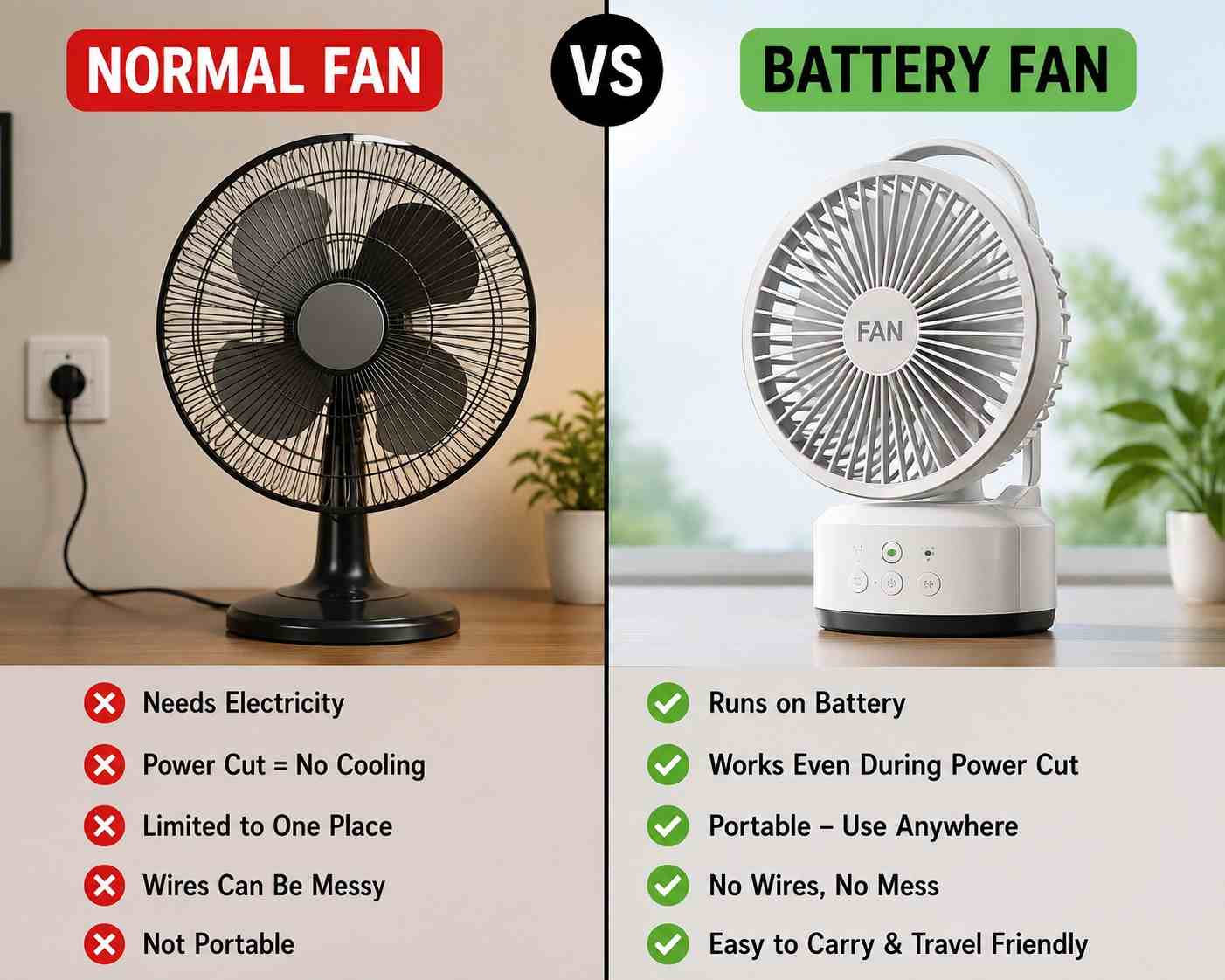
Best Normal Fan vs Battery Fan: Imagine a ceiling fan that keeps running even when the electricity goes out—without depending entirely on a separate inverter.
That is the basic idea behind a battery-operated fan.
These fans combine a BLDC (Brushless Direct Current) motor, rechargeable battery, electronic controller and charging system in one appliance. When mains electricity is available, the fan operates normally while its internal battery is charged. When a power cut occurs, compatible models automatically switch to battery operation.
Some battery-operated ceiling fans advertise up to 8–10 hours of backup, although the actual runtime depends on the fan model, battery capacity, speed setting, battery condition and other factors. For example, some current products specify different backup durations depending on the operating speed rather than promising the same runtime at maximum speed.
The technology is particularly useful in homes where power cuts, voltage fluctuations or inverter limitations are common.
⚡ How Does a Battery Fan Work?
A battery-operated fan generally combines four important components:
- 🔋 Rechargeable battery
- ⚙️ BLDC motor
- 🧠 Electronic motor controller
- 🔌 Charging and power-management circuit
When electricity is available, the charging circuit charges the internal battery while the fan operates.
When the power fails, the electronics switch the fan to battery power. The transition is designed to happen automatically in compatible models, allowing the blades to continue spinning without requiring the user to connect an external backup source.
The biggest difference from a conventional ceiling fan is that the battery and control electronics are integrated into the fan itself.
💡 Why Do Battery Fans Use BLDC Motors?
The BLDC motor is one of the main reasons these fans can deliver long backup times while consuming relatively little power.
Traditional ceiling fans commonly use AC induction motors. BLDC fans instead use electronically controlled brushless motors and permanent-magnet technology.
Government and consumer-focused technical material shows that conventional fans can typically consume around 60–80 watts, while BLDC fans can operate around 28–32 watts, although exact consumption varies by model and speed.
That lower power requirement has two major benefits:
- 💰 Lower electricity consumption during normal operation.
- 🔋 Longer potential backup time from a battery or inverter.
📊 BLDC Fan vs Normal Fan: Electricity Consumption
Consider a simple example.
Suppose:
- Normal fan = 75W
- BLDC fan = 30W
- Usage = 10 hours per day
A 75W fan would consume approximately:
0.75 kWh per day
A 30W BLDC fan would consume approximately:
0.30 kWh per day
Over 30 days:
| Fan Type | Example Power | 10 Hours/Day | Approx. Monthly Consumption |
|---|---|---|---|
| Normal fan | 75W | 10 hours | 22.5 kWh |
| BLDC fan | 30W | 10 hours | 9 kWh |
That represents a substantial difference in energy consumption.
However, these figures are illustrative calculations, not a guarantee for every fan. Actual electricity usage depends on the specific model, speed, airflow requirements and operating conditions. The Bureau of Energy Efficiency and consumer testing material both demonstrate the significant efficiency advantage of BLDC technology.
🔋 How Long Does a Battery Fan Run During a Power Cut?
This is one of the most important questions buyers ask.
The answer is: it depends.
Some battery-operated ceiling fans advertise approximately 8–10 hours of backup, but this should not be interpreted as a universal standard.
Backup time can change according to:
- 🔋 Battery capacity
- 🌬️ Fan speed
- ⚙️ Motor efficiency
- 🔌 Controller efficiency
- 🔋 Battery age and condition
- 🌡️ Operating conditions
- ⏱️ Whether the manufacturer measures backup at low, medium or maximum speed
For example, one current battery-fan specification lists around 3 hours at higher power and 8–10 hours at lower speeds, illustrating why advertised backup should always be checked against the manufacturer’s testing conditions.
⚠️ Important Buying Tip
Never buy a fan solely because the box says “10-hour backup.”
Check whether that figure applies to:
Speed 1, Speed 2, or maximum speed.
That small detail can make a major difference in real-world usage.
🏠 Can a Battery Fan Work Without an Inverter?
Yes.
That is one of the biggest advantages of a fan with an integrated battery.
A compatible battery-operated ceiling fan can use its internal battery when mains electricity is unavailable, so a separate inverter is not required specifically to keep that fan operating.
For households that only need backup for fans and lights, this can be an attractive alternative to installing a larger backup system.
However, a battery fan does not replace an inverter for your entire home. An inverter can power multiple appliances depending on its capacity, whereas an integrated battery fan primarily provides backup for that particular fan.
🔌 What If You Already Have an Inverter?
A BLDC fan can also be useful in a home with inverter backup.
Because BLDC fans generally require less power than traditional induction fans, they can place a smaller load on an inverter. This can potentially increase backup duration compared with running a higher-wattage conventional fan.
For example, a typical comparison may be around 70–75W for a conventional fan versus 28–35W for a BLDC fan, although exact specifications vary.
But don’t assume that having an internal battery automatically means the backup time will simply “double.” Actual performance depends on how the particular fan and inverter are designed.
🌬️ Battery Fan vs Normal Fan: Key Differences
| Feature | Normal Ceiling Fan | Battery-Operated BLDC Fan |
| Motor | Usually AC induction | BLDC |
| Battery backup | ❌ No internal battery | ✅ Built-in battery on compatible models |
| Typical power consumption | Around 60–80W | Often around 25–35W |
| Power-cut operation | Requires external backup | Can continue using internal battery |
| Electricity usage | Higher | Lower |
| Initial price | Lower | Higher |
| Inverter required for fan backup | Usually yes | Not necessarily |
| Noise | Model-dependent | Often quieter |
| Speed control | Usually regulator | Often remote/electronic |
| Best for | Budget-conscious buyers | Energy savings + backup |
The wattage ranges above are indicative rather than universal specifications.
💰 How Much Does a Battery-Operated Fan Cost?
Battery-operated BLDC fans generally cost more than basic conventional ceiling fans because they include additional electronics and a rechargeable battery.
The exact price depends on:
- Brand
- Motor efficiency
- Battery capacity
- Air delivery
- Sweep size
- Remote-control features
- Warranty
- Smart features
- Battery technology
For example, a current Orient battery-backup BLDC ceiling fan listing shows a price around ₹4,594, with a higher MRP, demonstrating that prices can vary considerably by model and promotions.
So rather than relying on an old fixed price range, buyers should compare current model specifications and prices before purchasing.
💰 Is a Battery Fan Worth the Higher Price?
For some households, yes.
The higher upfront price can potentially be justified by two separate benefits:
1. ⚡ Lower electricity consumption
A BLDC motor can consume substantially less power than a traditional induction fan.
2. 🔋 Built-in backup
The internal battery can keep the fan running during power cuts without requiring a dedicated inverter for that fan.
This makes the technology particularly attractive for people who:
- Experience frequent power cuts
- Run fans for many hours every day
- Want to reduce electricity consumption
- Have limited inverter capacity
- Are building or renovating a home
- Want independent backup for a bedroom or living room
🤫 Are Battery-Operated BLDC Fans Quieter?
They can be.
BLDC technology is electronically controlled and does not use the same motor design as conventional induction fans. Many manufacturers market their BLDC models as quieter than traditional fans.
However, actual noise also depends on:
- Motor design
- Blade balance
- Bearing condition
- Installation quality
- Speed
- Ceiling mounting
So “silent” should be treated as a model-specific claim, not a guarantee that every BLDC fan will be completely noiseless.
⚠️ What Are the Disadvantages of Battery Fans?
Battery fans have several advantages, but they are not perfect.
💰 Higher upfront cost
The purchase price is usually higher than a basic conventional fan.
🔋 Battery aging
Rechargeable batteries have a finite lifespan. Their capacity can decrease over time and eventually the battery may need servicing or replacement.
⏱️ Backup depends on speed
The advertised maximum backup may be measured at a lower speed. Maximum-speed operation can reduce runtime considerably.
🛠️ More electronics
Compared with a simple conventional fan, a battery-operated model contains additional electronics and battery-management components.
🔧 Replacement availability matters
Before buying, check whether the manufacturer provides replacement batteries and after-sales service in your area.
🛒 How to Choose the Best Battery-Operated Fan
Don’t choose a battery fan based only on its backup claim.
Check these specifications before purchasing:
🔋 1. Battery capacity
A larger battery can potentially provide longer runtime, but the motor’s power requirement also matters.
⚡ 2. Actual wattage
Look for the fan’s rated power consumption.
Lower wattage generally means less electricity consumption and potentially longer battery runtime.
🌬️ 3. Air delivery
Don’t sacrifice airflow simply to get lower wattage.
Check the CMM/air-delivery rating and sweep size.
⏱️ 4. Backup at different speeds
Ask for runtime at:
- Low speed
- Medium speed
- Maximum speed
This gives you a much more realistic idea of performance.
🔋 5. Battery replacement
Find out:
- Battery type
- Warranty
- Expected service life
- Replacement cost
- Availability of replacement batteries
🛡️ 6. Safety and protection
Look for appropriate battery-management and electrical protection features.
⭐ 7. Energy rating
Where applicable, check the BEE star rating and the manufacturer’s official technical specifications.
❓ Frequently Asked Questions
1. What is a battery-operated fan?
A battery-operated fan is a fan with a rechargeable internal battery that can continue operating when mains electricity fails. Many models use energy-efficient BLDC motors.
2. How many hours can a battery fan run?
Some models advertise approximately 8–10 hours, usually under specific operating conditions. Actual backup depends on battery capacity, fan speed, model and battery condition.
3. Can a battery fan work without an inverter?
Yes. A battery-operated fan with an integrated rechargeable battery can provide its own backup during a power cut.
4. Does a BLDC fan consume less electricity than a normal fan?
Generally, yes. Typical BLDC ceiling fans can consume substantially less electricity than conventional induction fans. Government and consumer sources show examples around 28–32W for BLDC versus 60–80W for conventional fans, depending on the model and operating conditions.
5. Is a battery fan better than a normal fan?
It depends on your priorities. If you want lower electricity consumption and built-in power-cut backup, a battery BLDC fan can be a strong choice. If your priority is the lowest purchase price, a conventional fan may be more economical initially.
6. Does a battery fan charge while running?
Many integrated battery models are designed to operate from mains power while charging their internal battery, but the exact charging behavior depends on the model. Always check the manufacturer’s specifications.
7. Can a BLDC fan run on an inverter?
Yes, compatible BLDC fans can operate on inverter power. Their lower wattage can also reduce the load on the backup system.
8. Is a battery-operated fan worth buying?
For homes with frequent power cuts or high daily fan usage, it can be worth considering. The decision should be based on the fan’s price, electricity savings, battery backup, warranty and expected battery-replacement cost.
9. Will a battery fan always give 10 hours of backup?
No. “Up to 10 hours” is usually a maximum or model-specific claim. Backup can be significantly shorter at higher speeds.
10. What should I check before buying a battery fan?
Check the battery capacity, backup at different speeds, BLDC wattage, air delivery, warranty, battery replacement cost, charging time, safety features and after-sales service.
🏆 Final Verdict: Should You Buy a Battery-Operated Fan?
A battery-operated BLDC fan is an interesting solution for Indian homes that want both energy efficiency and protection from power cuts.
The biggest advantage is that two technologies work together:
BLDC motor → lower power consumption ⚡
Built-in battery → backup during power cuts 🔋
That combination can make these fans particularly useful in bedrooms, living rooms, offices and other spaces where uninterrupted airflow matters.
However, don’t choose a model simply because it promises “50% electricity savings” or “10-hour backup.” Those numbers can vary depending on the model, speed and testing conditions.
Instead, compare the actual wattage, air delivery, battery capacity, speed-wise backup, warranty and replacement-battery cost.
💡 Bottom line
If you frequently experience power cuts and want to reduce the electricity consumed by your ceiling fan, a good-quality battery-operated BLDC fan can be a smart upgrade.
If power cuts are rare and your main priority is the lowest purchase price, a conventional fan—or a standard BLDC fan without an integrated battery—may offer better value.
The smartest purchase isn’t necessarily the fan with the longest advertised backup. It’s the one that gives you the right combination of airflow, efficiency, battery runtime, reliability and long-term cost. 🔋⚡