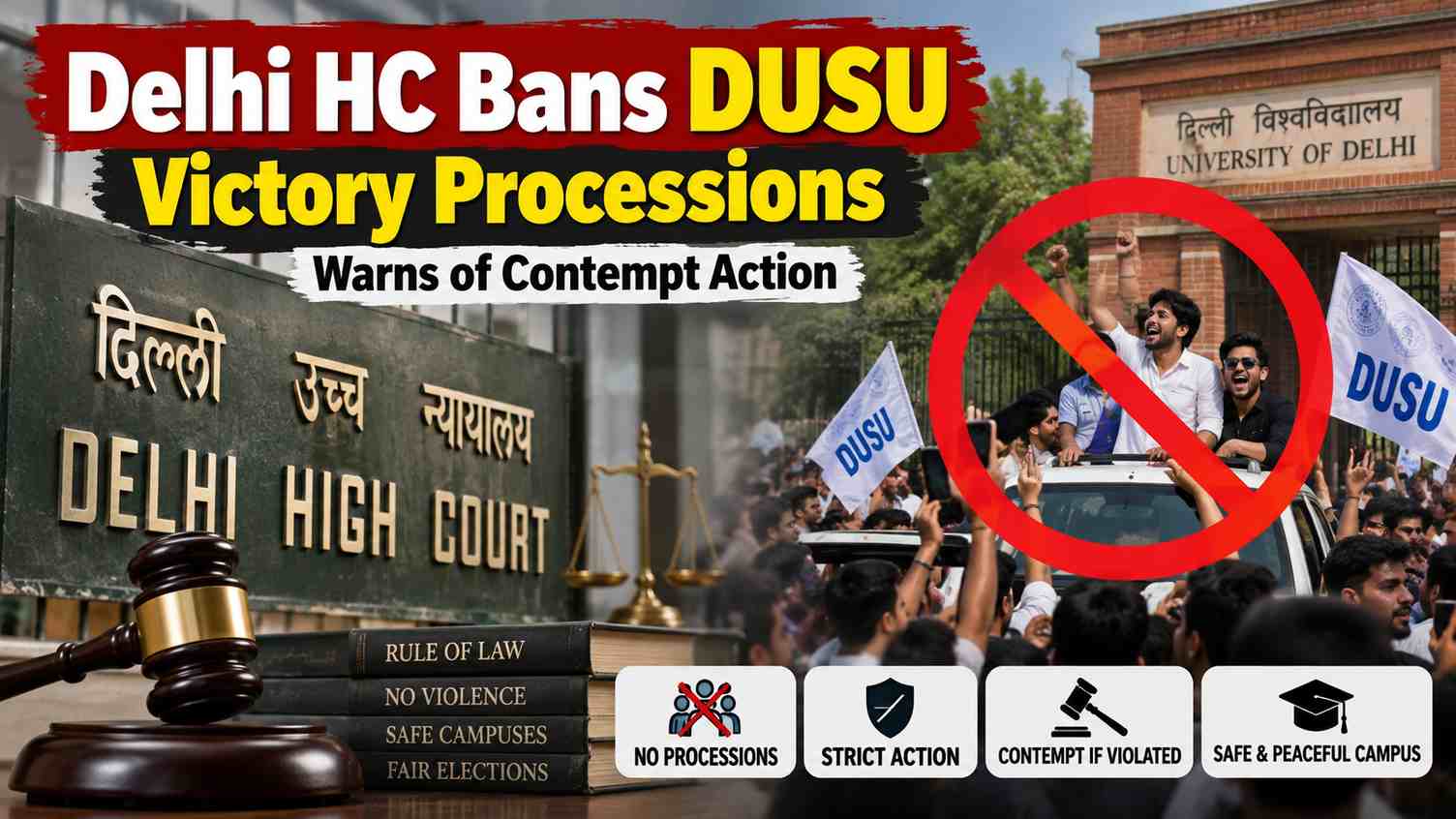
Delhi HC Bans DUSU Victory Processions: The Delhi High Court on Friday, September 18, 2026, barred victory processions following the declaration of the Delhi University Students’ Union (DUSU) election results, directing the Delhi Police to ensure that celebrations do not turn into processions on roads, college campuses or inside hostels.
The court made clear that the restriction extends beyond candidates themselves to students, supporters and others participating in such processions.
The High Court also warned that violations could trigger criminal and administrative action and may amount to contempt of court.
The directions came amid the court’s concern over recurring violations of election rules and allegations of unruly conduct during the DUSU election campaign.
📌 Key Takeaways
- Delhi High Court has barred victory processions after the DUSU election results.
- The restriction covers roads, college campuses and hostels.
- Delhi Police has been directed to ensure compliance.
- Violators may face criminal and administrative proceedings as well as contempt action.
- Notices have been issued to around 140 DUSU candidates.
- The court has raised concerns about alleged use of weapons, luxury-car cavalcades and other violations during campaigning.
- The court is considering electoral damages against students and student organisations found responsible for violations.
⚖️ What Did the Delhi High Court Order?
A Division Bench comprising Chief Justice Devendra Kumar Upadhyaya and Justice Tejas Karia passed the directions while considering alleged violations surrounding the DUSU elections.
The court said no victory procession should be taken out following the declaration of the results, whether on public roads or within colleges and hostels.
Delhi Police has been made responsible for ensuring that the direction is followed.
According to the court’s direction, violations could lead not only to criminal and administrative proceedings against those involved but also to contempt action.
The order assumes particular significance because DUSU elections traditionally attract substantial campaigning and student participation across Delhi University’s campuses.
🎓 Court Flags Repeated Violations of Election Norms
The Bench expressed concern over what it described as frequent and recurring violations of election norms.
The proceedings involve the implementation of the Lyngdoh Committee recommendations, anti-defacement rules and the DUSU election code of conduct.
The court observed that steps already taken by Delhi University and law-enforcement authorities did not appear to have created a sufficient deterrent against violations.
It consequently called for more effective enforcement.
🚗 Luxury Car Cavalcades Come Under Court Scrutiny
One of the issues that drew the court’s attention was the alleged use of large vehicle cavalcades during campaigning.
The Bench questioned how vehicles without registration plates could be allowed to travel on Delhi roads and raised concerns about reports of convoys involving numerous cars.
The court observed that such cavalcades could create fear and project dominance by candidates.
It also questioned conduct involving people standing on vehicle roofs and bonnets during campaigning.
The issue prompted scrutiny not merely of campaign behaviour but also of how traffic and election-related regulations were being enforced around Delhi University.
🚔 Delhi Police Details Enforcement Action
Delhi Police informed the High Court about enforcement measures taken in connection with alleged violations during the election period.
According to current court reporting, police told the Bench that more than 5,400 challans had been issued and 49 vehicles impounded. Four people had also been arrested.
The figures underline the scale of enforcement activity surrounding this year’s DUSU election campaign.
The High Court nevertheless questioned whether the measures had been sufficient to deter further violations.
👨🏫 Alleged Assault on Teacher Also Raised in Court
The proceedings also touched upon an alleged assault involving a teacher.
When the High Court sought information about the case, the police informed it that arrests had been made.
The court asked Delhi University about administrative measures taken against the students concerned. The university informed the Bench that show-cause notices had been issued.
The Bench stressed that criminal proceedings initiated by the police should be pursued in accordance with law.
💰 Court Raises Questions Over Campaign Spending
The High Court also questioned the apparent use of expensive vehicles during student election campaigning.
The issue brought campaign expenditure and compliance with student election rules into focus.
The Lyngdoh Committee framework was designed to regulate student elections and address issues including campaign expenditure, election conduct and the influence of money and organisational power.
The High Court proceedings therefore extend beyond victory celebrations and concern broader compliance with the rules governing DUSU elections.
📢 Notices Issued to Around 140 DUSU Candidates
In another significant development, the High Court issued notices to around 140 candidates contesting the DUSU elections.
Student organisations were also brought within the proceedings.
The court proposed considering electoral damages against individual students as well as student organisations where violations are established.
The petitioner has been directed to compile relevant records and documents concerning alleged violations within two weeks.
Those receiving notices will have an opportunity to respond before any decision on damages is made.
🗳️ Why the Court’s Order Matters for DUSU Results
The restriction directly affects how candidates and their supporters can celebrate once the DUSU results are declared.
Winning an election does not permit a candidate or supporters to organise a prohibited victory procession on roads, within college premises or in hostels.
The Delhi Police has been specifically tasked with enforcing the court’s direction.
That means post-result activity is likely to remain under heightened scrutiny.
📚 What Are the Lyngdoh Committee Recommendations?
The Lyngdoh Committee recommendations provide a regulatory framework for student union elections at universities and colleges.
They address issues such as campaign expenditure, candidate eligibility, campaigning practices and election conduct.
The current High Court proceedings focus in part on allegations that these standards and other election rules were repeatedly violated during the DUSU campaign.
The court has indicated that recurring non-compliance requires stronger enforcement by both university and law-enforcement authorities.
🔎 What Case Is the Delhi High Court Hearing?
The High Court is considering proceedings arising from a plea by advocate Prashant Manchanda seeking effective implementation of the Lyngdoh Committee recommendations, anti-defacement requirements and the DUSU election code of conduct.
The plea flagged alleged violence, vandalism, clashes and other violations during the election campaign.
The court subsequently sought responses from the authorities and examined measures taken by Delhi University and Delhi Police.
🔔 What Happens Next?
The immediate focus will be on enforcement once the DUSU results are declared.
Delhi Police has been directed to prevent prohibited victory processions, while candidates and student organisations that have received notices will have an opportunity to respond to the court.
The petitioner is also expected to submit material concerning alleged violations within the period specified by the High Court.
Further proceedings could therefore determine whether electoral damages or other consequences are imposed in individual cases.
❓ Frequently Asked Questions
1. Has the Delhi High Court banned DUSU victory processions?
Yes. The Delhi High Court has directed that no victory processions be taken out after the declaration of the DUSU election results.
2. Where does the DUSU victory procession ban apply?
The direction covers public roads as well as college campuses and hostels.
3. What happens if students violate the High Court order?
The court has said violations can attract criminal and administrative action and may also amount to contempt of court.
4. Who is responsible for enforcing the procession ban?
The Delhi Police has been directed to ensure that prohibited victory processions do not take place.
5. Why did the Delhi High Court issue the order?
The order came amid concerns over recurring violations of election norms and allegations involving unruly campaigning, vehicle cavalcades and other prohibited conduct.
6. How many DUSU candidates have received notices?
The High Court issued notices to around 140 candidates contesting the DUSU elections.
7. Could student organisations face financial consequences?
Potentially. The High Court has proposed considering electoral damages against individual violators and student organisations, subject to the proceedings and their responses.