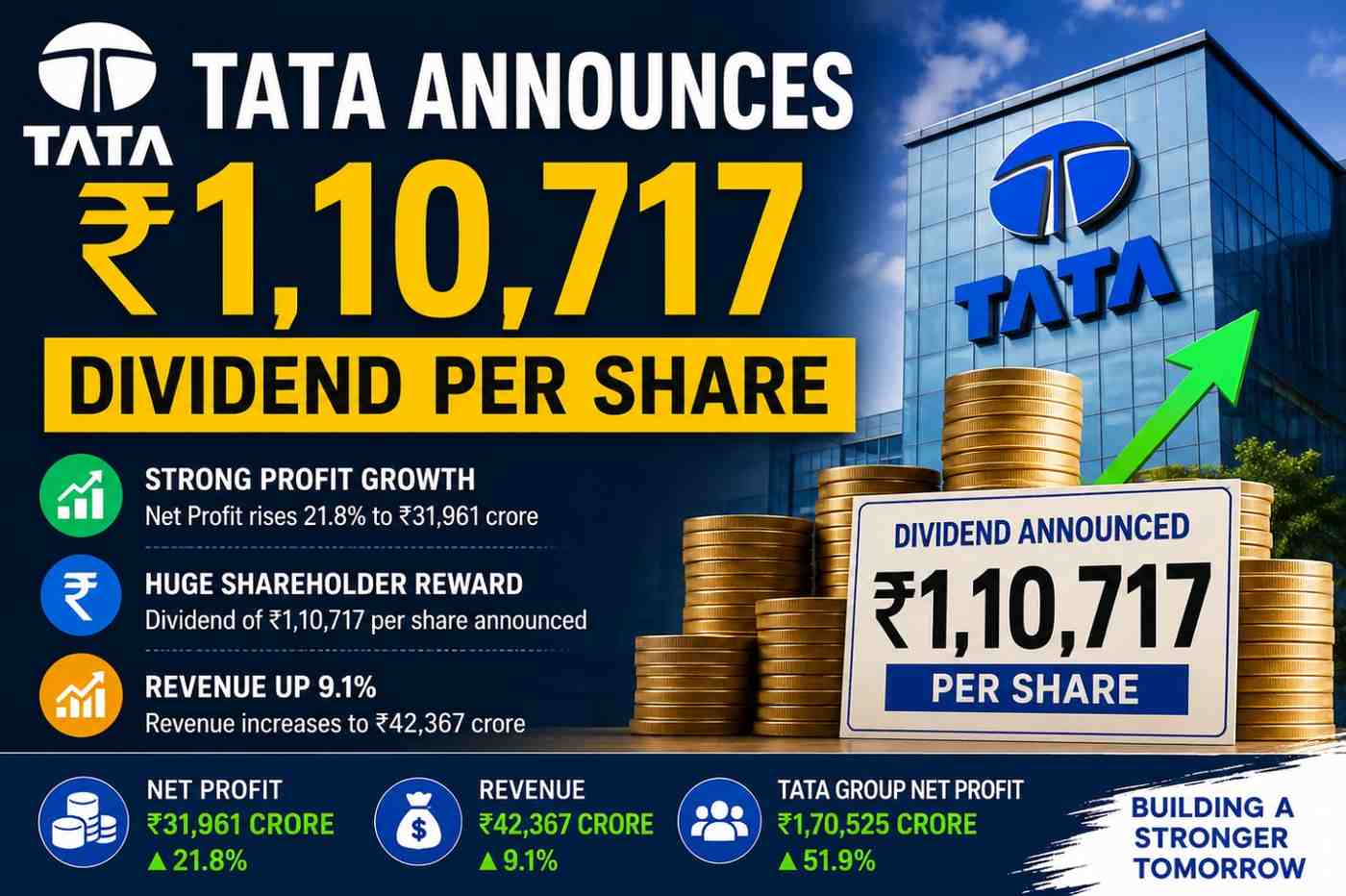
Tata Dividend : India’s largest business conglomerate, Tata Sons, has announced a dividend of ₹1,10,717 per share for its shareholders, subject to shareholder approval. 📈
The company also reported a strong financial performance for the financial year 2025-26, with net profit rising 21.8% and revenue recording healthy growth.
📌 Key Highlights
✅ Dividend announced: ₹1,10,717 per share
✅ Net Profit: ₹31,961 crore (up 21.8%)
✅ Revenue: ₹42,367 crore (up 9.1%)
✅ Tata Group Profit: ₹1,70,525 crore (up 51.9%)
📊 Tata Sons Revenue and Profit Grow Strongly
According to Tata Sons Chairman N. Chandrasekaran, the company delivered another impressive financial performance during FY2025-26.
Revenue Growth
- FY2025-26 Revenue: ₹42,367 crore
- FY2024-25 Revenue: ₹38,835 crore
- Growth: 9.1%
Net Profit Growth
- FY2025-26 Net Profit: ₹31,961 crore
- Previous Year Profit: ₹26,232 crore
- Growth: 21.8%
The Board of Directors has recommended a dividend of ₹1,10,717 per share, which will become effective after shareholder approval.
Note: Tata Sons is not listed on Indian stock exchanges. Therefore, its shares are not available for public trading.
🚀 Tata Group Delivers One of Its Best Financial Performances
The overall Tata Group also recorded exceptional growth during FY2025-26.
Tata Group Financial Performance
| Particulars | FY2025-26 | Growth |
|---|---|---|
| Revenue | ₹16,24,030 crore | 7.8% |
| Net Profit | ₹1,70,525 crore | 51.9% |
Speaking in the company’s Annual Report, N. Chandrasekaran said that despite geopolitical conflicts and record global investment in Artificial Intelligence (AI), the Tata Group maintained strong business momentum across its companies.
He stated that the group’s diversified business model and operational improvements helped deliver another year of robust earnings.
📈 Massive Growth Since FY2020
Tata Group has witnessed remarkable expansion over the past several years.
Compared to FY2019-20:
- 📊 Revenue has increased 2.1 times
- 💹 Net profit has grown 5.4 times
According to the Chairman, this growth reflects continuous improvements across multiple Tata Group businesses and long-term strategic investments.
✈️ Air India Remains Tata’s Biggest Challenge
While most Tata businesses posted strong numbers, Air India continued to face significant financial pressure.
Air India Losses Increase
| Financial Year | Loss |
|---|---|
| FY2025-26 | ₹22,238 crore |
| FY2024-25 | ₹10,859 crore |
Losses more than doubled during the financial year.
According to Chandrasekaran, several extraordinary factors affected Air India’s performance, including:
- ✈️ Rising aviation fuel prices
- 🌍 Closure of multiple international routes
- 💥 Air India Flight AI171 crash
- ⚠️ Geopolitical tensions in West Asia
Despite these setbacks, he emphasized that the airline’s long-term transformation remains on track.
He noted that building a world-class airline takes years, and significant progress has already been made in modernizing Air India’s operations, fleet, and customer experience.
📌 Key Takeaways
- 💰 Tata Sons announced a ₹1,10,717 per share dividend.
- 📈 Revenue increased 9.1% to ₹42,367 crore.
- 💹 Net profit climbed 21.8% to ₹31,961 crore.
- 🚀 Tata Group profit surged 51.9% to ₹1,70,525 crore.
- ✈️ Air India remained the biggest challenge, with losses widening to ₹22,238 crore.
Frequently Asked Questions (FAQs)
What dividend has Tata Sons announced?
Tata Sons has recommended a dividend of ₹1,10,717 per share, subject to shareholder approval.
Is Tata Sons listed on the stock market?
No. Tata Sons is a privately held company and is not listed on any stock exchange.
How much did Tata Sons’ net profit increase?
Net profit rose 21.8% to ₹31,961 crore in FY2025-26.
Why did Air India report higher losses?
Air India’s losses increased due to higher fuel costs, route disruptions, the AI171 crash, and geopolitical tensions affecting operations.
Disclaimer: This article is based on information released in Tata Sons’ FY2025-26 annual report and statements by Chairman N. Chandrasekaran. Investors should rely on official company disclosures before making investment decisions.