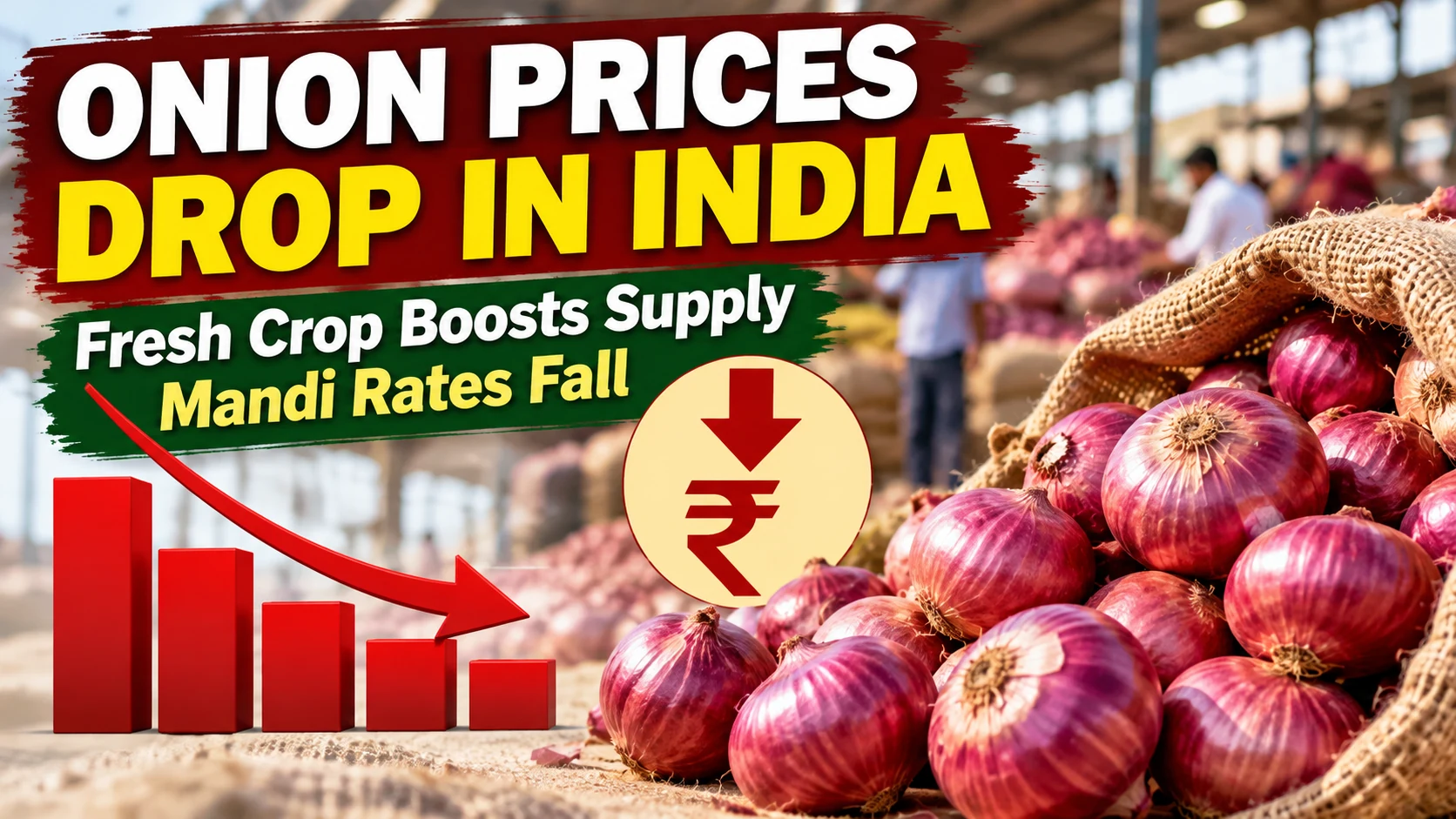
Onion Prices Drop in India: Onion prices in India are falling sharply in wholesale markets as fresh Kharif crops from major producing states increase supply. The latest decline is offering hope to households struggling with expensive vegetables, although retail prices remain relatively high in several cities.
According to an October 10 report by Dainik Jagran, wholesale onion prices have dropped by as much as 20% over approximately ten days in some markets. Fresh supplies from Karnataka, Andhra Pradesh and Madhya Pradesh are helping reduce pressure on existing stocks.
Meanwhile, additional harvests expected from Nashik in Maharashtra and Alwar in Rajasthan could improve availability further in the coming weeks.
📉 Onion Price Today: Latest Mandi Rates in India
Wholesale onion prices have recorded significant declines, particularly in Maharashtra, one of India’s major onion-producing states.
The Lasalgaon market, an important benchmark for onion trading, has witnessed a noticeable correction during October.
Latest reported onion price comparison
| Market or indicator | Earlier price | Latest reported price |
|---|---|---|
| Lasalgaon mandi, October 1–10 | ₹4,450/quintal | Below ₹3,700/quintal |
| Maharashtra weighted average, September 16–October 3 | ₹4,030/quintal | ₹3,475/quintal |
| Retail prices in some markets | — | Above ₹70/kg |
Figures reflect different reporting dates and market measures, not a single nationwide live price. Sources: Dainik Jagran and the Ministry of Consumer Affairs.
One quintal equals 100 kilograms. Therefore, a wholesale price of ₹3,700 per quintal corresponds to ₹37 per kilogram before transportation, handling, wastage and retail margins.
Consumers should remember that mandi prices and neighborhood vegetable-shop prices are different.
🌾 Why Are Onion Prices Falling in October 2026?
Several factors are contributing to the downward movement in onion prices.
1. Fresh Kharif onion harvest increases supply
New-season onions from Karnataka, Andhra Pradesh and other producing regions are entering wholesale markets.
As availability improves, traders have more purchasing options, reducing dependence on previously stored onions from Maharashtra.
2. More onions expected from Nashik and Alwar
Additional supplies from Rajasthan and Maharashtra are expected to reach markets during late October and November.
If harvesting and transportation proceed smoothly, these arrivals could place further downward pressure on wholesale rates.
3. Reduced demand for older stored onions
Fresh produce is becoming increasingly attractive to buyers and exporters.
Consequently, onions harvested earlier in the year and held in storage face greater competition, encouraging sellers to adjust their asking prices.
4. Government buffer stock releases
The central government is also increasing onion distribution to major consumption centers.
These combined developments are strengthening supply during the festive shopping season.
🚚 Government Action to Control Onion Prices
The Indian government has taken steps to improve onion availability and stabilize market prices. According to the Ministry of Consumer Affairs, onion buffer stocks have been released strategically to major consumption centers to help ease supply pressures.
These distribution measures are intended to improve onion supplies in high-demand urban markets. Additional railway movements may also help transport onions more efficiently across the country.
While improved availability could help reduce retail onion prices, authorities must also consider fair returns for farmers and the costs of transportation, storage, and distribution.
📌 Data reported: October 7, 2026. Source: Press Information Bureau, Government of India . Figures are historical and should not be interpreted as live distribution totals.
🛒 Why Are Retail Onion Prices Still High?
Despite falling wholesale rates, many consumers have not yet experienced equally large reductions at local vegetable shops.
Retail prices above ₹70 per kilogram were still being reported in some markets on October 10.
The difference between wholesale and retail prices reflects several costs, including transportation, storage, labor, spoilage and retailer margins.
There can also be a delay between wholesale price changes and retail price adjustments.
Nevertheless, the government reported retail onion price declines ranging from ₹1 to ₹21 per kilogram across 126 cities during the preceding two weeks.
This indicates that some households are already benefiting, although the improvement varies considerably by location.
📊 Onion Price Trend: What the Latest Data Shows
Maharashtra’s weighted average wholesale onion price declined between September 16 and October 3, 2026, according to India’s Ministry of Consumer Affairs. Fresh Kharif onion arrivals have helped improve market supply.
Maharashtra wholesale mandi prices | September–October 2026 | ₹ per quintal
Chart compares two reported observations. It does not represent daily price movements.
| Date | Price / Quintal | Change |
|---|---|---|
| 16 Sep 2026 | ₹4,030 | Baseline |
| 3 Oct 2026 | ₹3,475 | ↓ ₹555 |
Onion mandi prices fell by approximately ₹555 per quintal, equivalent to ₹5.55 per kg. Fresh harvest arrivals, existing stored stocks and government buffer-stock distribution are supporting market availability.
🧅 What does this mean for consumers? Lower wholesale prices may gradually translate into cheaper onions at retail shops. However, retail rates vary by city and include transport, handling and other distribution costs.
👨🌾 How Falling Onion Prices Affect Farmers
Lower onion prices can benefit consumers while creating challenges for farmers.
Growers who previously stored onions in anticipation of stronger market prices may face reduced profits when fresh supplies arrive.
Farmers also have to consider harvesting, sorting, transportation and storage expenses.
A sudden decline can be particularly difficult for producers who have already incurred substantial costs.
Maintaining an appropriate balance between consumer affordability and agricultural income is therefore essential.
🔮 Will Onion Prices Fall Further Before November?
The short-term outlook suggests that additional supplies could help prices moderate further.
The government estimates that Kharif onion cultivation area is approximately 5% higher than the previous year’s level. Favorable crop conditions also support expectations of improved availability.
However, future prices will depend on several factors: actual harvest volumes, rainfall, transportation efficiency, crop quality and retail distribution.
Unexpected weather disruptions or logistical problems could slow the decline.
Consumers should therefore treat predictions of cheaper onions as possibilities rather than guaranteed outcomes.
💡 What Should Consumers Do Now?
Households can compare prices across nearby vegetable markets, supermarkets and government-supported outlets where available.
Buying quantities appropriate for immediate household needs can help minimize spoilage.
Consumers looking for accurate daily information should check official price-monitoring services rather than relying exclusively on national averages.
❓ Frequently Asked Questions About Onion Prices in India
1. Why are onion prices falling in India?
Fresh Kharif onion arrivals, improved supply from producing states and government buffer stock releases are contributing to lower wholesale prices.
2. What is the latest Lasalgaon onion mandi rate?
According to the October 10 report, Lasalgaon prices had fallen below ₹3,700 per quintal. Actual trading rates vary by grade and transaction.
3. Are onion prices decreasing in retail markets?
Yes, although unevenly. Government data recorded reductions of ₹1–₹21 per kilogram across 126 cities over two weeks.
4. Will onion prices fall further in November 2026?
Additional harvests could increase availability and support lower prices, but weather, transportation and market demand will determine the outcome.
5. Which states are supplying fresh onions?
Karnataka, Andhra Pradesh and Rajasthan are among the important sources of fresh Kharif onion arrivals, with Maharashtra supplies expected to increase.
6. Why are retail onions more expensive than mandi onions?
Retail prices include transportation, handling, storage, wastage and seller margins. Wholesale reductions may also take time to reach consumers.
7. Where can I check daily onion prices in India?
Official consumer price-monitoring resources and agricultural mandi information portals provide market-specific updates.
✅ Conclusion
The decline in onion prices during October 2026 is an encouraging development for Indian consumers. Fresh harvests, improved market availability and government distribution measures are helping ease wholesale rates.
However, the biggest question remains how quickly lower mandi prices will translate into affordable retail prices.
With further onion arrivals expected over the coming weeks, consumers may experience additional relief, provided favorable weather and efficient distribution continue.