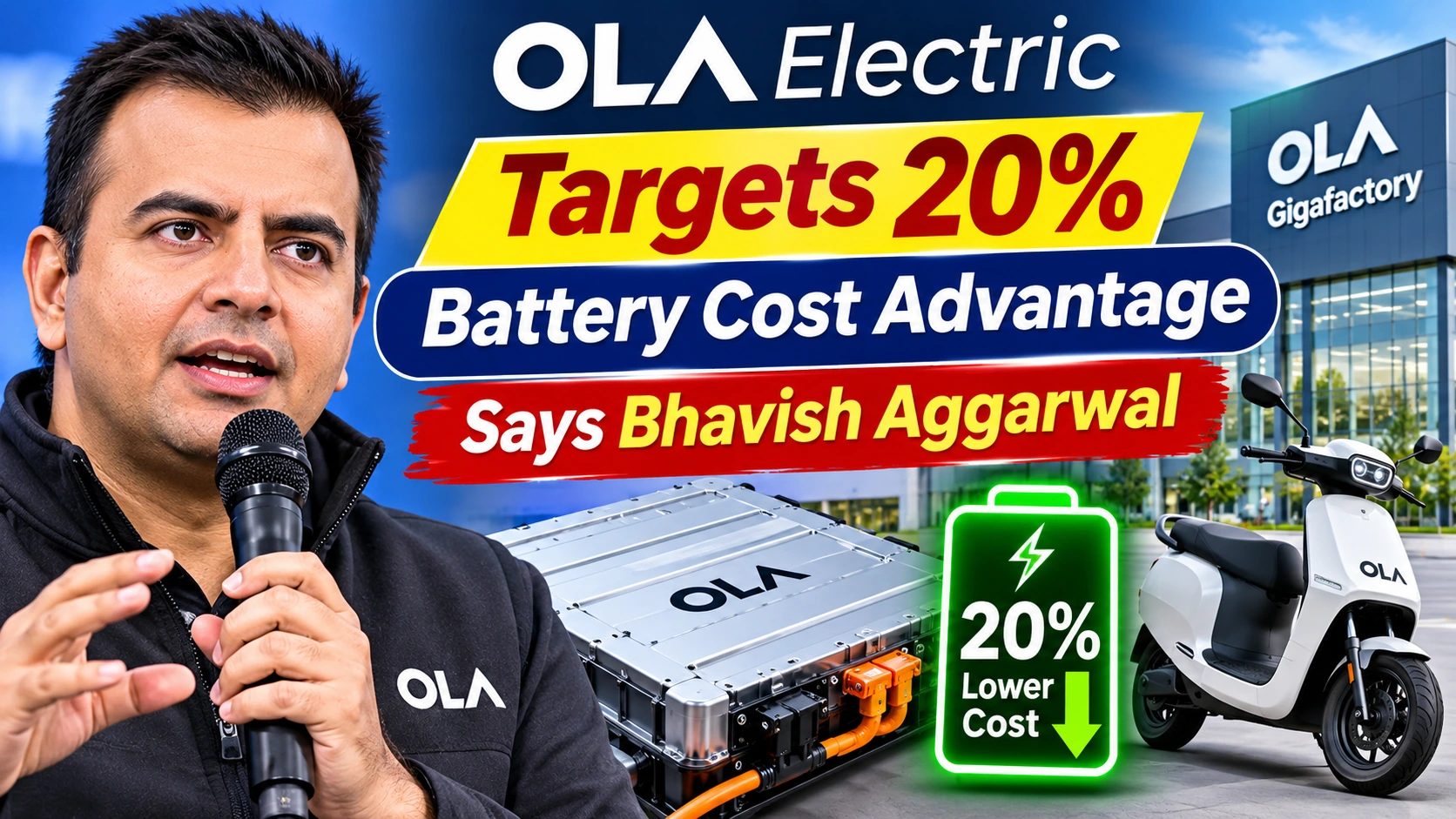
Ola Electric Battery News: Ola Electric founder and CEO Bhavish Aggarwal has revealed that the company expects to achieve approximately 20% lower battery cell costs through its in-house manufacturing strategy once production reaches the required scale. 🔋
Speaking during the company’s Q2 FY27 earnings call, Aggarwal highlighted the benefits of manufacturing battery cells internally rather than depending entirely on external suppliers.
The announcement comes as Ola Electric expands its battery gigafactory, increases domestic cell production and prepares to integrate more locally manufactured batteries into its electric scooters.
🔋 Ola Electric Targets 20% Battery Cost Advantage
Ola Electric is betting heavily on its battery manufacturing capabilities to strengthen its position in India’s competitive electric vehicle market.
According to Bhavish Aggarwal, producing battery cells internally could provide a cost advantage of approximately 20% when manufacturing reaches an efficient scale.
This projected benefit is significant because batteries represent an important component of electric vehicle manufacturing costs.
Reducing battery cell expenses could improve Ola Electric’s cost structure and provide greater flexibility in pricing its electric two-wheelers.
However, the 20% figure is a future manufacturing target rather than a saving already achieved across the company’s operations.
Actual savings will depend on production volumes, manufacturing yields, raw material prices and factory efficiency.
The company’s strategy focuses on controlling more of its battery supply chain while reducing dependence on outside manufacturers.
🔋 Ola Electric Battery Cost Advantage
Illustrative comparison based on company projections. External procurement cost is indexed at 100.
📊 Ola Electric Battery Manufacturing Facts
| Metric | Reported Figure |
|---|---|
| Installed Capacity | 6 GWh |
| Recently Added Capacity | 3.5 GWh |
| Planned NMC Share | 30% |
| Planned LFP Share | 70% |
| FY28 Auto Cell Consumption | 2–3 GWh projected |
| Long-Term Capacity Goal | 20 GWh |
Note: Targets are forward-looking company estimates. Actual savings depend on manufacturing scale, yields and costs.
⚡ Ola Electric Gigafactory Reaches 6 GWh Capacity
A major part of Ola Electric’s battery strategy is the expansion of its gigafactory.
The company recently commissioned an additional 3.5 GWh of battery cell manufacturing capacity, taking its total capacity to approximately 6 GWh.
This development provides a larger manufacturing base for increasing production of its own cells.
However, installed capacity should not be confused with actual production output.
A factory capable of producing 6 GWh annually does not necessarily manufacture that quantity immediately.
Production must increase gradually as equipment is commissioned, manufacturing processes stabilise and cell yields improve.
Ola Electric intends to expand utilisation of the facility while integrating more internally produced cells into its vehicles.
The company has also discussed a longer-term ambition to increase its manufacturing capacity to 20 GWh.
For now, its immediate priority is stabilising the existing 6 GWh capacity before undertaking further expansion.
🚗 NMC and LFP Battery Cells: Ola’s Manufacturing Strategy
Ola Electric plans to use two major lithium-ion battery chemistries in its automotive business.
These are nickel manganese cobalt (NMC) and lithium iron phosphate (LFP).
Both technologies have different characteristics and can serve different product requirements.
What Are NMC Battery Cells?
NMC batteries use a cathode chemistry containing nickel, manganese and cobalt.
They are commonly associated with relatively high energy density, making them useful for electric vehicles where battery weight, size and driving range are important considerations.
Ola Electric plans to increase the integration of its internally manufactured NMC cells into its automotive products during Q3 FY27.
The company has indicated that NMC cells will account for approximately 30% of its automotive battery cell requirements in its planned product mix.
What Are LFP Battery Cells?
LFP batteries use lithium iron phosphate cathode chemistry.
They are known for thermal stability, durability and the absence of nickel and cobalt in the cathode.
These characteristics can make LFP attractive for cost-sensitive electric mobility applications.
Ola Electric expects to increase LFP cell production and integrate the technology into its vehicles around the end of Q4 FY27 or the beginning of FY28.
Under its planned battery strategy, approximately 70% of the automotive business would use LFP cells.
The proposed combination would allow the company to match battery chemistry with different product requirements.
📊 How Battery Manufacturing Could Reduce Ola Electric’s Costs
Battery manufacturing efficiency depends on more than the number of cells produced.
One important factor is manufacturing yield.
Yield refers to the proportion of manufactured cells that meet the required quality standards and can be used commercially.
Higher yields reduce material wastage and spread production expenses across more usable cells.
Ola Electric has indicated that its LFP manufacturing costs could reach parity with externally purchased cells at approximately 70% yield.
At around 85% yield, the company estimates potential savings of 10–15% compared with external procurement.
Aggarwal’s broader estimate of approximately 20% cost advantage assumes manufacturing reaches the appropriate scale.
These figures describe different production conditions and should not be interpreted as identical milestones.
For Ola Electric, improving yields and increasing factory utilisation will be critical to achieving its cost targets.
🏭 Why Vertical Integration Matters for Ola Electric
Vertical integration is central to Ola Electric’s manufacturing strategy.
Instead of purchasing every major component from external suppliers, the company aims to design and manufacture more components internally.
Aggarwal has said that Ola Electric’s bill of materials is already approximately 15–20% lower than that of certain competitors.
The bill of materials, commonly called BOM, represents the cost of components and materials required to manufacture a product.
The company attributes its claimed advantage to internal engineering, integrated product design and reduced reliance on Tier 1 suppliers.
Ola Electric believes that combining its in-house battery cells with its upcoming Gen 4 platform could further reduce manufacturing expenses.
However, the claimed BOM advantage and the projected 20% battery cell cost advantage are different measures.
They should not be added together to calculate an overall vehicle cost reduction.
🇮🇳 What Does This Mean for India’s Electric Vehicle Industry?
Domestic battery cell manufacturing is becoming increasingly important for India’s electric mobility sector.
Electric vehicle manufacturers have traditionally depended on imported battery cells for a significant portion of their requirements.
Developing domestic production capabilities could help companies gain more control over supply chains, product development and manufacturing costs.
Ola Electric’s battery strategy represents an attempt to establish a stronger domestic manufacturing base.
If the company successfully increases production and achieves competitive costs, it could strengthen its ability to manufacture electric vehicles using locally produced cells.
The development may also encourage greater investment in battery technology, production equipment and supporting supply chains.
However, building a competitive domestic battery industry requires consistent quality, reliable raw material sourcing, strong manufacturing yields and substantial capital investment.
💰 Can Cheaper Battery Cells Make Ola Scooters More Affordable?
Lower battery cell manufacturing costs could eventually support more competitive electric scooter pricing.
However, a 20% reduction in battery cell costs does not mean that the retail price of an Ola electric scooter will fall by 20%.
A vehicle’s final price includes several expenses beyond battery cells.
These include motors, electronics, chassis components, assembly, logistics, research and development, distribution and applicable taxes.
Companies may also choose to retain some manufacturing savings to improve profitability rather than passing the entire benefit to customers.
Therefore, while Ola Electric’s battery strategy could improve its cost competitiveness, any future retail price reduction would depend on separate commercial decisions.
🔮 Ola Electric’s Future Battery Manufacturing Roadmap
Ola Electric expects battery cell production to increase as it integrates its own technology into more products.
The company plans to prioritise automotive applications while also developing opportunities in battery energy storage.
Its Shakti energy storage portfolio represents another potential source of demand for internally manufactured cells.
Aggarwal has indicated that Ola Electric expects its automotive business to consume approximately 2–3 GWh of battery cell capacity in FY28.
The company has also discussed expanding its gigafactory capacity from 6 GWh to 20 GWh over the longer term.
However, further expansion will depend on stabilising existing operations and arranging additional investment.
The immediate focus remains on improving manufacturing yields, increasing utilisation and integrating cells into commercially available products.
⭐ Key Highlights of Ola Electric’s Battery Strategy
- 🔋 Ola Electric targets approximately 20% lower battery cell costs at efficient manufacturing scale.
- ⚡ Its gigafactory has reached 6 GWh of installed cell manufacturing capacity.
- 🚗 The planned automotive cell mix is approximately 30% NMC and 70% LFP.
- 📊 Manufacturing yield improvements are important for reducing production costs.
- 🏭 The company aims to increase vertical integration and reduce reliance on external suppliers.
- 🇮🇳 Domestic cell production could support India’s electric vehicle manufacturing ecosystem.
- 💰 Lower manufacturing costs may improve margins or pricing flexibility, but retail price reductions are not guaranteed.
- 🔮 Ola Electric has a longer-term roadmap to expand cell manufacturing capacity to 20 GWh.
❓ Frequently Asked Questions (FAQs)
1. What is Ola Electric’s expected battery cost advantage?
Bhavish Aggarwal has said Ola Electric could achieve approximately 20% lower battery cell costs by manufacturing cells internally at an efficient production scale.
2. Has Ola Electric already achieved 20% lower battery costs?
No. The figure represents a projected cost advantage at the required manufacturing scale, not a company-wide saving already realised.
3. What is Ola Electric’s current gigafactory capacity?
Ola Electric has reported approximately 6 GWh of installed battery cell manufacturing capacity following the commissioning of an additional 3.5 GWh.
4. Which battery technologies will Ola Electric use?
The company plans to use both NMC and LFP lithium-ion cells, with an intended automotive mix of approximately 30% NMC and 70% LFP.
5. Will Ola electric scooters become 20% cheaper?
Not necessarily. The estimated saving relates to battery cell manufacturing costs, not the complete vehicle’s retail price.
6. When will Ola Electric integrate its LFP cells?
The company expects to increase LFP cell production and integrate them into vehicles around the end of Q4 FY27 or early FY28, subject to manufacturing progress.
7. Will Ola Electric expand its gigafactory to 20 GWh?
Ola Electric has identified 20 GWh as a longer-term capacity objective. Its immediate priority is stabilising the existing 6 GWh manufacturing base.
✅ Conclusion
Ola Electric’s plan to achieve an approximately 20% battery cell cost advantage highlights the growing importance of domestic manufacturing in India’s electric vehicle industry.
By expanding its gigafactory, developing NMC and LFP cells, and increasing vertical integration, the company aims to gain greater control over production costs and battery supply.
However, achieving the targeted savings will require consistent improvements in manufacturing scale, yield and efficiency.
If successful, the strategy could strengthen Ola Electric’s cost competitiveness and support its broader ambitions in electric mobility and energy storage.
For customers and industry observers, the key developments to watch will be actual cell production, vehicle integration, manufacturing yields and whether lower costs eventually translate into improved affordability.