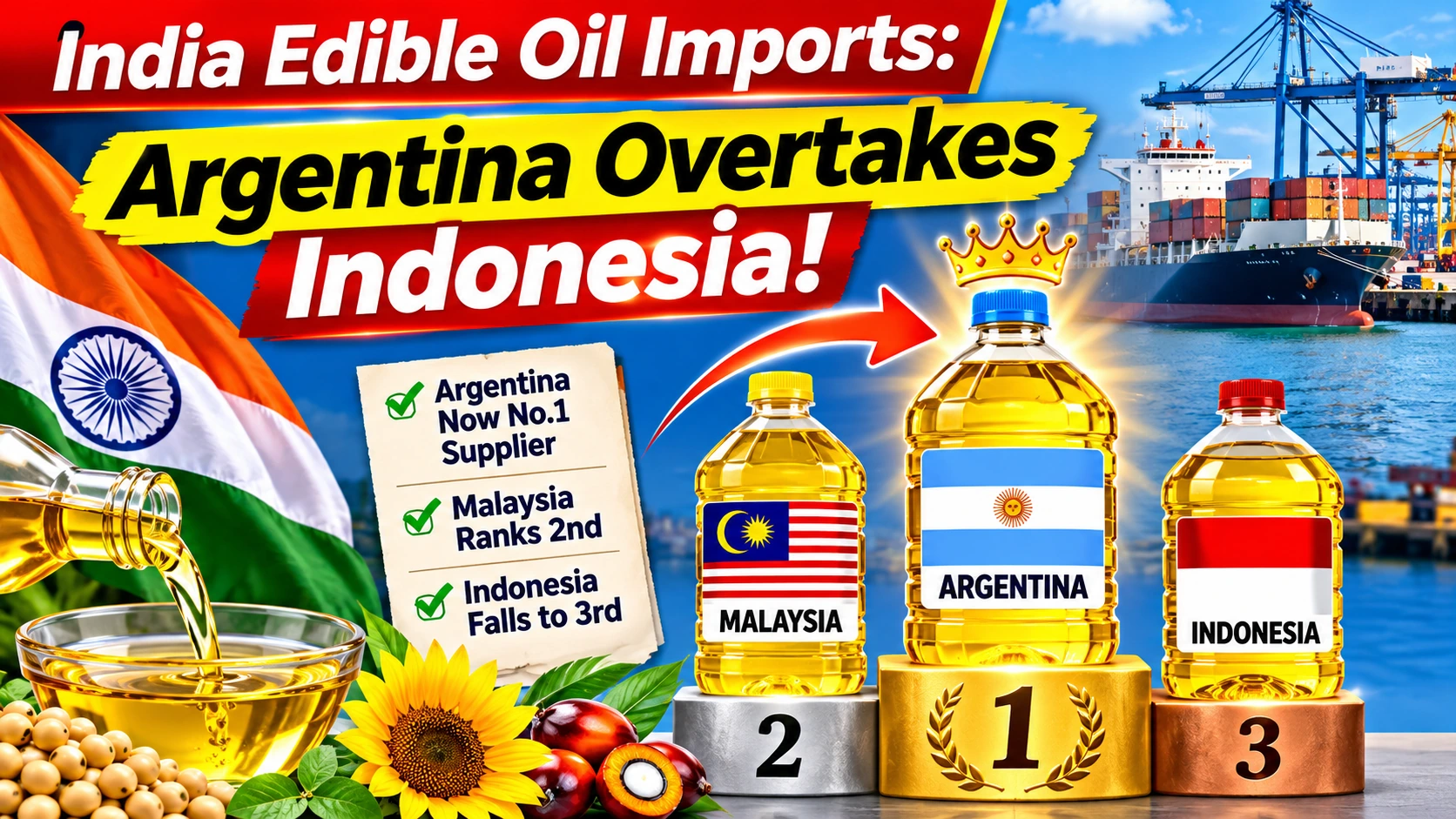
India Edible Oil Imports: India’s cooking oil import market has witnessed a major transformation as Argentina overtakes Indonesia to become the country’s largest vegetable oil supplier. Malaysia has secured second place, pushing Indonesia, which dominated India’s edible oil imports for decades, into third position.
According to the United States Department of Agriculture (USDA) Foreign Agricultural Service report released on November 10, the shift reflects changing global supply patterns, Indonesia’s expanding biodiesel programme, and competitive soybean oil prices from Argentina.
The development is particularly significant because India is the world’s largest importer of vegetable oils and depends heavily on international markets to meet domestic demand.
With India’s total vegetable oil imports forecast to reach a record 17.39 million metric tonnes in 2026–27, the changing supplier landscape could influence trade relationships, import costs, and future cooking oil prices.
🚨 Argentina Becomes India’s Largest Edible Oil Supplier
For decades, Indonesia maintained a dominant position in India’s vegetable oil import market, primarily because of its massive palm oil production and export capacity.
However, the situation has changed considerably.
During the 2025–26 marketing year, which runs from October to September, Argentina emerged as India’s largest vegetable oil supplier, followed by Malaysia and Indonesia.
The shift has been driven by rising Indian demand for competitively priced soybean oil and reduced availability of Indonesian palm oil for international buyers.
Argentina’s expanding presence also reflects India’s willingness to diversify its edible oil purchases rather than depend excessively on one exporting country.
Other suppliers, including Brazil, Thailand, Nepal, and China, are also playing increasingly important roles in regional and international vegetable oil trade.
India Edible Oil Imports: 2026–27 Forecast
USDA forecast comparison in million metric tonnes (MMT)
Total vegetable oil imports
16.85 → 17.39 MMT (+3.2%)Source: USDA Foreign Agricultural Service, November 2026. Figures are estimates and forecasts. Bar scale: 10 MMT maximum.
🌴 Why Has Indonesia Fallen to Third Place?
Indonesia remains the world’s largest palm oil exporter, but its domestic energy policies are changing the amount of oil available for overseas markets.
The country has expanded its biodiesel blending requirements, encouraging greater use of palm oil in fuel production.
Biodiesel is a renewable fuel that can be produced from vegetable oils and other feedstocks.
When more palm oil is directed toward domestic fuel manufacturing, less may be available for export.
According to USDA projections, Indonesia’s domestic palm oil consumption is expected to increase from 19.13 million tonnes in 2022–23 to 23.38 million tonnes in 2026–27.
Meanwhile, Indonesian palm oil exports are forecast to decline from 25.03 million tonnes in 2025–26 to 21.60 million tonnes in 2026–27.
This represents a projected decline of approximately 13.7%.
The changing balance between domestic demand and exports has helped other countries capture a larger share of India’s vegetable oil market.
🇦🇷 How Argentina Became India’s Leading Supplier
Argentina’s rise is closely connected to its strong soybean-processing industry and competitive international prices.
The country is a major producer and exporter of soybean oil, which is widely used in Indian households and food manufacturing.
Recent reductions in Argentine export taxes have helped make its soybean oil more attractive to international buyers.
As Indonesian palm oil supplies become more constrained, Indian importers have increasingly looked toward alternative vegetable oils and suppliers.
Argentina has also strengthened its position in India’s sunflower oil market.
Since July 2026, Argentina has been India’s leading sunflower oil supplier, according to USDA reporting.
Competitive prices have helped India approximately double its sunflower oil purchases from Argentina compared with the previous marketing year.
These developments have made Argentina an increasingly important partner in India’s edible oil supply chain.
🇲🇾 Malaysia and Thailand Gain From Indonesia’s Changing Policy
Malaysia has emerged as India’s second-largest vegetable oil supplier, supported by improved palm oil production and competitive pricing.
Thailand has also increased shipments to India.
Both countries benefited from stronger production compared with the previous year and opportunities created by Indonesia’s changing export availability.
For Indian importers, having multiple palm oil suppliers provides greater flexibility when negotiating purchases.
However, supply diversification does not eliminate exposure to global price volatility.
Weather conditions, international demand, currency movements, and government policies can still influence the cost of imported edible oils.
📊 India Edible Oil Import Forecast for 2026–27
USDA forecasts suggest that India’s vegetable oil import requirements will continue increasing.
Total imports are projected to rise from 16.85 million tonnes in 2025–26 to 17.39 million tonnes in 2026–27.
This would represent an increase of approximately 3.2%.
The expected changes differ across major edible oil categories.
| Edible oil category | 2025–26 | 2026–27 forecast |
|---|---|---|
| Palm oil | 8.10 million tonnes | 8.40 million tonnes |
| Soybean oil | 5.60 million tonnes | 5.00 million tonnes |
| Sunflower oil | 3.00 million tonnes | 3.85 million tonnes |
| Total vegetable oil imports | 16.85 million tonnes | 17.39 million tonnes |
Figures are USDA estimates and forecasts. The total includes vegetable oil categories beyond the three individually listed.
Sunflower oil imports are expected to register particularly strong growth as global sunflower seed supplies improve.
Palm oil imports are also forecast to rise moderately, although international availability could limit expansion.
Soybean oil imports, meanwhile, may decline because of tighter export supplies.
💰 Will Cooking Oil Prices Increase in India?
The changing import pattern raises an important question for Indian households: will cooking oil become more expensive?
The answer depends on several factors.
International vegetable oil prices are influenced by production levels, demand, freight charges, exchange rates, and government import duties.
Indonesia’s declining palm oil exports could tighten global supplies and place upward pressure on prices if demand remains strong.
However, competitive soybean oil shipments from Argentina and increased palm oil supplies from Malaysia and Thailand may help offset some of that pressure.
India’s retail cooking oil prices will also depend on domestic inventories, refining costs, and competition among suppliers.
Therefore, Argentina becoming the largest supplier does not automatically mean that edible oil prices will rise or fall.
Consumers should monitor actual retail price trends rather than assume an immediate impact from changes in supplier rankings.
🌏 Nepal and China Emerge as Important Suppliers
India’s edible oil trade is also being reshaped by smaller and emerging suppliers.
Nepal has benefited from preferential trade arrangements under the South Asian Free Trade Agreement (SAFTA).
Some soybean oil imported by India from Nepal originates in Argentina, is refined in Nepal, and is subsequently exported to India.
This illustrates how regional refining operations can influence international trade flows.
China has also expanded its soybean oil exports.
USDA estimates indicate that Chinese soybean oil exports could reach 1.08 million tonnes in 2025–26, compared with 318,000 tonnes in 2024–25.
The increase highlights China’s growing importance in the global soybean-processing and vegetable oil markets.
🌍 Global Palm Oil Exports Expected to Decline
The effects of Indonesia’s biodiesel policy extend beyond India.
USDA forecasts global palm oil exports to fall from 46.76 million tonnes in 2025–26 to 43.75 million tonnes in 2026–27.
That represents a projected decline of approximately 6.4%.
Reduced Indonesian exports are expected to be a major contributor.
For international buyers, the development highlights the growing relationship between renewable fuel policies and food commodity markets.
When vegetable oils are used more extensively for energy production, their availability for food-related purposes can change.
As a result, government decisions in major producing countries may have consequences for importers thousands of kilometres away.
🔮 What Does This Mean for India’s Edible Oil Industry?
India’s changing supplier rankings underline the importance of a diversified import strategy.
Argentina’s rise provides access to competitive soybean and sunflower oil supplies, while Malaysia and Thailand offer alternative sources of palm oil.
For edible oil refiners, food manufacturers, and importers, greater supplier diversity can create opportunities to manage procurement risks.
Nevertheless, India’s dependence on international vegetable oil markets remains a major challenge.
Increasing domestic oilseed production, improving processing infrastructure, and strengthening agricultural productivity could help reduce long-term import dependence.
The immediate outlook will depend on global production, trade policies, biodiesel demand, and international commodity prices.
❓ Frequently Asked Questions
1. Which country is India’s largest edible oil supplier in 2026?
Argentina became India’s largest vegetable oil supplier in the 2025–26 marketing year, overtaking Indonesia. Malaysia ranked second, while Indonesia fell to third.
2. Why has Indonesia lost its leading position?
Indonesia’s expanding biodiesel blending requirements have increased domestic palm oil consumption, reducing the quantity available for export.
3. How much edible oil will India import in 2026–27?
USDA forecasts India’s total vegetable oil imports at approximately 17.39 million metric tonnes in 2026–27, compared with 16.85 million tonnes in 2025–26.
4. Why is India importing more oil from Argentina?
Competitive soybean oil prices, changes in Argentine export taxes, and growing sunflower oil shipments have strengthened Argentina’s position in India’s market.
5. Will edible oil prices rise in India?
Not necessarily. Prices will depend on international supply, demand, exchange rates, import duties, freight costs, and domestic market conditions.
6. Which edible oil imports are expected to grow fastest?
Among the major categories, sunflower oil imports are forecast to grow strongly, rising from 3.00 million tonnes in 2025–26 to 3.85 million tonnes in 2026–27.
🏁 Conclusion: India’s Cooking Oil Trade Enters a New Phase
India’s edible oil import market is undergoing a significant transformation as Argentina replaces Indonesia as its largest vegetable oil supplier.
Indonesia’s biodiesel expansion, Argentina’s competitive soybean oil exports, and Malaysia’s growing palm oil shipments are reshaping long-established trade relationships.
With imports projected to reach a record level in 2026–27, India will remain highly sensitive to developments in international vegetable oil markets.
For consumers, businesses, and policymakers, the most important factors to watch are global supply conditions, import prices, and India’s progress toward strengthening domestic edible oil production.