US Inflation October 2026: American consumer prices are expected to increase at a slower pace in October, offering some relief after September’s sharp inflation surge. However, persistent price pressures across housing, services, and essential goods could keep the Federal Reserve on track to raise interest rates in December.
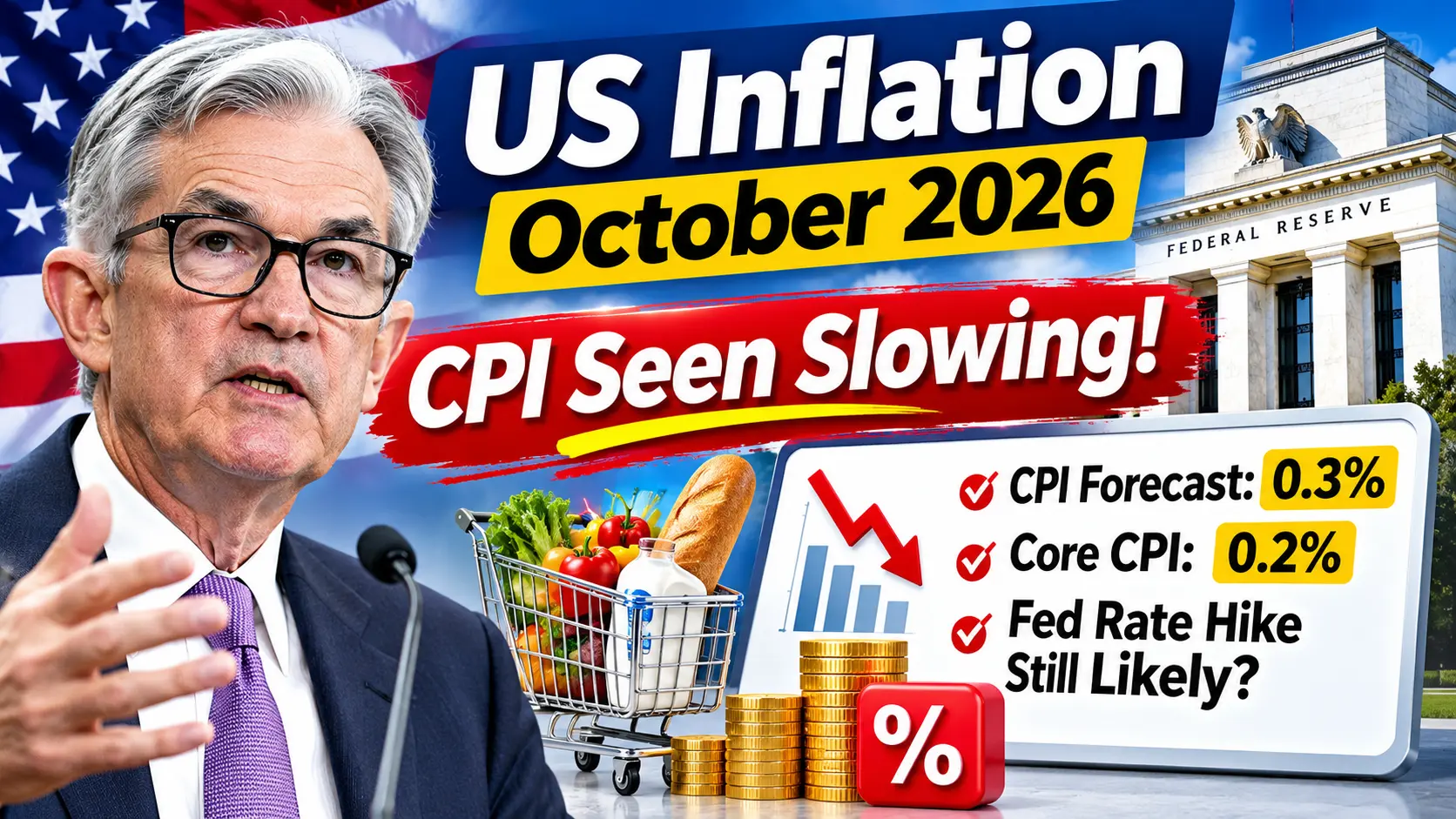
According to economists surveyed by Reuters, the US Consumer Price Index (CPI) is forecast to increase 0.3% in October 2026, compared with a 0.6% rise in September.
Meanwhile, core inflation, which excludes volatile food and energy prices, is expected to ease to 0.2% from September’s 0.3%.
Despite the anticipated monthly slowdown, inflation remains a significant challenge for American households and policymakers.
The upcoming CPI report could provide important clues about the future direction of interest rates, consumer spending, and financial markets.
📊 US Inflation October 2026: Key CPI Forecasts
Economists expect October’s inflation report to show slower monthly price increases, largely because of declining gasoline prices.
However, the improvement may not be enough to convince the Federal Reserve that inflation is under control.
| Inflation Indicator | September 2026 | October 2026 Forecast |
|---|---|---|
| Headline CPI, Monthly | 0.6% | 0.3% |
| Core CPI, Monthly | 0.3% | 0.2% |
| Headline CPI, Annual | 3.7% | 3.9% estimated |
| Core CPI, Annual | 2.6% | 2.7% estimated |
| Federal Reserve Inflation Target | 2% | 2% |
| Fed Benchmark Rate | 3.75%–4.00% | 3.75%–4.00% |
Important: October’s annual inflation figures are economists’ estimates rather than official Bureau of Labor Statistics readings.
🔥 Why US Inflation Is Expected to Slow in October
One of the biggest factors behind the anticipated moderation in inflation is the decline in retail gasoline prices.
According to energy market data, gasoline prices fell approximately 0.9% in October compared with September before seasonal adjustment.
This followed a substantial increase in gasoline prices during September.
Because energy costs directly influence the headline Consumer Price Index, lower gasoline prices can reduce the overall monthly inflation reading.
However, the broader inflation picture remains complicated.
Oil prices have experienced considerable volatility amid geopolitical tensions involving Iran, while import tariffs continue to contribute to higher costs for certain products.
Economists also expect food prices to increase after remaining unchanged in September.
Consequently, the anticipated slowdown does not necessarily mean that the cost of living is falling.
It simply indicates that consumer prices may be rising more slowly than during the previous month.
💰 Core Inflation Expected to Ease to 0.2%
Core inflation is one of the most closely watched indicators in the US CPI report.
Unlike headline inflation, core CPI excludes food and energy prices, which can fluctuate significantly from month to month.
Economists expect core consumer prices to increase 0.2% in October, compared with 0.3% in September.
Lower airfare inflation could contribute to the moderation.
However, several service-related categories remain under pressure.
Hotel accommodation costs, housing expenses, and owners’ equivalent rent continue to present challenges.
Owners’ equivalent rent estimates the rental value of owner-occupied homes and is an important component of US inflation calculations.
Healthcare insurance adjustments could also influence the October core CPI reading.
Meanwhile, growing investment in artificial intelligence infrastructure may contribute to higher prices for certain information technology products.
These developments suggest that underlying inflation pressures have not completely disappeared.
🏠 Housing and Food Prices Remain a Concern
Although gasoline prices may provide temporary relief, many American households continue to face elevated living expenses.
Housing remains a particularly important factor because shelter costs account for a substantial share of the Consumer Price Index.
Persistent rental inflation can keep overall price growth elevated even when energy costs decline.
Food prices are another concern.
Economists expect grocery and other food-related prices to increase in October after remaining broadly unchanged in September.
For households managing tight budgets, even modest increases in essential expenses can create financial pressure.
The distinction between slower inflation and falling prices is important.
A lower inflation rate means prices are increasing more slowly. It does not mean consumers are necessarily paying less than before.
🏦 Federal Reserve December Rate Hike Expectations Rise
The October CPI report arrives at a critical moment for US monetary policy.
The Federal Reserve has been attempting to control inflation while balancing economic growth and financial stability.
Its inflation objective remains 2%, measured using the Personal Consumption Expenditures price index.
However, the Federal Reserve’s preferred inflation measures remain above 3%, indicating that price pressures are still elevated.
At its previous meeting, the central bank maintained its benchmark interest rate within the 3.75%–4.00% range.
Financial markets were pricing in approximately an 85% probability of a December interest rate increase late on November 9.
Economists believe that a modest slowdown in October CPI may not be sufficient to change the central bank’s expected policy direction.
Nevertheless, the Federal Reserve’s eventual decision will depend on incoming economic information, financial conditions, and policymakers’ assessment of inflation risks.
📉 Why the October CPI Report Will Be Unusual
The October 2026 inflation report will contain an unusual statistical limitation.
The Bureau of Labor Statistics will not publish its normal year-over-year CPI comparisons because the federal government shutdown in October 2025 prevented the collection of the necessary consumer price data.
Without an official October 2025 comparison base, standard annual CPI calculations cannot be produced.
Economists have developed alternative estimates using surrounding months and independent data.
Some estimate that headline inflation reached approximately 3.9% annually in October, while core inflation was around 2.7%.
However, these calculations should not be confused with official annual CPI statistics.
The missing comparison data do not affect the Federal Reserve’s preferred Personal Consumption Expenditures inflation measures in the same way.
📈 How the US CPI Report Could Affect Stock Markets
Inflation data can influence stock prices, government bond yields, and expectations for Federal Reserve policy.
A lower-than-expected CPI reading could encourage investors who believe inflation pressures are easing.
Technology companies and other interest-rate-sensitive businesses may respond positively if markets reduce expectations for future monetary tightening.
Conversely, stronger-than-expected inflation could reinforce expectations of higher interest rates.
Higher borrowing costs can affect business investment, household spending, and financial asset valuations.
However, market reactions depend on more than one economic report.
Investors will also consider employment data, corporate earnings, geopolitical developments, and overall financial conditions.
🇺🇸 What Slower Inflation Means for American Consumers
For American households, a slowdown in inflation could offer limited financial relief.
Lower gasoline prices may reduce transportation expenses, while slower increases in other categories could help consumers manage monthly budgets.
However, elevated housing, food, and service costs remain significant concerns.
Interest rate increases could also affect consumers through more expensive borrowing.
Credit card rates, variable-rate loans, and some other financing costs may remain elevated if monetary policy becomes more restrictive.
Mortgage rates do not move automatically with the Federal Reserve’s benchmark rate, but they can respond to inflation expectations and broader financial market conditions.
Therefore, consumers should distinguish between a slowing inflation rate and an actual reduction in living expenses.
❓ US Inflation October 2026: Frequently Asked Questions
1. What is the expected US inflation rate for October 2026?
Economists expect headline CPI to increase 0.3% month over month in October, compared with a 0.6% increase in September.
2. What is the October 2026 core CPI forecast?
Core CPI is forecast to rise 0.2% in October, down from 0.3% in September. Core inflation excludes food and energy prices.
3. Will the Federal Reserve raise interest rates in December 2026?
Financial markets were pricing in approximately an 85% probability of a December rate hike as of late November 9. However, no future interest rate decision is guaranteed.
4. Why are official annual CPI figures unavailable for October 2026?
The October 2025 federal government shutdown interrupted the collection of consumer price data, leaving the Bureau of Labor Statistics without the necessary comparison base.
5. Does lower inflation mean prices are falling?
No. Lower inflation means prices are increasing at a slower rate. Prices can remain elevated even when the inflation rate declines.
✅ Conclusion: US Inflation May Cool, but Economic Risks Remain
The US Inflation October 2026 outlook suggests that consumer price increases may have slowed after September’s sharp acceleration.
Economists forecast headline CPI growth of 0.3% and core CPI growth of 0.2%, with declining gasoline prices contributing to the anticipated improvement.
However, persistent housing costs, food prices, and service-sector inflation continue to challenge the Federal Reserve’s efforts to restore price stability.
With financial markets expecting another possible interest rate increase in December, the October CPI report remains an important indicator for investors, businesses, and American households.
The key question is whether slower monthly inflation represents a lasting improvement or merely temporary relief from elevated price pressures.
The official CPI release will provide the next important evidence about the direction of the US economy.