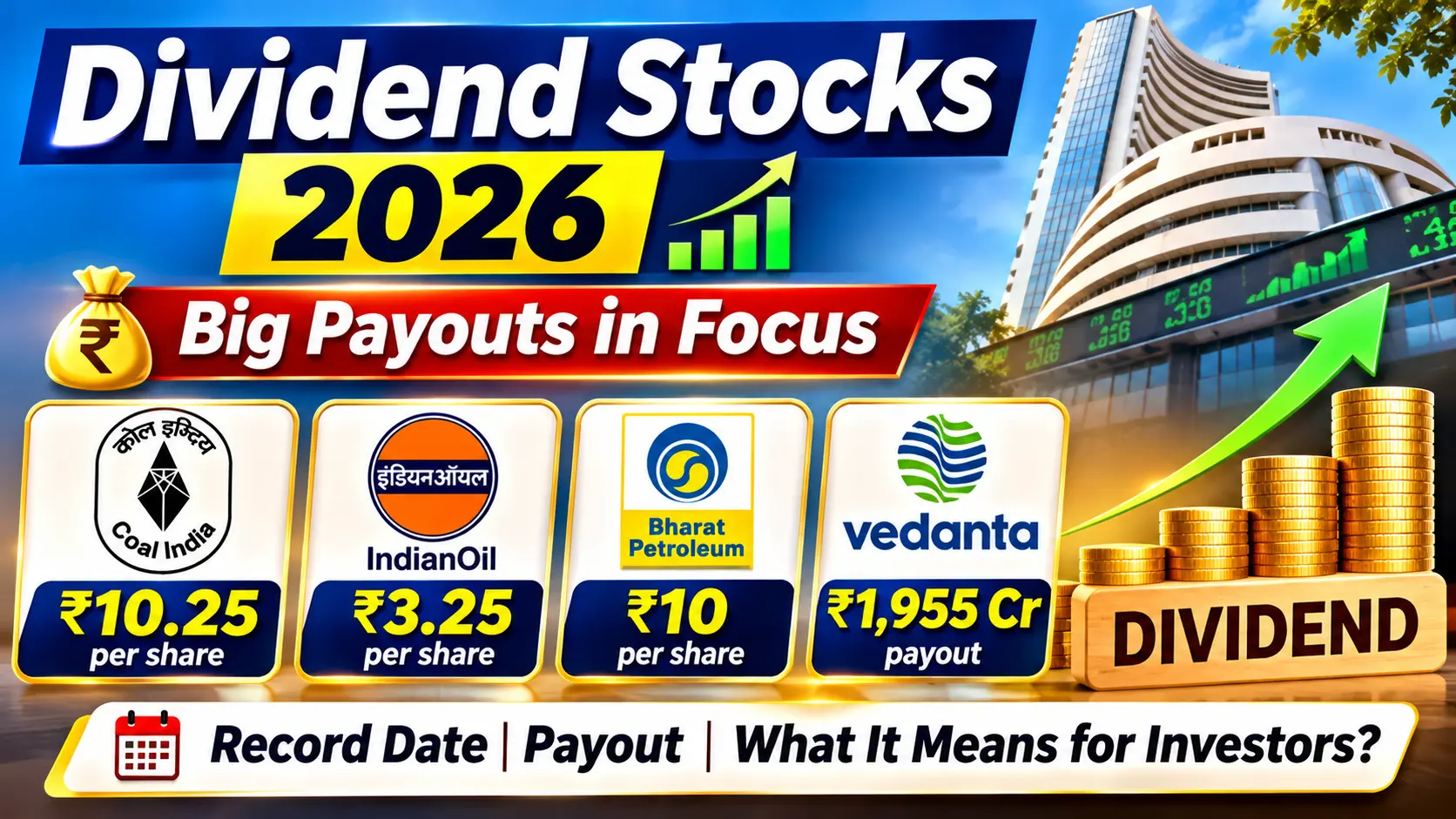
Dividend Stocks 2026: Indian stock market investors are closely watching dividend-paying companies, particularly Coal India, Indian Oil Corporation (IOCL), Bharat Petroleum Corporation Limited (BPCL) and Vedanta, as cash payouts attract attention amid market volatility.
As of 9 November 2026, Coal India’s latest interim dividend of ₹10.25 per share has become a major talking point. Meanwhile, dividend distributions by other energy and natural-resource companies have highlighted the importance of shareholder returns beyond share-price appreciation.
For investors seeking regular income, understanding dividend amounts, record dates, eligibility requirements and payout sustainability is essential.
📈 Dividend Stocks 2026: Key Highlights
Several major Indian companies have rewarded shareholders through dividend distributions during 2026.
| Company | Reported 2026 dividend information | Key detail |
|---|---|---|
| Coal India | ₹26.50 per share across four payouts | Latest ₹10.25 interim dividend |
| IOCL | ₹3.25 per share reported for 2026 | Oil marketing PSU |
| BPCL | ₹10 per share reported for 2026 | Petroleum-sector dividend |
| Vedanta | ₹1,955 crore FY27 interim payout reported | Per-share amount needs verification |
| ONGC | ₹7.25 per share reported for 2026 | Ex-dividend date: 12 November |
Note: The figures refer to reported distributions during 2026 or the relevant financial-year period, not necessarily the same accounting year. They should not be interpreted as current dividend yields or guaranteed future payouts.
💰 Coal India Dividend 2026: ₹10.25 Interim Payout
Coal India Limited remains one of the prominent dividend-paying public-sector companies in India.
The company declared an interim dividend of ₹10.25 per equity share, with 4 November 2026 fixed as both the record date and ex-dividend date.
The dividend was approved on 29 October 2026, and the company indicated that payment would be made on or before 27 November 2026.
This latest distribution follows other dividend payments during the year.
Coal India’s reported 2026 payouts include ₹5.50 in February, ₹5.50 in July, ₹5.25 associated with the September ex-dividend date, and ₹10.25 in November.
Together, these distributions amount to ₹26.50 per share.
📊 Dividend Stocks India 2026
Coal India, IOCL, BPCL, Vedanta & ONGC
| Company | Dividend Information | Record Date | Status |
|---|---|---|---|
| Coal India | ₹10.25/share | 4 Nov 2026 | Interim declared |
| IOCL | ₹1.25/share final | 14 Aug 2026 | Earlier payout reported |
| BPCL | ₹10/share reported for 2026 | Not confirmed here | Check corporate action |
| Vedanta | ₹1,955 crore total payout | 14 Oct 2026 reported | Per-share amount unverified |
| ONGC | ₹7.25/share reported for 2026 | 12 Nov 2026 ex-date reported | Check specific payout |
Who Is Eligible for Coal India’s Latest Dividend?
Investors needed to satisfy the eligibility requirements associated with the 4 November 2026 ex-dividend and record date.
Since that date has already passed, purchasing Coal India shares on 9 November will not qualify a new buyer for this particular ₹10.25 dividend.
Eligible shareholders should monitor their registered bank accounts and demat-related communications for payment updates.
🛢️ IOCL Dividend 2026: What Shareholders Should Know
Indian Oil Corporation is another major public-sector company followed by dividend-focused investors.
Market reporting has identified ₹3.25 per share in dividend distributions during 2026.
A ₹1.25-per-share final dividend, associated with a 14 August 2026 record date, is among the reported distributions.
However, investors should avoid confusing an annual total with a newly declared interim dividend.
Dividend payments from oil marketing companies can be influenced by refining margins, marketing profitability, crude oil prices, operating cash flow and capital expenditure requirements.
Consequently, historical payouts do not guarantee similar distributions in future periods.
⛽ BPCL Dividend 2026: ₹10 Payout in Focus
Bharat Petroleum Corporation Limited has also attracted attention among investors looking for income from energy-sector stocks.
Financial reporting on 9 November identified a ₹10-per-share dividend amount for 2026.
However, the available information does not establish a newly announced BPCL dividend record date in November 2026.
This distinction matters because investors cannot determine eligibility merely from an annual dividend figure.
BPCL’s dividend capacity depends on profitability, cash generation, investment requirements and the company’s dividend decisions.
Shareholders should verify the specific corporate action and its corresponding financial year before making any investment decision.
🔥 Vedanta Dividend: Why Investors Are Watching
Vedanta has historically attracted dividend-focused investors because of its substantial shareholder distributions.
A reported interim payout of approximately ₹1,955 crore for FY2026–27 has brought the company into the dividend discussion.
The reported record date for this distribution was 14 October 2026.
However, the per-share dividend amount has not been independently established from the information used for this article.
A company’s total dividend payout and its dividend per share are different figures.
The total distribution represents the aggregate amount paid to eligible shareholders, while the per-share dividend determines the cash entitlement associated with each share.
Investors should also consider Vedanta’s earnings, debt obligations, commodity-market exposure and capital allocation priorities when assessing dividend sustainability.
📅 Dividend Record Date vs Ex-Dividend Date Explained
Two important terms frequently appear in dividend announcements: record date and ex-dividend date.
Record date: The date used by a company to identify shareholders eligible for a declared dividend.
Ex-dividend date: The first trading date on which shares are traded without entitlement to that particular dividend.
In India’s current settlement environment, the ex-dividend date and record date are commonly the same trading day.
To qualify, investors generally need to purchase shares before the ex-dividend date, subject to applicable settlement rules.
Buying a share on or after its ex-dividend date ordinarily does not provide entitlement to that declared payout.
Example of Dividend Eligibility
Suppose a company announces a ₹10 dividend with an ex-dividend date of 12 November.
An investor who buys shares before the ex-dividend date and satisfies the settlement requirements would ordinarily qualify.
An investor buying on 12 November would not ordinarily receive that dividend.
This makes the corporate-action calendar particularly important for income-focused investors.
📊 How to Calculate Dividend Yield
Dividend yield helps investors compare annual cash distributions with the market price of a stock.
The formula is:
Dividend Yield (%) = Annual Dividend Per Share ÷ Share Price × 100
For example, suppose a company pays ₹20 per share over a year and its stock trades at ₹400.
The dividend yield would be:
₹20 ÷ ₹400 × 100 = 5%
However, a high dividend yield does not automatically make a stock attractive.
A falling share price can increase the calculated yield even when the company’s financial position is deteriorating.
Investors should therefore examine earnings, free cash flow, debt and dividend history rather than focusing only on the headline percentage.
📉 What Do Dividend Stocks Mean for Dalal Street?
Dividend-paying companies can attract attention during volatile market conditions because shareholders may receive cash distributions even when share prices fluctuate.
Public-sector energy companies are particularly relevant because their earnings and dividend policies can be affected by commodity cycles, government ownership and sector-specific operating conditions.
For long-term investors, dividends may contribute to total investment returns.
However, dividends are not free additional profits.
On the ex-dividend date, a company’s share price may adjust downward to reflect the cash distribution, although actual market movements depend on trading conditions.
Investors should assess total returns, including both dividends and changes in share value.
⚠️ Risks of Investing in High Dividend Yield Stocks
Dividend investing carries several risks.
A company may reduce or suspend distributions when profits decline or cash requirements increase.
High dividend yields may also reflect weak investor confidence or a falling share price.
Energy and mining companies face additional risks associated with global commodity prices, regulations and capital expenditure.
Dividend income is also generally taxable in the hands of shareholders according to applicable income-tax rules.
Therefore, an investment strategy based entirely on dividend yield may overlook important financial risks.
❓ Dividend Stocks 2026: Frequently Asked Questions
1. What is Coal India’s latest dividend in November 2026?
Coal India declared an interim dividend of ₹10.25 per share, with 4 November 2026 as the record date and ex-dividend date.
2. What is Coal India’s total reported dividend for 2026?
Coal India’s four reported dividend distributions during calendar year 2026 total ₹26.50 per share.
3. What is the IOCL dividend amount in 2026?
Market reporting has identified ₹3.25 per share in dividend distributions during 2026, including a reported ₹1.25 final dividend.
4. Has BPCL announced a new November 2026 dividend record date?
The information reviewed does not confirm a new November 2026 BPCL record date. Investors should check the latest company corporate-action disclosure.
5. What is the difference between dividend yield and dividend amount?
The dividend amount is the cash paid per share, while dividend yield expresses annual dividends as a percentage of the share price.
6. Are dividend stocks safe for long-term investors?
Dividend stocks can provide income, but they still carry market, business and financial risks. Neither dividend payments nor capital appreciation is guaranteed.
✅ Conclusion: Should Investors Watch Dividend Stocks in 2026?
Coal India, IOCL, BPCL and Vedanta remain important names for investors following dividend distributions in India’s energy and natural-resource sectors.
Coal India’s ₹10.25 interim dividend is a clearly documented recent corporate action, while reported payouts from IOCL, BPCL and Vedanta provide additional context about shareholder distributions.
However, investors must distinguish between past dividends, annual totals and newly declared payouts.
The most useful approach is to evaluate dividend sustainability alongside company fundamentals, valuations and long-term financial performance.
Disclaimer: This article is intended for general information and educational purposes only. It does not constitute financial or investment advice. Dividend figures and corporate-action dates should be checked against official company disclosures before making investment decisions. Stock market investments are subject to risk.