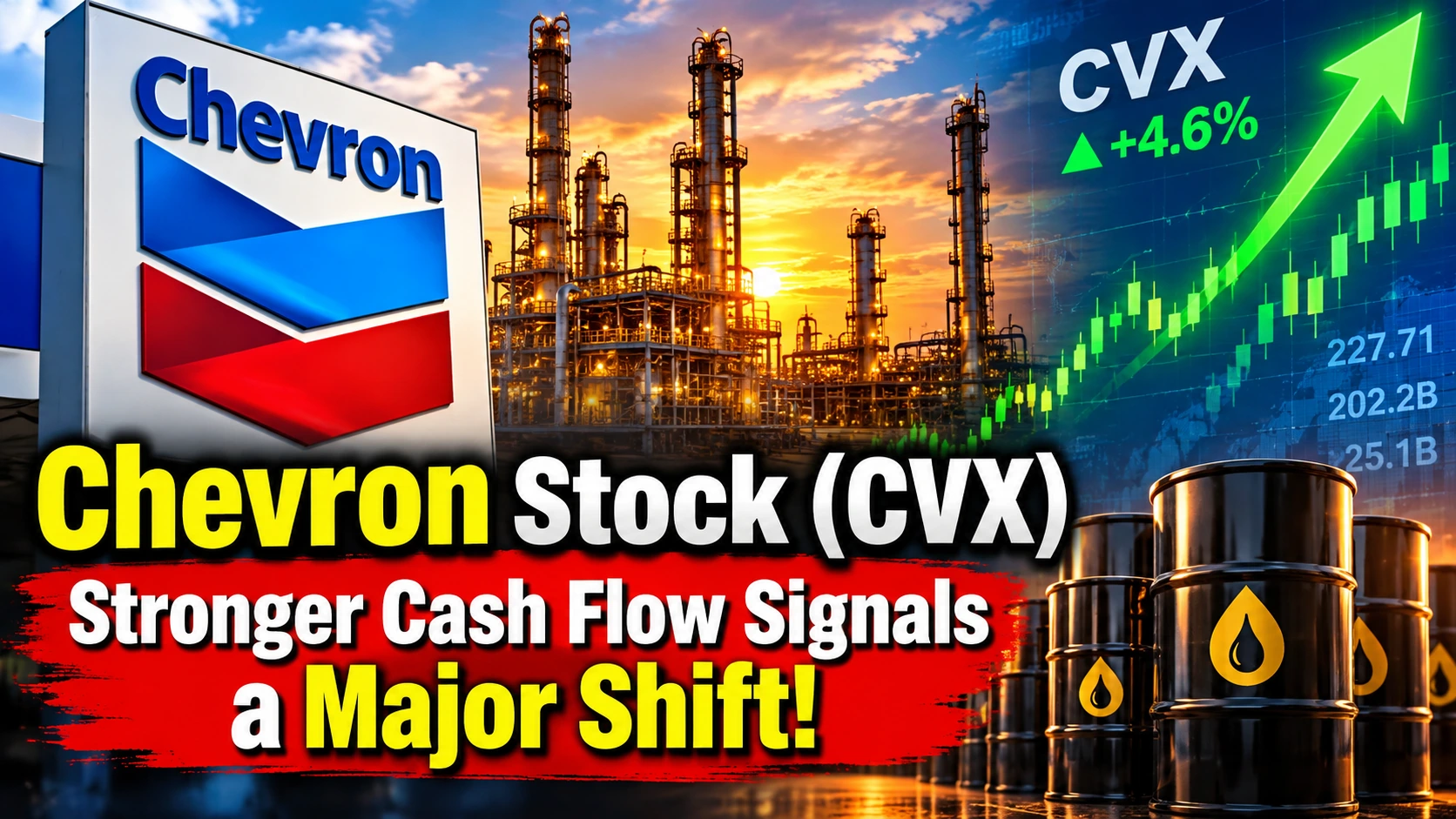
Chevron stock cash flow 2026: CVX) is attracting renewed investor attention as stronger cash generation, a major leadership reshuffle, and ambitious earnings forecasts reshape the energy giant’s investment outlook. With Chevron shares delivering impressive gains during 2026, Wall Street faces an important question: Can the company’s improving financial performance justify its higher valuation?
Chevron’s expanding production portfolio, cost-cutting initiatives, and long-term energy investments offer potential opportunities. However, oil price volatility, integration expenses, and execution risks could determine whether the company’s momentum continues.
Here’s what investors should understand about Chevron’s financial outlook, stock valuation, and potential growth through 2029.
🚀 Why Chevron Stock Is Back in the Spotlight
Chevron has emerged as a closely watched energy stock in 2026, supported by stronger oil prices, increased production, and improving expectations for cash generation.
The company operates across oil and natural gas exploration, production, refining, transportation, and energy infrastructure. This integrated business model helps Chevron generate revenue across multiple stages of the energy supply chain.
Higher commodity prices can significantly improve earnings from oil and gas production. Meanwhile, operational efficiency programs and disciplined spending can strengthen profitability.
However, investors are increasingly asking whether Chevron’s stock price already reflects these positive developments.
The central issue is no longer simply whether Chevron can generate substantial cash. It is whether the company can maintain that performance while managing future investments and shareholder distributions.
Chevron (CVX) Financial Outlook
Analyst estimates published in October 2026. Forecast values are not guaranteed.
Annual Earnings (US$ Billion)
Net Profit Margin
Source: October 2026 analyst estimates discussed in Chevron investment coverage. Bar lengths are scaled to the highest value within each comparison, not to zero-to-100% axes. Estimates may change. This chart is informational and is not investment advice.
💰 Chevron’s Stronger Cash Flow Changes the Conversation
Cash flow remains one of the most important financial indicators for evaluating an energy company.
Chevron’s investment outlook has received support from substantial cash generation, with recent analysis highlighting approximately $18.1 billion in quarterly free cash flow.
Free cash flow represents cash remaining after capital expenditures. Companies can use this money to reduce debt, distribute dividends, repurchase shares, or fund future investments.
For Chevron, stronger cash generation creates several potential advantages.
First, it provides financial flexibility during periods of oil price uncertainty.
Second, it can support the company’s long-standing commitment to shareholder dividends.
Third, it helps finance major energy projects without relying excessively on additional borrowing.
Nevertheless, investors should remember that exceptionally strong quarterly results do not automatically translate into sustainable annual performance.
Oil prices, capital spending, working capital movements, and production costs can cause cash flow to fluctuate significantly.
🔄 Chevron Announces Major Leadership Changes for 2027
Chevron’s October 2026 leadership announcement adds another important dimension to its investment story.
Jeff B. Gustavson is scheduled to become Chief Financial Officer beginning January 1, 2027.
Gustavson brings experience from Chevron’s New Energies business, potentially offering a valuable perspective on traditional energy operations and emerging investment opportunities.
Eimear P. Bonner is also moving into the position of President, Oil, Products & Gas.
These changes place experienced executives in influential positions overseeing capital allocation, operational performance, and strategic investments.
Chevron is also adjusting board representation connected with Hess Midstream following developments involving its Hess-related assets.
For investors, the significance lies in how effectively the new leadership team balances expansion, spending discipline, and financial returns.
A management reshuffle alone does not guarantee stronger profits, but leadership decisions can influence long-term shareholder value.
📊 Chevron Earnings Forecast: Could Profits Reach $25.1 Billion?
Analyst expectations suggest Chevron could improve profitability even if revenue growth remains limited.
Forecasts indicate that annual revenue could decline by approximately 1.2% over the next three years.
Despite this projected decline, analysts anticipate an improvement in profit margins.
Chevron’s net profit margin is expected to increase from approximately 9.8% to 12.4% by 2029.
That would represent a meaningful improvement in how efficiently the company converts revenue into earnings.
Current earnings estimates of approximately $20.6 billion are projected to increase to around $25.1 billion by 2029.
This implies approximately $4.5 billion in additional annual earnings.
Analysts also forecast roughly $202.2 billion in revenue for 2029.
These figures suggest that cost efficiency, production mix, and capital discipline could become increasingly important drivers of profitability.
However, these are forecasts rather than guaranteed financial outcomes.
📈 Chevron Stock Valuation: Is CVX Still Attractive?
Valuation has become a central consideration following Chevron’s substantial share price appreciation.
One October 2026 analyst framework placed Chevron’s estimated fair value at approximately $227.71 per share.
Using a reference share price of $217.73, that estimate represented potential upside of roughly 4.6%.
However, Chevron subsequently traded closer to $225, narrowing the difference between its market price and the estimated fair value.
This suggests that much of the anticipated improvement in financial performance may already be reflected in the stock.
Chevron has also traded at a price-to-earnings multiple above several traditional oil and gas industry benchmarks.
A higher valuation can be justified by strong financial performance, reliable dividends, and attractive growth opportunities.
But it also increases the importance of meeting investor expectations.
If earnings growth disappoints or commodity prices weaken, the market could reassess the premium investors are willing to pay.
🌍 Hess Assets, Venezuela and Energy Projects Support Growth
Chevron’s long-term investment outlook extends beyond near-term oil prices.
The company’s expanded portfolio following the Hess acquisition provides additional production opportunities and infrastructure exposure.
Operations connected with Guyana and other major producing regions could contribute to future output.
Chevron’s activities in Venezuela also represent a potential growth opportunity, although political, regulatory, and operational uncertainty remains significant.
Meanwhile, the company’s interest in power infrastructure and lower-carbon energy investments could broaden its long-term revenue opportunities.
Projects associated with growing electricity demand, including demand from data centers, may become increasingly relevant.
Nevertheless, large energy projects require significant investment and careful execution.
Delays, cost overruns, or weaker-than-expected demand could reduce anticipated returns.
💵 Can Chevron Maintain Its Dividend?
Chevron’s dividend remains an important attraction for income-focused investors.
The company has an established record of shareholder distributions, making dividend sustainability a key part of its investment appeal.
Stronger free cash flow can improve dividend coverage while leaving additional funds available for debt reduction and reinvestment.
However, dividend investors should examine more than the current yield.
Important considerations include recurring operating cash flow, capital expenditure requirements, debt obligations, and the resilience of earnings during weaker commodity markets.
A sustainable dividend depends on the company’s ability to generate sufficient cash throughout the energy cycle.
⚠️ Major Risks Facing Chevron Investors
Despite Chevron’s financial strengths, several risks deserve attention.
Oil price volatility: Falling crude oil prices could weaken upstream earnings and reduce available cash flow.
Project execution: Major developments in Venezuela, Guyana, and other regions could face delays or unexpected expenses.
Capital allocation: Excessive spending on acquisitions or expansion could reduce financial flexibility.
Valuation pressure: A premium share price may leave limited room for disappointing financial results.
Energy transition uncertainty: Changing regulations, technology, and global energy demand could influence long-term profitability.
These risks highlight why strong cash flow should be evaluated alongside operational performance and valuation.
🔮 Chevron Stock Outlook: What Happens Next?
Chevron’s future investment performance will depend on whether management can translate higher production and operational efficiencies into consistent earnings growth.
The upcoming leadership transition may influence how Chevron prioritizes capital spending, shareholder distributions, and emerging energy opportunities.
Investors should monitor quarterly free cash flow, production growth, capital expenditures, debt levels, and management guidance.
The company’s next earnings report could provide additional evidence about the sustainability of its recent financial momentum.
If Chevron delivers stronger margins while maintaining disciplined spending, its investment outlook could remain constructive.
However, weaker oil prices or disappointing project execution could challenge current expectations.
❓ Chevron Stock FAQs
1. Why is Chevron stock attracting investor attention in 2026?
Chevron has benefited from stronger oil prices, substantial cash generation, production growth, and improving earnings expectations. Leadership changes and long-term projects have also attracted attention.
2. What is Chevron’s earnings forecast for 2029?
Analyst projections indicate that Chevron could generate approximately $25.1 billion in annual earnings by 2029, compared with an estimated $20.6 billion in the current forecast baseline.
3. Is Chevron stock undervalued?
One analyst framework estimated Chevron’s fair value at $227.71 per share. Whether the stock is undervalued depends on its prevailing market price and the assumptions behind the valuation.
4. Who is Chevron’s incoming Chief Financial Officer?
Jeff B. Gustavson is scheduled to become Chevron’s Chief Financial Officer on January 1, 2027.
5. Can Chevron maintain its dividend?
Strong recurring cash generation can support dividends, but future payments depend on earnings, capital spending, debt requirements, and commodity market conditions.
6. What are the biggest risks for CVX stock?
Major risks include lower oil prices, project delays, cost inflation, geopolitical uncertainty, and the possibility that future earnings fail to justify the stock’s valuation.
🏁 Final Thoughts: Is Chevron Stock Worth Watching?
Chevron enters the next phase of its investment story with substantial cash-generation capabilities, a reshaped leadership team, and opportunities for long-term earnings improvement.
Forecasts pointing toward $25.1 billion in earnings by 2029 support the argument that operational efficiency could strengthen profitability.
However, investors must weigh those opportunities against commodity price uncertainty, project execution risks, and an increasingly demanding valuation.
For Chevron shareholders and prospective investors, the critical question is whether future cash flow growth can continue supporting the company’s share price and dividend commitments.
Disclaimer: This article is for general financial information and educational purposes only. It does not constitute personalized investment advice or a recommendation to buy or sell securities. Market prices and forecasts are subject to change.