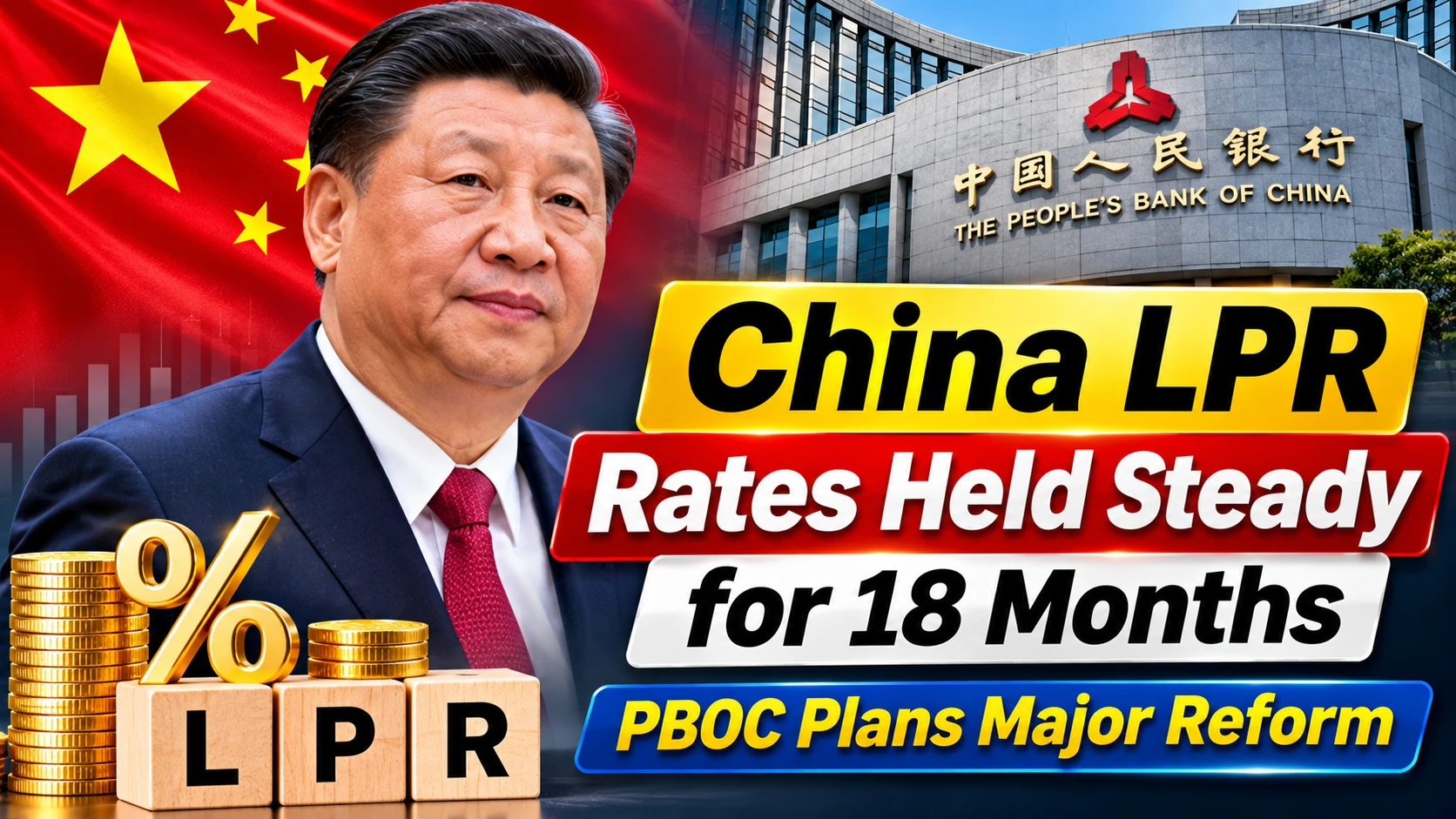
China LPR November 2026: China’s central bank kept its benchmark lending rates unchanged on Friday, November 20, extending a period of stability that has now lasted 18 consecutive months. 🏦
The People’s Bank of China (PBOC) maintained the one-year Loan Prime Rate (LPR) at 3.0% and the five-year-plus LPR at 3.5%, matching market expectations.
Although the decision brought no immediate change to benchmark lending rates, the central bank is considering important reforms to the way banks determine borrowing costs.
The proposed changes could eventually allow financial institutions to use a wider range of market-based interest rate benchmarks, including DR001, when pricing floating-rate loans.
The development could have significant implications for Chinese businesses, mortgage borrowers, commercial banks, and the broader economy.
🌟 China Interest Rate Decision: Key Highlights
- One-year LPR: Unchanged at 3.0%.
- Five-year-plus LPR: Unchanged at 3.5%.
- Consecutive months without a change: 18.
- Last LPR adjustment: May 2025, when both rates were reduced by 10 basis points.
- Average new corporate loan rate: Approximately 2.9% in October 2026.
- Average new personal housing loan rate: Approximately 3.1%.
- Proposed reform: Broader use of market-based loan pricing benchmarks, including DR001.
The unchanged rates suggest that policymakers are maintaining stability while exploring ways to make monetary policy more responsive to changing market conditions.
China Interest Rates: November 2026
Benchmark rates and average new-loan rates (% per year)
Source: PBOC figures reported by BigGo Finance. LPR quotations: November 20, 2026. Average new-loan rates: October 2026. Bars use a 0%-4% scale. This is a comparison of different lending-rate categories, not a historical time series.
🏦 China Keeps Loan Prime Rates Unchanged in November 2026
On November 20, the People’s Bank of China authorized the National Interbank Funding Center to publish the latest Loan Prime Rates.
The one-year benchmark remained at 3.0%, while the rate for loans with maturities exceeding five years stayed at 3.5%.
The one-year LPR is an important reference for corporate and other shorter-term lending.
Meanwhile, the five-year-plus LPR is widely associated with longer-term borrowing, including mortgage pricing.
Both benchmarks have remained unchanged since May 2025, when policymakers reduced them by 10 basis points.
A basis point represents one-hundredth of a percentage point. Therefore, a reduction of 10 basis points equals 0.10 percentage point.
The prolonged period of unchanged LPR quotations indicates that China has avoided further adjustments to these headline lending benchmarks while continuing to manage credit conditions through other policy mechanisms.
📉 Why Has China Maintained Interest Rate Stability?
The stability of China’s Loan Prime Rates is closely connected to the central bank’s monetary policy framework.
The seven-day reverse repurchase agreement rate, commonly called the seven-day reverse repo rate, serves as a key policy interest rate.
Because that rate has remained unchanged, the foundation for calculating LPR quotations has also remained relatively stable.
The LPR is determined using quotations submitted by designated banks, based on the relevant policy rate plus a spread.
The National Interbank Funding Center then calculates and publishes the benchmark rates.
With no major change in the underlying policy rate, November’s unchanged LPR announcement was consistent with market expectations.
However, stable benchmark rates do not necessarily mean that borrowing conditions across the economy have remained completely unchanged.
Actual loan rates can move because of changes in bank pricing, borrower creditworthiness, competition, and other lending conditions.
💼 Corporate Borrowing Costs Continue to Decline
One of the most important findings in the latest lending data concerns business financing.
In October 2026, the weighted average interest rate on newly issued corporate loans was approximately 2.9%.
That represented a decline of around 0.2 percentage point compared with the same period a year earlier.
The reduction occurred even though the headline Loan Prime Rates had not changed.
This illustrates how businesses can experience lower borrowing costs without a new cut to the central bank’s published LPR benchmarks.
Lower financing expenses may help companies manage existing obligations, support working capital, and evaluate new investments.
However, cheaper loans do not automatically guarantee stronger investment or economic growth.
Businesses also consider consumer demand, profitability, confidence, and future economic conditions before increasing borrowing.
The decline in corporate lending rates therefore demonstrates an easing in actual financing costs, but its broader economic impact depends on how companies respond.
🏠 What Does China’s LPR Decision Mean for Mortgage Borrowers?
China’s housing market is another important area affected by lending benchmarks.
The five-year-plus LPR remained unchanged at 3.5% in November.
Meanwhile, the weighted average rate on newly issued personal housing loans was approximately 3.1% in October 2026.
That figure was broadly unchanged from a year earlier.
The difference between the five-year-plus LPR and the average mortgage rate reflects the fact that banks can price loans using applicable spreads and other lending arrangements.
For households considering property purchases, actual mortgage costs depend on individual loan terms, bank policies, and local market conditions.
Existing mortgage borrowers may also be affected differently from new borrowers.
A stable LPR does not necessarily mean that every mortgage payment will remain unchanged, because some loans have contractual repricing arrangements.
The pace at which rates on outstanding mortgages adjust remains an important issue for households and financial institutions.
🔄 PBOC Plans Major Reform of Loan Pricing Benchmarks
While the November rate announcement was largely uneventful, the central bank’s longer-term policy proposals attracted attention.
In its monetary policy report for the third quarter of 2026, the PBOC outlined plans to advance reform of China’s loan interest rate pricing system.
The central bank wants to move away from relying too heavily on a relatively narrow set of LPR references.
Instead, it is encouraging a more diversified framework that could include additional market-based benchmarks.
Such a transition could make bank lending rates more responsive to changes in financial market conditions.
The reform would not necessarily eliminate the LPR.
Rather, it could gradually reduce dependence on the LPR as the single dominant reference for certain types of loans.
The effectiveness of the changes will depend on implementation, bank participation, and the design of future lending products.
📊 What Is DR001 and Why Does It Matter?
DR001 is an important short-term interest rate in China’s interbank financial market.
It measures the overnight repurchase rate for depository institutions using eligible bonds as collateral.
Because DR001 reflects short-term funding conditions among financial institutions, it provides useful information about liquidity in the banking system.
When liquidity becomes tighter, short-term funding rates may rise.
When liquidity is more abundant, those rates may decline.
The PBOC has encouraged financial institutions to explore floating-rate loans linked to DR001.
Under such arrangements, borrowing costs could respond more directly to changes in market funding conditions.
This may improve the transmission of monetary policy into actual lending rates.
However, it could also introduce additional variability for borrowers.
Important distinction: DR001 is an overnight rate, while the seven-day reverse repo rate is a separate policy benchmark. They should not be treated as identical indicators.
⚠️ How Could the Reform Affect Chinese Banks?
A broader loan pricing system could create both opportunities and challenges for commercial banks.
Banks would need to manage interest rate risks more carefully if a greater proportion of their lending portfolios became linked to changing market benchmarks.
For example, a bank might face rising funding costs while earning interest from loans that adjust at a different pace.
Such mismatches can affect profitability and financial stability.
Banks may therefore need stronger asset-liability management systems, more sophisticated risk pricing, and improved internal funds transfer pricing.
The transition could also require changes to lending contracts, technology systems, and customer disclosures.
For borrowers, clearer information about how floating rates are calculated would become especially important.
🌏 What Does China’s Monetary Policy Mean for the Economy?
China’s decision to maintain its Loan Prime Rates highlights the balance between monetary stability and efforts to improve financial conditions.
Lower average corporate lending rates suggest that financing costs have eased even without additional headline LPR reductions.
At the same time, the central bank’s proposed benchmark reforms indicate an interest in improving how monetary policy influences bank lending.
A more responsive pricing framework could help financial institutions reflect changing liquidity conditions more quickly.
Nevertheless, the ultimate economic impact will depend on loan demand, business confidence, household borrowing, and the broader financial environment.
The November announcement does not by itself establish that a new easing or tightening cycle has begun.
🔮 China Interest Rate Outlook: What Happens Next?
With the seven-day reverse repo rate unchanged, market participants expect the LPR to remain relatively stable in the near term.
Attention is increasingly shifting towards the practical implementation of loan pricing reforms.
Important developments to monitor include the introduction of DR001-linked lending products, possible pilot programs, and changes in banks’ interest rate risk management practices.
Future central bank policy decisions and economic conditions could also influence the direction of lending rates.
For now, the November announcement reflects continuity in China’s benchmark lending policy alongside preparations for a potentially more flexible pricing framework.
❓ Frequently Asked Questions About China’s LPR
1. What is China’s LPR rate in November 2026?
China’s one-year Loan Prime Rate is 3.0%, while the five-year-plus LPR is 3.5%, according to the November 20, 2026 announcement.
2. Why did China leave interest rates unchanged?
The key seven-day reverse repo policy rate remained unchanged, supporting stable LPR quotations. The decision was also consistent with market expectations.
3. When did China last cut its Loan Prime Rates?
China last reduced both major LPR benchmarks in May 2025, cutting each by 10 basis points.
4. What is the DR001 interest rate?
DR001 is an overnight interbank repurchase rate for depository institutions. It reflects short-term funding and liquidity conditions in China’s banking system.
5. How does the LPR affect home loans in China?
The five-year-plus LPR serves as an important reference for longer-term lending, including mortgages. Actual mortgage rates also depend on bank pricing and loan terms.
6. Will China change its loan pricing system?
The PBOC has proposed developing a more diversified benchmark framework and encouraging banks to explore DR001-linked floating-rate loans. The timing and extent of implementation remain uncertain.
🏁 Conclusion
The China LPR November 2026 announcement confirmed that the country’s benchmark lending rates have remained unchanged for 18 consecutive months.
The one-year LPR continues at 3.0%, while the five-year-plus rate remains at 3.5%.
Despite the stability of these benchmarks, average corporate borrowing costs have declined, demonstrating that actual lending conditions can change without headline rate cuts.
The more significant longer-term development may be the PBOC’s proposal to diversify loan pricing benchmarks and encourage the exploration of DR001-linked lending.
For businesses, households, and financial institutions, the coming months will reveal how these proposals develop and whether they lead to meaningful changes in borrowing costs.
China’s next monetary policy challenge may be less about changing headline interest rates and more about improving how those rates influence the wider economy.