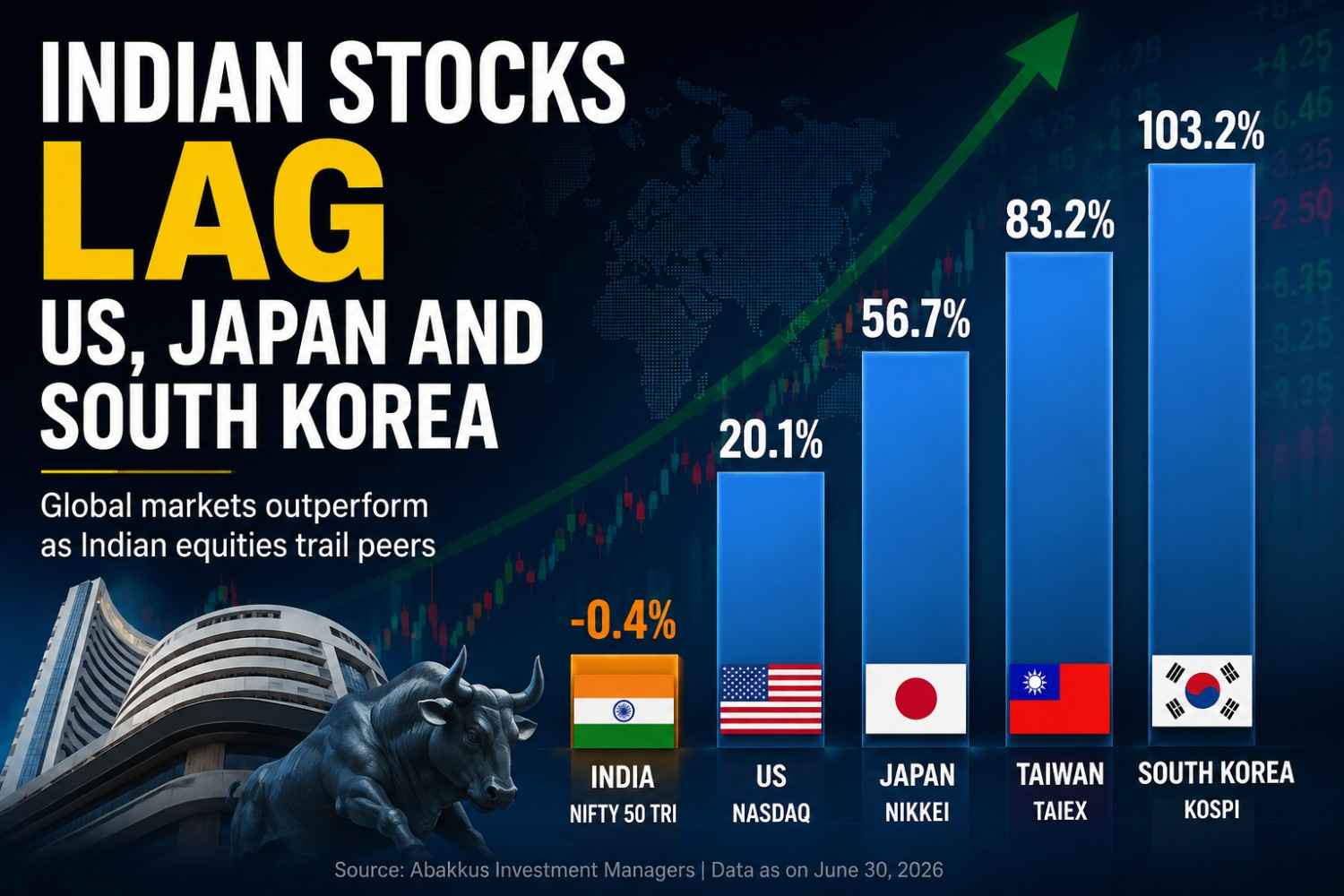
Indian Stocks Lag US: Indian equities may have trailed global peers over the past year, but experts believe the country’s long-term growth story remains firmly intact. 📈
A new study by Abakkus Investment Managers says the recent underperformance of Indian stocks has been driven largely by global investor sentiment, sector rotation and valuation adjustments, rather than any weakness in India’s economic fundamentals.
While investors poured money into AI and semiconductor-focused markets such as the United States, South Korea and Taiwan, India’s diversified economy continues to benefit from strong domestic demand, infrastructure spending, policy stability and favourable demographics.
For long-term investors, analysts believe the current phase could offer attractive investment opportunities rather than a reason to panic.
🔍 Why Have Indian Equities Underperformed Global Markets?
According to the Abakkus study, the biggest reason behind India’s underperformance has been the massive global shift towards Artificial Intelligence (AI) and semiconductor-related investments.
Global investors aggressively increased allocations to companies involved in AI chips, cloud infrastructure, data centres and semiconductor manufacturing.
India, however, has relatively limited exposure to these industries.
📊 One-Year Market Performance (As of June 30, 2026)
| Market | One-Year Return |
|---|---|
| 🇰🇷 South Korea (Kospi) | 103.2% |
| 🇹🇼 Taiwan (TAIEX) | 83.2% |
| 🇯🇵 Japan (Nikkei) | 56.7% |
| 🇺🇸 Nasdaq | 20.1% |
| 🇮🇳 Nifty 50 TRI | -0.4% |
Interestingly, market momentum shifted during the most recent month.
- Nifty 50 TRI gained 2.4%
- South Korea’s Kospi declined 22.2%
This suggests that global leadership may already be beginning to rotate.
💡 Why Is the Indian Stock Market Facing Pressure?
According to Abakkus Investment Managers, several global factors weighed on Indian equities.
Key Reasons
✅ Global funds shifted towards AI and semiconductor stocks.
✅ India has limited semiconductor manufacturing exposure.
✅ Concerns over AI disruption impacted Indian IT services companies.
✅ Foreign Institutional Investors (FIIs) reduced exposure amid global portfolio reallocation.
✅ Valuation correction in large-cap stocks despite healthy earnings.
✅ US tariff uncertainty, Middle East tensions and geopolitical risks affected investor sentiment.
✅ Rupee depreciation reduced dollar-denominated returns for overseas investors.
🇮🇳 Why India’s Long-Term Investment Story Remains Strong
Despite recent market weakness, Abakkus believes India’s structural growth story remains one of the strongest among emerging markets.
Strong Economic Fundamentals
India continues to benefit from:
- 🚀 Robust GDP growth
- 💰 Healthy foreign exchange reserves
- 🛣 Massive infrastructure investment
- 👨👩👧 Young and growing population
- 🛍 Rising domestic consumption
- 🏢 Formalisation of the economy
- 📈 Stable policy environment
Unlike several emerging markets that depend heavily on technology exports, India’s economy is diversified across financial services, manufacturing, healthcare, automobiles, consumer businesses and infrastructure.
This balanced market structure reduces dependence on any single sector.
💵 Why Foreign Investors Could Return to India
Abakkus expects India to become increasingly attractive as global capital begins rotating away from AI-driven markets.
Several developments support this outlook:
- FIIs may reallocate funds after booking profits in South Korea and Taiwan.
- Strong SIP and mutual fund inflows continue supporting Indian markets.
- Mid-cap and small-cap stocks have significantly outperformed large caps.
- Lower energy imports are helping moderate dollar outflows.
- Reduced gold imports are easing pressure on India’s external account.
- RBI initiatives, including FCNR measures, are improving foreign currency liquidity.
- A stronger rupee could improve returns for foreign investors.
📈 What Makes India Different From Other Emerging Markets?
Unlike the MSCI Emerging Markets Index—which is heavily concentrated in technology—India offers diversified exposure across multiple sectors.
This makes the Indian market less vulnerable to sharp corrections in a single industry.
Experts believe this balanced structure could become a major advantage if global AI valuations begin cooling.
🗣 Expert View
Aman Chowhan, Head of Equities – Alternates at Abakkus Investment Managers, said:
“The country’s underlying growth drivers, including demographics, consumption, formalisation and infrastructure creation, continue to strengthen. Periods of market underperformance often create the foundation for future opportunities.”
His comments reinforce the view that temporary market weakness should not be confused with deteriorating economic fundamentals.
🔑 Key Takeaways
- 📉 Indian equities have lagged major global markets over the past year.
- 🤖 AI-driven rallies boosted US, Taiwan and South Korea.
- 🇮🇳 India’s underperformance is linked more to global capital flows than economic weakness.
- 💼 Strong domestic demand and policy stability continue to support long-term growth.
- 💰 Mutual fund SIP inflows remain a key pillar of market resilience.
- 📈 Analysts believe India could benefit if global investors rotate capital back into diversified emerging markets.
❓Frequently Asked Questions (FAQs)
Why are Indian equities underperforming global markets?
Indian equities have underperformed mainly because global investors shifted capital toward AI, semiconductor and technology-focused markets such as the US, Taiwan and South Korea.
Is India’s economy weakening?
No. According to Abakkus Investment Managers, India’s economic fundamentals remain strong, supported by healthy GDP growth, domestic consumption, infrastructure investment and favourable demographics.
Why are foreign investors selling Indian stocks?
Foreign Institutional Investors have reduced exposure due to global capital reallocation, geopolitical uncertainty, valuation concerns and currency movements.
Is this a good time to invest in Indian equities?
Experts believe periods of market underperformance often create attractive long-term investment opportunities, especially when economic fundamentals remain strong.
What sectors are supporting India’s long-term growth?
Infrastructure, manufacturing, financial services, consumption, healthcare, industrials and domestic manufacturing continue to support India’s long-term growth story.
📌 Conclusion
Although Indian equities have lagged the spectacular gains seen in AI-driven markets like South Korea, Taiwan and the United States, the broader picture remains encouraging. India’s strong economic fundamentals, diversified market structure, resilient domestic demand and consistent policy support continue to underpin its long-term investment appeal.
As global capital cycles evolve and valuations normalize, analysts believe India could once again emerge as a preferred destination for long-term investors looking beyond short-term market fluctuations. 🚀