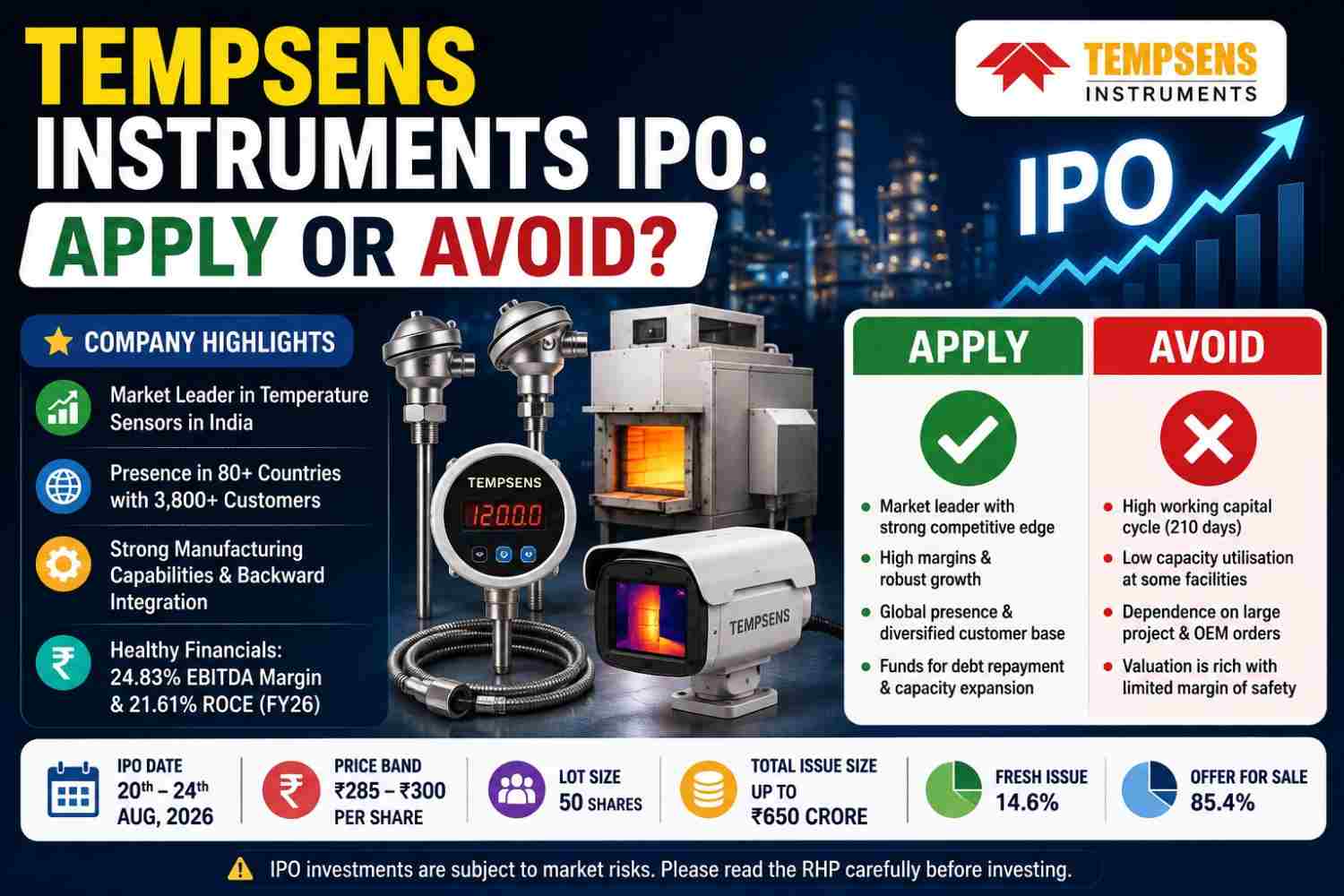
Tempsens Instruments IPO: Tempsens Instruments (India) IPO has attracted significant attention as the specialised temperature-sensor and industrial heating solutions manufacturer enters the public market with a ₹650 crore IPO.
The issue is priced at ₹285 to ₹300 per share, with investors required to bid for at least 50 shares. At ₹300 per share, the minimum retail investment works out to ₹15,000.
Investor interest has also been supported by a strong grey market premium (GMP). However, GMP is unofficial, unregulated and highly volatile, so it should never be the sole reason to apply for an IPO.
Behind the market excitement lies a more interesting investment question:
Does Tempsens’ specialised business, strong margins and market position justify its valuation despite its long working-capital cycle and execution risks?
Let’s examine the Tempsens Instruments IPO in detail. 🔍
🚀 Tempsens Instruments IPO: Key Takeaways
Tempsens operates in an attractive industrial niche rather than competing as a conventional commodity manufacturer.
The bullish case is supported by its specialised temperature-sensing capabilities, strong EBITDA margins, international presence, backward integration and exposure to industries requiring reliable temperature-control systems.
However, investors also need to consider its 210-day net working-capital cycle, dependence on large project and OEM orders, relatively low utilisation at some facilities and a valuation that already prices in considerable future growth.
At the upper price band of ₹300, the company is seeking a post-IPO valuation of approximately ₹2,515 crore.
In short:
Strong business quality + attractive niche + healthy margins, but demanding valuation + working-capital risks.
📊 Tempsens Instruments IPO Details
| Particulars | Details |
|---|---|
| IPO Open Date | August 20, 2026 |
| IPO Close Date | August 24, 2026 |
| Price Band | ₹285–₹300 per share |
| Lot Size | 50 shares |
| Minimum Investment | ₹15,000 at ₹300 |
| Total Issue Size | Up to ₹650 crore |
| Fresh Issue | ₹95 crore |
| Offer for Sale | ₹555 crore |
| Fresh Issue Share | ~14.6% |
| OFS Share | ~85.4% |
| Listing | BSE & NSE |
The ₹650 crore issue consists of a ₹95 crore fresh issue and ₹555 crore offer for sale (OFS). This means approximately 85% of the IPO is an OFS, while only around 15% represents fresh capital going to the company.
🔥 Tempsens Instruments IPO GMP Today
Tempsens Instruments IPO has seen strong activity in the unofficial grey market.
On August 20, 2026, media reports indicated a GMP of roughly ₹220–₹232 per share. At the ₹300 upper price band, that implied an unofficial premium of approximately 73%–77%.
⚠️ Important: GMP is not an official exchange price. It is an unofficial and unregulated indicator that can change sharply before listing.
A high GMP may indicate strong short-term market sentiment, but it does not guarantee an equivalent listing gain.
Investors should therefore evaluate the company’s fundamentals, valuation, financial performance and risks rather than applying based only on GMP.
🏭 What Does Tempsens Instruments Do?
Tempsens Instruments India manufactures specialised equipment designed to measure, control and withstand extreme industrial temperatures.
Think about a steel plant handling molten metal at extremely high temperatures. A normal thermometer or conventional electrical wire would be useless in such an environment.
That’s where Tempsens’ products come in.
Its portfolio broadly covers three areas:
Temperature Sensing Solutions: Sensors, thermocouples, temperature-measurement equipment and non-contact systems such as thermal cameras.
Specialised Cable Solutions: High-performance cables designed to carry power and signals in extreme heat or hazardous industrial environments.
Electrical Heating Solutions: Industrial heaters, heating systems and furnaces used across manufacturing processes.
These products serve industries including steel, chemicals, glass, power and other industrial manufacturing applications.
💰 How Does Tempsens Instruments Make Money?
FY26 operating revenue was approximately ₹444.88 crore.
| Revenue Stream | FY26 Revenue | Contribution |
| Temperature Sensing Solutions | ₹196.66 crore | 44.21% |
| Specialised Cable Solutions | ₹153.11 crore | 34.42% |
| Electrical Heating Solutions | ₹91.33 crore | 20.53% |
| Other Operating Revenue | ₹3.77 crore | 0.84% |
| Total Operating Revenue | ₹444.88 crore | 100% |
Source: Tempsens Instruments RHP
Temperature sensing is the largest segment, accounting for more than 44% of operating revenue, while specialised cables contribute another 34%.
This provides Tempsens with greater diversification than a business dependent on one industrial product.
🔄 Project Orders vs Replacement Revenue
Another important feature of Tempsens’ business model is the combination of project orders and replacement demand.
In FY26:
- Large project and OEM orders: 67.55% of operating revenue
- Replacement orders: 32.45%
Replacement demand can provide an attractive recurring component because temperature sensors operating in extreme industrial environments eventually need to be replaced.
The company says such sensors generally require replacement every 12–24 months, depending on operating conditions.
The downside is that roughly two-thirds of revenue remains linked to large projects and OEM orders, which can be more cyclical.
🌍 Manufacturing and Global Presence
Tempsens operates 15 manufacturing facilities, including 10 in Udaipur and five overseas.
The company serves more than 3,800 customers across over 80 countries, supported by its own operations and 28 global distributors.
Exports are becoming increasingly important.
Overseas revenue increased from approximately ₹58.64 crore in FY24 to ₹125.82 crore in FY26, more than doubling over the period.
That gives Tempsens another potential growth engine beyond India’s industrial expansion.
🏗️ Backward Integration: A Key Competitive Advantage
One of Tempsens’ most interesting strengths is its backward-integrated manufacturing model.
Instead of purchasing every critical component from external suppliers, the company performs several important manufacturing processes internally, including melting specialised metal alloys and drawing wires.
Why does this matter?
Greater backward integration can potentially provide:
✅ Better quality control
✅ Greater control over production schedules
✅ Reduced supplier dependence
✅ Faster product development
✅ Better cost control
✅ Higher barriers to entry
In specialised industrial applications, reliability can matter more than simply offering the lowest price.
📈 Industry Outlook and Growth Opportunity
Tempsens operates in industries supported by automation, electrification and India’s continuing industrial expansion.
India’s temperature sensor market is estimated at around ₹1,880 crore in FY26 and is projected to reach approximately ₹2,880 crore by FY31E, representing roughly an 8.9% CAGR.
The specialised cable replacement opportunity is considerably larger, estimated at around ₹12,800 crore in FY26, with projections reaching approximately ₹27,250 crore by FY31E.
Potential demand drivers include:
- 🏭 Smart manufacturing
- ⚡ Industrial electrification
- 🔋 EV and battery manufacturing
- 🏗️ Infrastructure investment
- 🔥 Metals and steel production
- 🧪 Petrochemicals and chemicals
- ⚙️ Industrial automation
Tempsens appears well positioned within certain parts of these markets.
According to disclosures cited in its offer documents, it has approximately a 10.5% share of India’s contact temperature sensor market and a strong position in non-contact temperature-sensing products.
But industry growth alone doesn’t guarantee shareholder returns.
The company must convert that opportunity into revenue, profit and—crucially—cash flow.
🏆 Why Tempsens Instruments Stands Out
1. Specialised Market Position
Tempsens operates in industrial categories requiring technical expertise, specialised manufacturing and customer trust.
A steel or chemical plant cannot afford unreliable temperature sensors simply because an alternative product is cheaper.
Failure can disrupt production, affect product quality and potentially create safety issues.
That creates a meaningful entry barrier.
2. Strong Revenue Growth 📈
Operating revenue increased from approximately:
₹274.81 crore in FY24 → ₹444.88 crore in FY26
That’s substantial growth over two financial years.
3. Growing International Business 🌎
Overseas revenue increased from:
₹58.64 crore → ₹125.82 crore
between FY24 and FY26.
Geographical diversification can reduce dependence on a single domestic market while expanding the company’s addressable opportunity.
4. Healthy EBITDA Margin
Tempsens reported an FY26 EBITDA margin of approximately 24.83%.
For an industrial manufacturing company, this is one of the more attractive aspects of the investment case.
5. Healthy ROCE
FY26 ROCE stood at approximately 21.61%, indicating relatively healthy operating returns on capital employed.
6. Diversified Customer Base
The top 10 customers contributed only around 18.59% of FY26 revenue.
Lower customer concentration reduces the impact if one large customer cuts orders.
⚠️ Tempsens Instruments IPO Risks
A strong business can still be a poor investment if investors ignore the risks or pay too high a price.
Tempsens has several risks worth examining carefully.
🔴 Risk 1: 210-Day Working Capital Cycle
This is arguably the biggest financial concern.
Net working-capital days increased from:
152 days in FY24 → 210 days in FY26
In simple terms, more capital is getting tied up in inventory and money owed by customers before returning to the company as cash.
Trade receivables increased from approximately:
₹45.56 crore → ₹85.74 crore
while the collection period increased from around 61 days to 70 days.
This matters because accounting profit doesn’t necessarily equal cash.
A company can report strong profit growth while still requiring increasing amounts of capital to fund day-to-day operations.
🔴 Risk 2: Dependence on Large Orders
Approximately 67.55% of FY26 operating revenue came from large project and OEM orders.
Large industrial projects can be delayed when customers reduce or postpone capital expenditure.
This can make quarterly and annual revenue less predictable.
🔴 Risk 3: Geographic Manufacturing Concentration
Ten of Tempsens’ 15 manufacturing facilities are located in Udaipur.
Concentration improves manufacturing coordination but also creates regional operational risk.
A significant disruption in the region could affect multiple production facilities simultaneously.
🔴 Risk 4: Low Capacity Utilisation
Some facilities operated at only around 41%–42% capacity in FY26.
Low utilisation is worth monitoring because manufacturing economics generally improve when factories operate closer to efficient capacity levels.
The positive interpretation is that Tempsens already has infrastructure available to support future growth.
The negative interpretation is that existing capacity is currently underutilised.
Execution will determine which interpretation proves correct.
🔴 Risk 5: Borrowings Have Increased
Borrowings rose from approximately:
₹30.13 crore in FY24 → ₹77.95 crore in FY26
The balance sheet also expanded following the Marathon Heater amalgamation.
Part of the IPO proceeds is intended for debt repayment, which should provide some balance-sheet support.
💸 Fresh Issue vs OFS: Where Is Your Money Going?
This deserves particular attention.
Of the approximately ₹650 crore IPO:
Fresh Issue: ₹95 crore
Offer for Sale: ₹555 crore
Therefore, approximately 85.4% of the issue is OFS.
Money raised through an OFS goes to the selling shareholders rather than directly into the company’s operations.
The fresh issue proceeds are intended to support purposes including capital expenditure, repayment/prepayment of certain borrowings and general corporate purposes.
A high OFS isn’t automatically negative, but investors should understand that only a relatively small part of the total IPO proceeds represents fresh capital for Tempsens itself.
💎 Tempsens Instruments IPO Valuation
Now comes one of the most important parts of the review.
At the upper price band of ₹300 per share, Tempsens is seeking a post-IPO market capitalisation of approximately:
₹2,515 crore
Based on reported FY26 earnings, the P/E ratio works out to approximately:
35.4x P/E
That’s not a bargain valuation.
However, there is additional context.
Reported profit includes approximately ₹3.80 crore of non-cash amortisation associated with acquired intangible assets.
After adjusting for this, PAT comes to roughly ₹74.87 crore, implying an adjusted P/E of approximately:
33.6x
Meanwhile, EV/EBITDA is approximately:
22.1x
These multiples suggest that investors are already being asked to pay a premium for Tempsens’ specialised market position and future growth potential.
📊 Is the Premium Valuation Justified?
There are reasons why Tempsens could deserve a premium.
Factors supporting the valuation 🟢
- Specialised industrial products
- High barriers to entry
- Strong temperature-sensor positioning
- 24.83% EBITDA margin
- 21.61% ROCE
- Growing exports
- Backward-integrated manufacturing
- Diversified customer base
- Exposure to industrial automation and electrification
But there are also reasons for caution.
Factors challenging the valuation 🔴
- 210-day working-capital cycle
- Low capacity utilisation at certain facilities
- Dependence on project/OEM orders
- High OFS component
- Increasing receivables
- Execution risks following expansion
- Limited valuation cushion
- Dilution in per-share earnings growth
The last point deserves more attention.
Consolidated profit reportedly grew at approximately 31.79% CAGR, but diluted EPS increased only from approximately ₹8.06 to ₹8.33 following changes in the share count.
This illustrates why investors should evaluate per-share economics, not just headline PAT growth.
⚖️ Tempsens Instruments IPO: Bull Case vs Bear Case
| 🟢 Bull Case | 🔴 Bear Case |
| Strong niche market position | Premium valuation |
| High EBITDA margin | 210-day working-capital cycle |
| Growing exports | High receivables |
| Backward integration | Project-order dependence |
| Diversified products | Low utilisation at some plants |
| Strong customer relationships | 85%+ OFS component |
| Attractive industry opportunity | Limited room for execution mistakes |
| Healthy ROCE | EPS growth needs monitoring |
This captures the investment debate well.
Tempsens does not look like a weak company coming to market at a cheap valuation.
It looks more like a quality specialised industrial business being offered at a valuation that already expects continued execution.
🎯 Tempsens Instruments IPO: Apply or Avoid?
From a fundamental perspective, the Tempsens Instruments IPO appears attractive but not risk-free.
The company’s biggest strengths are difficult to ignore: specialised manufacturing capabilities, strong positioning in temperature sensing, healthy margins, international expansion, backward integration and a diversified customer base.
These characteristics distinguish Tempsens from a conventional commodity industrial manufacturer.
However, the valuation provides less room for disappointment.
At roughly 33.6x adjusted FY26 earnings and around 22.1x EV/EBITDA, investors are paying upfront for future growth.
The 210-day working-capital cycle is particularly important. If revenue and profit continue growing without corresponding improvement in cash conversion, the quality of that growth becomes less attractive.
Therefore, the central question isn’t whether Tempsens is a good business.
It appears to have several characteristics of one.
The more difficult question is:
Is today’s IPO valuation attractive enough relative to the execution risks?
🟢 Who May Consider the Tempsens IPO?
The IPO may appeal more to investors who:
- Have a long-term investment horizon
- Are comfortable with mid-sized industrial businesses
- Believe Indian manufacturing and industrial automation will continue expanding
- Accept premium valuations for specialised businesses
- Can tolerate IPO and post-listing volatility
- Are willing to monitor cash conversion and execution
🔴 Who May Prefer to Avoid It?
More conservative investors may be uncomfortable if they:
- Primarily seek low-P/E IPOs
- Require a large valuation margin of safety
- Are concerned about long working-capital cycles
- Prefer businesses generating stronger free cash flow
- Are applying solely because of GMP
- Cannot tolerate significant post-listing volatility
🧠 Tempsens Instruments IPO Review: Final Verdict
⭐ Overall View: Positive, but Valuation and Cash Conversion Need Watching
Tempsens Instruments enters the IPO market with several qualities investors typically look for in a specialised manufacturing company.
It has demonstrated revenue growth, healthy operating margins, international expansion, technical manufacturing capabilities and a differentiated position in industrial temperature sensing.
The business therefore deserves serious consideration on fundamentals.
But this isn’t an obvious “cheap IPO.”
At the upper price band of ₹300, the valuation already reflects considerable optimism about future growth.
The biggest fundamental metric to watch after listing may not be revenue growth—it could be cash conversion.
If Tempsens can reduce working-capital days, improve utilisation of existing manufacturing capacity and convert rising profits into stronger cash flow, its underlying business economics could become substantially more attractive.
If working capital remains elevated while project-led growth requires additional capital, the premium valuation becomes harder to justify.
Bottom Line
For long-term investors: Tempsens offers an interesting specialised manufacturing story, but the valuation demands continued execution.
For listing-gain investors: Strong GMP indicates positive unofficial market sentiment, but GMP can change dramatically and does not guarantee listing returns.
For conservative value investors: The valuation and 210-day working-capital cycle may warrant caution.
Rather than treating Tempsens as a simple “apply or avoid” IPO, investors should weigh its high-quality niche business against a valuation that leaves limited room for execution mistakes.
❓ Tempsens Instruments IPO FAQs
What is the Tempsens Instruments IPO price band?
The Tempsens Instruments IPO price band is ₹285 to ₹300 per share.
What is the Tempsens Instruments IPO lot size?
The minimum lot size is 50 shares. At the upper price band of ₹300, one lot requires an investment of ₹15,000.
When does Tempsens Instruments IPO open?
The IPO opened for subscription on August 20, 2026 and is scheduled to close on August 24, 2026.
What is the Tempsens Instruments IPO issue size?
The total issue size is up to approximately ₹650 crore, comprising a ₹95 crore fresh issue and ₹555 crore offer for sale.
What is Tempsens Instruments IPO GMP today?
As of August 20, 2026, reports indicated a grey market premium around ₹220–₹232, although GMP can change rapidly. It is unofficial and should not be treated as a guaranteed listing-price indicator.
Is Tempsens Instruments IPO good for long-term investors?
Tempsens has attractive characteristics including specialised products, strong margins, backward integration and international operations. However, investors should also evaluate its premium valuation, long working-capital cycle and project-order dependence before making a decision.
What are the biggest risks in Tempsens Instruments IPO?
Key risks include its 210-day working-capital cycle, project/OEM order dependence, low utilisation at certain manufacturing facilities, geographical manufacturing concentration and premium valuation.
What is the valuation of Tempsens Instruments IPO?
At ₹300 per share, the post-IPO market capitalisation is approximately ₹2,515 crore. Based on the figures used in this analysis, the IPO is valued at approximately 35.4x reported FY26 earnings and around 33.6x adjusted earnings.
Is Tempsens Instruments IPO expensive?
The valuation is not cheap. Investors are paying a premium for the company’s specialised capabilities, margins and growth potential. Whether that premium is justified depends on future earnings growth, capacity utilisation and cash-flow improvement.
Should I apply for Tempsens Instruments IPO?
The IPO presents a potentially attractive specialised industrial growth story, but it also carries valuation and working-capital risks. Investors should decide based on their risk tolerance, investment horizon and independent assessment rather than GMP alone.
⚠️ Disclaimer
This article is for educational and informational purposes only and should not be considered investment advice or a recommendation to buy, sell or subscribe to any security. IPOs and equity investments involve market risk. GMP is unofficial and unregulated. Investors should read the company’s Red Herring Prospectus (RHP), evaluate the risks and consult a SEBI-registered investment adviser where appropriate before making an investment decision.