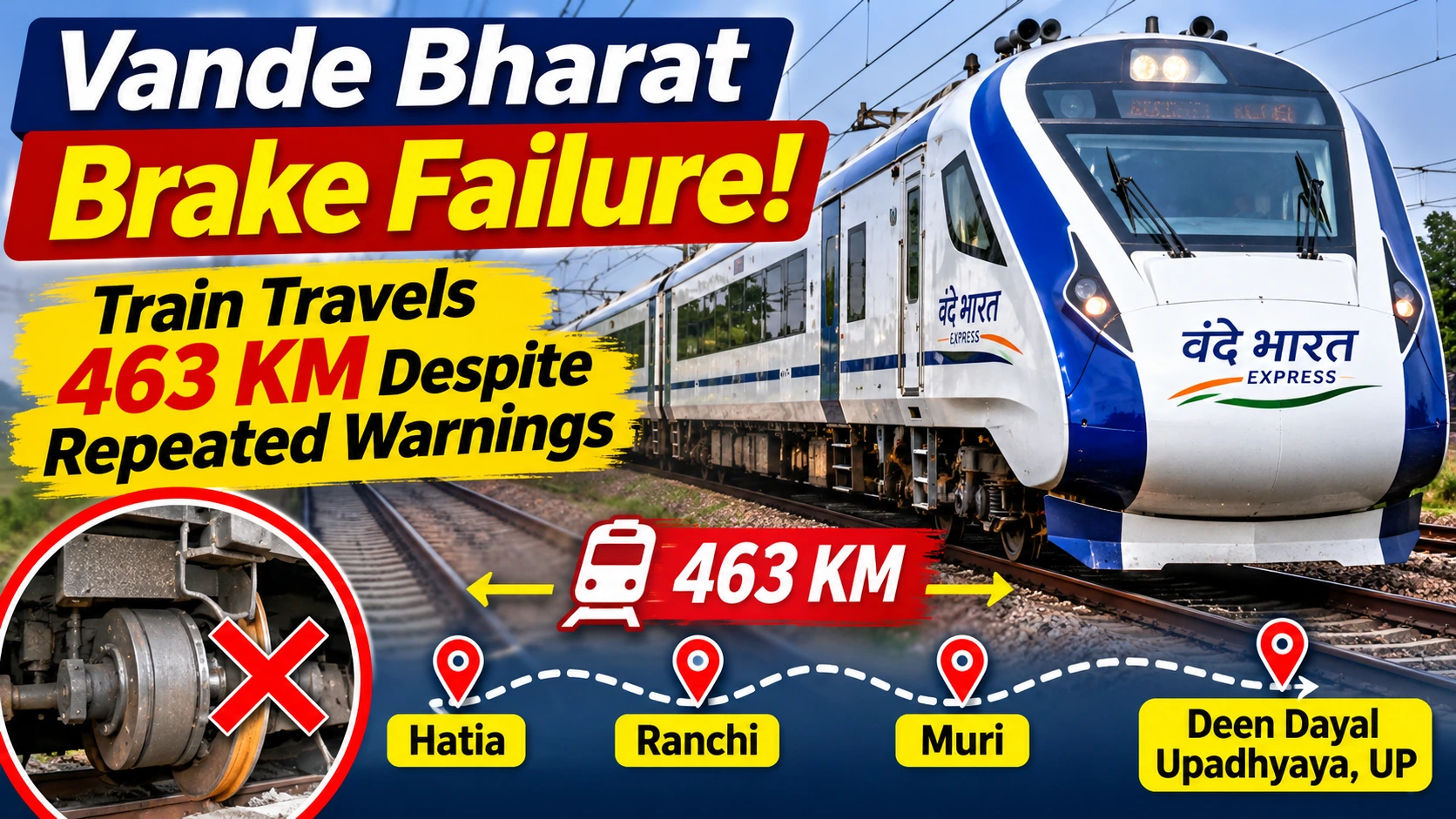
Vande Bharat Brake Failure: A serious railway safety lapse has come to light after an empty Vande Bharat train travelled approximately 463 kilometres between Jharkhand and Uttar Pradesh without effective coach brakes. Despite repeated warnings from loco pilots, the train was reportedly allowed to continue its journey, prompting South Eastern Railway to order a detailed investigation.
The incident occurred on October 24, 2026, when an empty Vande Bharat chair car rake was being transported from Hatia in Jharkhand to Jhansi in Uttar Pradesh using a freight locomotive.
The train’s braking system was supposed to be integrated with the locomotive’s braking equipment. However, an inspection later revealed that the braking systems of all the coaches had been isolated.
Although the train continued using the locomotive’s brakes and regenerative braking, the absence of effective coach brakes created a potentially dangerous situation.
Here is the complete account of the Vande Bharat brake failure incident, the ignored warnings, the railway investigation, and the safety concerns raised by the episode.
🚆 What Happened During the Vande Bharat 463 KM Journey?
The incident began on October 24 when railway authorities arranged to transport an empty Vande Bharat chair car rake from Hatia to Jhansi.
Because the coaches were being moved by a freight locomotive, their braking equipment needed to function correctly with the locomotive’s braking system.
Soon after departure from Hatia, the loco pilot conducted a prescribed brake feel and brake power test on the Hatia–Ranchi section.
During this test, the driver discovered that the train’s braking performance was extremely poor.
This was an important warning sign because effective braking is essential for controlling a train safely, particularly when approaching signals, stations, and other railway movements.
Despite the problem being identified early in the journey, the rake was allowed to continue.
The incident later raised serious questions about whether railway safety procedures had been followed properly.
🚆 Vande Bharat Brake Failure: 463 KM Incident
Key facts and investigation timeline | October 2026
| Event / Detail | Reported Information |
|---|---|
| Incident Date | 24 October 2026 |
| Distance Travelled | Approximately 463 KM |
| Train Type | Empty Vande Bharat Chair Car Rake |
| Starting Station | Hatia, Jharkhand |
| Planned Destination | Jhansi, Uttar Pradesh |
| First Brake Warning | Ranchi Station |
| Second Brake Warning | Muri Station |
| Inspection Location | Deen Dayal Upadhyaya Station |
| Coach Braking System | Ineffective / Isolated |
| Locomotive Braking | Locomotive and Regenerative Brakes Used |
| Investigation Order | 7 November 2026 |
| Investigation Authority | South Eastern Railway |
| Investigation Status | Detailed Probe Ordered |
Source: Reported railway investigation findings. All responsibility findings remain subject to investigation.
⚠️ First Warning at Ranchi Railway Station
After discovering the braking problem, the loco pilot reported the issue to railway authorities.
Upon reaching Ranchi station, the driver submitted a written complaint concerning the train’s poor braking performance.
The warning was communicated to the relevant railway control officials, including the section controller and traction locomotive controller.
However, the train was reportedly permitted to continue without the underlying problem being resolved.
This decision became one of the major concerns identified in the preliminary railway examination.
A written warning about ineffective braking should have prompted appropriate technical verification before the movement continued.
Instead, the empty Vande Bharat rake proceeded farther along its planned journey.
The failure to act on the initial warning allowed the safety problem to remain unresolved.
🔴 Second Loco Pilot Raises Alarm at Muri Junction
The braking problem was reported again when another loco pilot operated the train from Muri station in Jharkhand.
The second driver informed railway controllers that the train’s braking performance remained inadequate.
The loco pilot specifically reported that reducing the brake pipe pressure did not apply the brakes as expected.
Brake pipe pressure is an important part of the air-braking system used in railway operations.
Under normal operating conditions, changes in brake pipe pressure help control the application of brakes across connected railway vehicles.
The driver’s observation therefore indicated a potentially serious problem with the coach braking arrangement.
Despite this second warning, the rake continued its journey.
The repeated complaints became a central issue in the subsequent investigation.
🔍 Major Brake Problem Discovered at Deen Dayal Upadhyaya Station
The seriousness of the incident became clear when the train reached Deen Dayal Upadhyaya station in Uttar Pradesh’s Chandauli district.
Railway personnel finally inspected the Vande Bharat rake to determine why its braking performance had been so poor.
The inspection revealed a significant technical problem.
The braking systems of all the coaches had been isolated, preventing the coach brakes from being applied.
This meant the train had travelled approximately 463 kilometres without effective braking from its coaches.
Importantly, the locomotive itself still had functioning braking capabilities.
According to the railway findings reported in the media, the train was operated using the locomotive’s brakes and regenerative braking.
Therefore, describing the incident as a train travelling with absolutely no brakes would be inaccurate.
The actual safety concern was that the coaches’ braking systems were not functioning as required.
🛠️ Why Did the Vande Bharat Braking System Fail?
The problem involved the braking arrangement between the Vande Bharat coaches and the freight locomotive pulling them.
For the movement to operate safely, the coaches’ braking systems needed to be properly integrated with the locomotive’s braking equipment.
However, the required arrangement was not correctly verified before departure.
The subsequent inspection found that the coach brakes had been isolated.
This prevented the coaches from responding to the expected brake application.
The preliminary findings also indicated that maintenance personnel had not physically verified the functioning of the coach brakes before the rake departed.
Another concern was that the operating crew was reportedly unfamiliar with aspects of the Vande Bharat braking system.
As a result, the crew did not physically confirm whether the brakes were being applied throughout the coaches.
These findings suggest that the incident involved multiple operational and procedural failures rather than a single reported equipment malfunction.
The detailed investigation is expected to establish the precise circumstances and responsibilities.
📋 South Eastern Railway Orders Investigation
South Eastern Railway took formal action after the incident came to light.
In an order dated November 7, 2026, the railway zone directed the Ranchi Divisional Railway Manager to investigate the incident.
The preliminary examination raised concerns about the conduct of several categories of railway employees.
These included coach and wagon maintenance personnel, section controllers, traction controllers, and members of the operating crew.
Maintenance staff were questioned over the failure to physically verify the braking system before departure.
Controllers came under scrutiny because the train was permitted to continue despite warnings about poor braking performance.
The operating crew’s familiarity with the braking arrangement was also identified as an area of concern.
The railway authorities called for a detailed examination to determine the lapses and recommend measures to prevent similar incidents.
The findings reported so far should be treated as preliminary, rather than as a final determination of individual responsibility.
🚨 Why Was the 463 KM Journey So Dangerous?
Effective braking is among the most important safety requirements in railway operations.
A train’s braking system must provide sufficient control to reduce speed and stop safely under different operating conditions.
When a train is being hauled with ineffective coach brakes, its overall braking capability may be significantly reduced.
This can create additional risks during emergency situations, unexpected signal changes, or movements involving other trains.
In the Vande Bharat incident, the rake was empty, meaning it was not carrying regular passengers.
However, the absence of passengers did not eliminate the potential danger.
Railway employees, infrastructure, and other trains operating on the network could still have been affected if a serious incident had occurred.
South Eastern Railway acknowledged the safety implications of operating a train without adequate braking power.
Fortunately, no collision or derailment involving this rake was reported during the approximately 463-kilometre movement.
🚉 What Does This Incident Mean for Indian Railways?
The Vande Bharat brake failure case highlights the importance of technical inspections, operational communication, and immediate responses to safety warnings.
Vande Bharat trains are among India’s most prominent modern railway services.
However, the October incident concerned an empty rake being transferred by a freight locomotive, rather than a regular passenger service operating under its usual configuration.
This distinction is important when understanding the nature of the braking problem.
The incident does not establish that every Vande Bharat train has a braking defect.
Instead, it highlights potential risks when equipment integration, maintenance verification, and operational procedures are not carried out effectively.
Railway authorities will need to examine how warnings were handled and why the braking problem was not resolved earlier.
🔧 What Safety Measures Could Prevent Similar Incidents?
The investigation could help identify improvements to railway safety procedures.
One important measure is ensuring that braking systems are physically checked before a rake is permitted to depart.
Another is providing appropriate technical training to employees handling different types of railway equipment.
Clear communication between loco pilots, maintenance staff, and railway controllers is also essential.
When a driver reports inadequate braking performance, the warning must receive prompt technical attention.
Railway authorities may also need to review the procedures followed when specialized trainsets are transported using other locomotives.
These are potential areas for improvement, not confirmed new rules announced after the incident.
The investigation will determine which corrective and preventive measures are necessary.
❓ Vande Bharat Brake Failure: Frequently Asked Questions
1. What happened in the Vande Bharat brake failure incident?
An empty Vande Bharat rake travelled approximately 463 kilometres from Jharkhand toward Uttar Pradesh without effective coach brakes, despite repeated warnings from loco pilots.
2. When did the Vande Bharat braking incident occur?
The incident occurred on October 24, 2026. South Eastern Railway subsequently issued an investigation order dated November 7, 2026.
3. Did the Vande Bharat train travel completely without brakes?
No. The coaches’ brakes were ineffective, but the train continued using the locomotive’s brakes and regenerative braking.
4. Where was the braking problem discovered?
The full extent of the problem was identified during an inspection at Deen Dayal Upadhyaya station in Uttar Pradesh, where officials found that the coach braking systems had been isolated.
5. What action did Indian Railways take?
South Eastern Railway ordered a detailed investigation into the incident, including the roles of maintenance staff, controllers, and the operating crew, and called for corrective and preventive measures.
🏁 Conclusion
The Vande Bharat brake failure incident involving a 463-kilometre journey has raised important questions about railway safety, technical inspections, and the handling of loco pilot warnings.
Despite complaints at Ranchi and Muri, the empty train continued until an inspection at Deen Dayal Upadhyaya station revealed that its coach brakes had been isolated.
Although the train retained locomotive braking capability and no accident involving the rake was reported, the incident exposed potentially serious operational shortcomings.
The South Eastern Railway investigation will be crucial in establishing accountability and identifying steps to prevent similar safety lapses.
For Indian Railways, the case reinforces a fundamental principle: timely action on technical warnings is essential to safe railway operations.