Pumped Storage Hydropower: India is strengthening its position in the global energy storage sector as countries increasingly focus on reliable electricity supplies and renewable energy infrastructure.
According to International Renewable Energy Agency (IRENA) statistics presented by India’s Press Information Bureau (PIB), global installed pumped storage hydropower capacity reached approximately 159.8 gigawatts (GW) by the end of 2025.
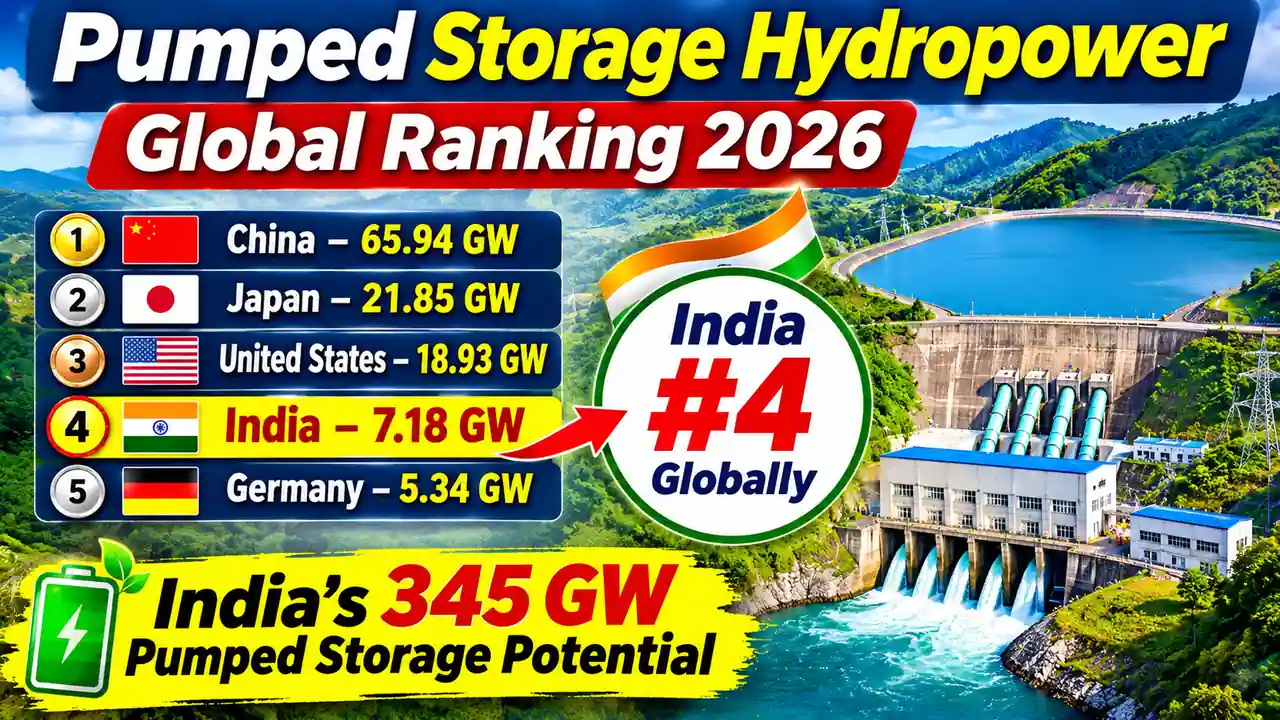
China dominates the rankings with 65.94 GW of installed capacity, accounting for approximately 41.3% of the global total. Japan and the United States occupy the next two positions, while India ranks fourth with 7.18 GW.
India’s growing investment in pumped storage projects could play an important role in supporting its clean energy transition and future electricity requirements.
🌍 Global Pumped Storage Hydropower Ranking: Key Highlights
- Global installed capacity: 159.8 GW
- First position: China – 65.94 GW
- Second position: Japan – 21.85 GW
- Third position: United States – 18.93 GW
- Fourth position: India – 7.18 GW
- Fifth position: Germany – 5.34 GW
- China’s global share: Approximately 41.3%
- India’s identified pumped storage potential: 345.38 GW
The international rankings are based on year-end 2025 installed capacity figures presented in the government’s 2026 energy sector publication.
💧 What Is Pumped Storage Hydropower?
Pumped storage hydropower, commonly known as a water battery, is an established technology that allows electricity to be stored for future use.
Unlike conventional power plants that primarily generate electricity, pumped storage facilities can absorb surplus electricity and release stored energy when required.
These systems generally use two water reservoirs located at different elevations.
When surplus electricity is available, pumps transfer water from the lower reservoir to the upper reservoir. When electricity demand increases, the stored water flows downhill through turbines to generate electricity.
The process can be repeated, allowing the facility to operate as a large-scale rechargeable energy storage system.
The technology does not create additional energy. Some electricity is lost during pumping and generation, but its ability to shift electricity supply to periods of higher demand makes it valuable.
⚡ How Do Water Batteries Generate Electricity?
Pumped storage hydropower operates through four principal stages:
- Charging: Surplus electricity powers pumps that move water uphill.
- Storage: Water remains in the upper reservoir, storing gravitational potential energy.
- Discharging: Water flows downhill through hydroelectric turbines when electricity is required.
- Recharging: Water collects in the lower reservoir and can be pumped uphill again.
This system is particularly useful for storing surplus solar electricity generated during daylight hours and supplying electricity during evening demand peaks.
📊 Top 5 Countries by Pumped Storage Hydropower Capacity
| Rank | Country | Installed Capacity | Global Share |
|---|---|---|---|
| 1 | 🇨🇳 China | 65.94 GW | 41.26% |
| 2 | 🇯🇵 Japan | 21.85 GW | 13.67% |
| 3 | 🇺🇸 United States | 18.93 GW | 11.85% |
| 4 | 🇮🇳 India | 7.18 GW | 4.49% |
| 5 | 🇩🇪 Germany | 5.34 GW | 3.34% |
Source: IRENA Renewable Capacity Statistics 2026, as presented by PIB. Global shares are calculated using the reported worldwide capacity of 159.8 GW.
🇨🇳 China Dominates the Global Pumped Storage Sector
China has established a substantial lead in pumped storage hydropower infrastructure.
Its installed capacity exceeds the combined capacity of Japan, the United States and India.
One of China’s most prominent facilities is the Fengning Pumped Storage Power Station, which has an installed generating capacity of 3,600 megawatts (MW).
Developing large storage facilities helps electricity networks manage fluctuations in renewable power generation. This becomes increasingly important as more solar and wind farms are connected to the grid.
China’s extensive pumped storage infrastructure demonstrates the growing importance of energy storage alongside electricity generation.
🇮🇳 India Ranks Fourth in Global Pumped Storage Capacity
India’s fourth-place ranking in the government-published international comparison highlights the country’s progress in large-scale electricity storage.
India recorded 7.18 GW of installed pumped storage capacity at the end of 2025. According to government figures, this increased to approximately 7.43 GW by July 2026.
The country is also developing additional facilities to strengthen its electricity infrastructure.
With rising electricity consumption, expanding industrial activity and increasing renewable energy generation, storage technologies could become increasingly important for India’s energy security.
🚀 India’s Pumped Storage Hydropower Potential
India has identified approximately 345.38 GW of pumped storage potential across 320 projects.
The country’s varied geography provides opportunities for developing reservoirs and storage facilities in several regions.
| Region | Identified Potential |
|---|---|
| Western India | 129.72 GW |
| Southern India | 97.76 GW |
| Eastern India | 53.41 GW |
| Northern India | 50.32 GW |
| North Eastern India | 14.18 GW |
The Western Region has the largest identified potential, supported by favourable geographical characteristics in several locations.
Maharashtra, Gujarat, Andhra Pradesh, Telangana, Tamil Nadu and Odisha are among the states with significant development opportunities.
However, identified potential should not be confused with installed capacity. Many proposed projects still require technical studies, investment, regulatory approvals and construction.
🏗️ Major Pumped Storage Hydropower Projects Around the World
Fengning Pumped Storage Power Station, China
With 3,600 MW of installed capacity, Fengning is among the world’s largest pumped storage facilities.
Bath County Pumped Storage Station, United States
The Bath County facility has a generating capacity of approximately 3,003 MW and is a major example of large-scale electricity storage infrastructure.
Okutataragi Pumped Storage Power Station, Japan
Japan’s Okutataragi facility has a generating capacity of approximately 1,932 MW, demonstrating the country’s long-standing experience with pumped storage technology.
☀️ Why Pumped Storage Is Important for Renewable Energy
Solar and wind power generation depends on weather conditions, making electricity production variable throughout the day.
Pumped storage facilities can help address this challenge by storing electricity during periods of surplus generation and returning it when supplies are lower.
The major advantages include:
- Improved integration of solar and wind energy.
- Better management of peak electricity demand.
- Increased power grid flexibility.
- Long-duration electricity storage opportunities.
- Reduced curtailment of surplus renewable generation.
- Potentially lower dependence on fossil-fuel-based peak power generation.
Pumped storage can complement lithium-ion batteries rather than completely replacing them.
🏛️ India’s Plans for Future Pumped Storage Development
The Indian government has introduced policy measures intended to encourage pumped storage development.
These include infrastructure assistance, competitive procurement mechanisms and streamlined project appraisal procedures.
According to government planning documents, India’s cumulative pumped storage capacity could reach approximately 105.56 GW by the financial year 2035–36 if the envisaged projects are commissioned as planned.
Achieving this expansion will require substantial investment, suitable locations, transmission infrastructure and responsible environmental management.
⚠️ Challenges of Pumped Storage Hydropower
Despite its advantages, pumped storage technology faces several challenges.
Building reservoirs, tunnels, pumping stations and powerhouses can require significant capital expenditure and lengthy construction periods.
Projects must also consider water availability, geological conditions, biodiversity, land requirements and potential impacts on nearby communities.
Careful environmental assessments and transparent consultation are essential to ensure that new infrastructure delivers sustainable benefits.
❓ Frequently Asked Questions (FAQs)
1. Which country has the highest pumped storage hydropower capacity?
China leads the government-published global comparison with 65.94 GW of installed capacity at the end of 2025.
2. What is India’s rank in pumped storage hydropower?
India ranks fourth in the international comparison published by PIB using IRENA statistics.
3. What is India’s installed pumped storage capacity?
India had 7.18 GW at the end of 2025, increasing to approximately 7.43 GW by July 2026.
4. Why is pumped storage called a water battery?
It stores energy by pumping water uphill and releases that energy by allowing water to flow downhill through turbines.
5. What is China’s share of global pumped storage capacity?
China accounts for approximately 41.3% of the reported worldwide installed capacity.
6. What is India’s total pumped storage potential?
India has identified approximately 345.38 GW of potential across 320 projects.
7. Can pumped storage replace lithium-ion batteries?
Not entirely. Both technologies have different advantages, and they can work together to support electricity networks.
8. What is India’s projected pumped storage capacity by 2035–36?
Government planning documents envisage approximately 105.56 GW of cumulative capacity, subject to successful project implementation.
📝 Conclusion
Pumped storage hydropower is becoming increasingly important as the world transitions towards renewable energy and more flexible electricity networks.
China remains the dominant country in the reported global comparison, while India’s fourth-place ranking demonstrates its growing presence in the energy storage sector.
With substantial identified potential and ambitious infrastructure development plans, India has an opportunity to expand its water battery capabilities and strengthen its future electricity system.
Successful implementation, responsible environmental planning and continued investment will determine how effectively India converts this potential into operational energy storage capacity.