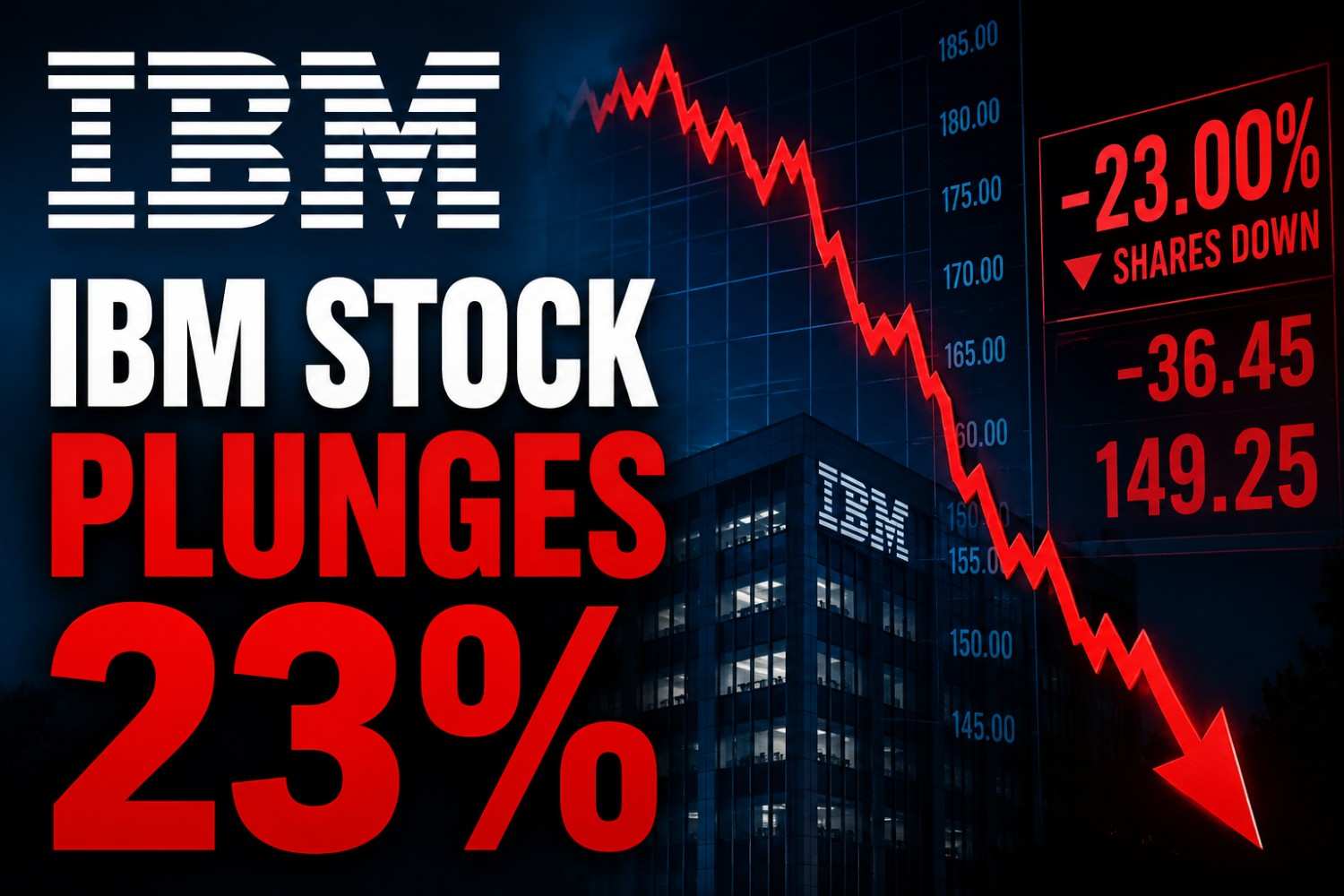
IBM Stock: International Business Machines (IBM) shocked Wall Street on Tuesday after its stock plunged 23%, following the release of preliminary second-quarter earnings that missed analyst expectations.
The sharp decline marks IBM’s biggest one-day drop since October 19, 1987, when the company’s shares fell 23.7% during the infamous Black Monday market crash.
The unexpected earnings miss has raised fresh concerns about enterprise technology spending and whether the rapid shift toward AI infrastructure investments is beginning to pressure traditional software companies.
📊 IBM Misses Revenue and Earnings Expectations
IBM reported preliminary second-quarter adjusted earnings of $2.93 per share on $17.2 billion in revenue.
Unfortunately, those numbers fell short of Wall Street estimates.
IBM Q2 Results vs Expectations
| Metric | Reported | Expected |
|---|---|---|
| Adjusted EPS | $2.93 | $3.01 |
| Revenue | $17.2 Billion | $17.86 Billion |
The weaker-than-expected results immediately triggered heavy selling, sending IBM shares sharply lower during Tuesday’s trading session.
💬 CEO Arvind Krishna Explains the Earnings Miss
IBM CEO Arvind Krishna said the disappointing quarter was largely driven by an unexpected shift in customer spending priorities.
Instead of purchasing software and infrastructure services, many enterprise clients redirected their budgets toward AI hardware, including:
- 💾 Memory chips
- 🖥️ Servers
- 📦 Storage infrastructure
According to Krishna:
“In the last few weeks of June, we saw clients shift their quarterly capital expenditures toward servers, storage, and memory purchases to secure supply-constrained infrastructure ahead of expected price increases.”
Although IBM expected some supply-chain disruption, management admitted the magnitude of the spending shift caught the company off guard.
Krishna also acknowledged execution problems, stating that several major enterprise deals failed to close before the end of the quarter.
⚠️ IBM Admits Execution Fell Short
Beyond changing customer priorities, IBM admitted internal execution issues also hurt quarterly performance.
Krishna noted that the company did not respond quickly enough to changing market conditions.
Several high-value contracts that IBM expected to finalize during the quarter were delayed, contributing significantly to the earnings shortfall.
That combination of weaker software demand and slower deal closures amplified investor concerns.
📈 A Sharp Reversal After a Strong First Quarter
The disappointing second-quarter update contrasts sharply with IBM’s impressive performance earlier this year.
During the first quarter, IBM exceeded analyst expectations.
IBM First Quarter Highlights
- ✅ Software revenue increased 11% to $7.05 billion
- ✅ Adjusted EPS reached $1.91, beating estimates of $1.81
- ✅ Revenue totaled $15.92 billion, ahead of expectations of $15.62 billion
That strong start had boosted confidence in IBM’s turnaround strategy, making Tuesday’s warning even more surprising.
🤖 AI Spending Is Reshaping Enterprise Technology
IBM’s earnings warning also highlights a broader trend sweeping across the technology sector.
As companies race to build artificial intelligence infrastructure, enterprise customers are increasingly prioritizing investments in:
- 🚀 AI servers
- 💾 High-bandwidth memory
- ⚡ Data center upgrades
- 🖥️ GPU infrastructure
These purchases are consuming larger portions of corporate technology budgets, leaving less available for traditional software projects.
This shift is beginning to affect even established technology companies like IBM.
💾 Memory Chip Companies Continue to Benefit
While IBM struggled, memory manufacturers continue to benefit from booming AI demand.
Companies producing advanced memory chips have seen rapidly increasing orders as cloud providers and AI developers expand their infrastructure.
Growing demand for high-performance memory has become one of the biggest winners of the AI revolution.
📉 Why IBM Stock Fell So Much
Several factors combined to trigger IBM’s steep decline:
- ❌ Revenue missed Wall Street expectations
- ❌ Earnings came in below analyst forecasts
- ❌ Enterprise customers shifted spending toward AI hardware
- ❌ Large software deals were delayed
- ❌ Management acknowledged execution mistakes
- ❌ Investors worry AI spending could pressure traditional software growth
Together, these issues sparked one of IBM’s worst trading days in decades.
🔍 What Investors Should Watch Next
Investors will closely monitor IBM’s next earnings report for signs that:
- 📈 Software demand stabilizes
- 🤝 Delayed enterprise contracts begin closing
- 🤖 AI-related products generate stronger revenue
- 💼 Corporate IT spending returns to software projects
- 📊 Profit margins recover during the second half of the year
The company’s ability to adapt to the rapidly evolving AI market could determine whether Tuesday’s sell-off proves temporary or signals a longer-term challenge.
📝 Final Take
IBM’s 23% stock plunge reflects more than just a disappointing earnings report. It underscores how quickly enterprise technology spending is changing as artificial intelligence reshapes corporate investment priorities.
While IBM remains one of the world’s largest technology companies with a strong enterprise customer base, investors are now looking for evidence that management can successfully navigate the AI transition, improve execution, and restore growth in its software business.
If IBM can regain momentum in future quarters, confidence may return. Until then, the company faces increased scrutiny from Wall Street as competition and AI-driven disruption continue to reshape the technology landscape.
🔑 Keypoints
IBM stock, IBM stock crashes 23%, IBM earnings, IBM Q2 earnings, IBM revenue miss, Arvind Krishna, IBM earnings warning, IBM stock news, AI infrastructure spending, IBM software revenue, IBM shares, IBM stock price today, IBM latest news, enterprise software, AI hardware demand