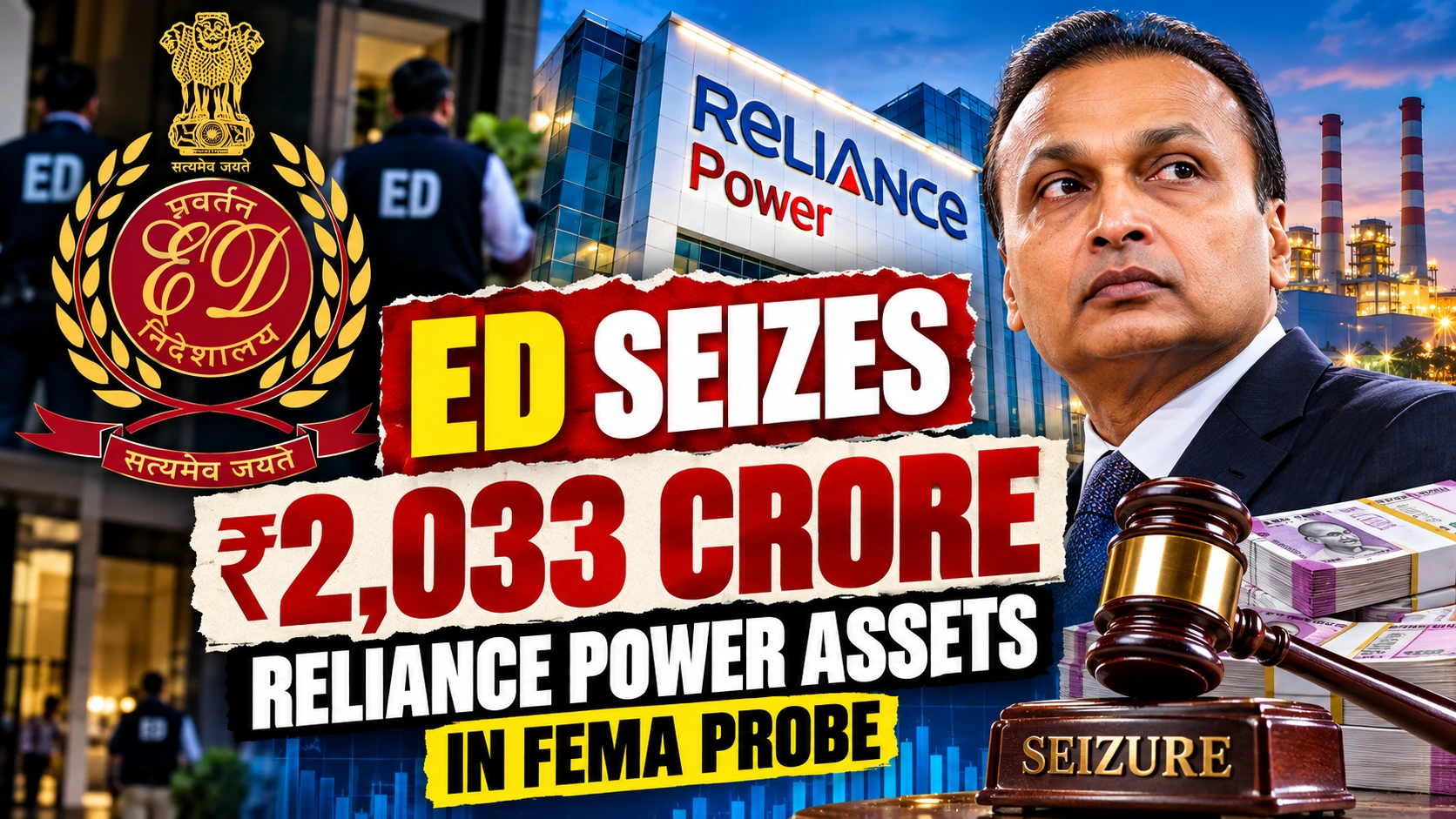
ED seizes Reliance Power assets: The Enforcement Directorate (ED) has announced the seizure of assets worth ₹2,032.81 crore belonging to Reliance Power Limited, an Anil Ambani Group company, as part of an investigation into alleged violations of India’s foreign exchange regulations.
The action involves shares held by Reliance Power in Sasan Power Limited and certain bank balances. The investigation concerns historical overseas financial transactions, including investments and loans involving entities in Singapore, the British Virgin Islands, and other jurisdictions.
Reliance Power has disputed the allegations and maintained that the relevant overseas investments were undertaken with applicable approvals.
🔴 ED Takes Major Action Against Reliance Power
The Enforcement Directorate announced the action on Wednesday, October 14, 2026, following a seizure order issued on October 12.
The order was made under Section 37A of the Foreign Exchange Management Act (FEMA), 1999.
According to the reported details, the assets covered by the order are valued at ₹2,032.81 crore.
The investigation focuses on whether foreign exchange was held outside India in violation of applicable regulations.
The agency has alleged that certain historical transactions involved overseas entities and financial arrangements that require further scrutiny.
However, the seizure is a regulatory enforcement action and does not, by itself, establish that the company has committed the alleged violations.
Reliance Power: ED Asset Seizure Breakdown
FEMA investigation | Reported financial figures
Asset Composition
Investigation Timeline
Reliance Natural Resources raised $300 million through foreign currency convertible bonds.
Historical overseas investment referenced in Reliance Power’s response.
ED issued the asset seizure order under FEMA Section 37A.
ED publicly detailed the action involving assets worth ₹2,032.81 crore.
Reliance Power disputes the allegations. The seizure is provisional and subject to statutory procedures. It does not constitute a final finding of wrongdoing.
📊 Reliance Power Asset Seizure: Key Financial Details
The seizure order covers two major categories of assets.
| Asset category | Reported value |
|---|---|
| Shares in Sasan Power Limited | ₹2,026.65 crore |
| Reliance Power bank balances | ₹6.16 crore |
| Total assets covered | ₹2,032.81 crore |
The overwhelming majority of the amount relates to Reliance Power’s shareholding in its wholly owned subsidiary, Sasan Power Limited.
The bank balances account for a comparatively small portion.
Reliance Power has stated that the Sasan Power shares were already pledged in favour of Power Finance Corporation Limited under security arrangements established more than a decade ago.
This distinction is important because the reported seizure does not mean that ₹2,032.81 crore in cash was taken from the company’s bank accounts.
🔍 Why Is the Enforcement Directorate Investigating Reliance Power?
The investigation reportedly began after information received from the Securities and Exchange Board of India (SEBI) raised concerns about certain financial entries in Reliance Power’s accounts.
These entries involved write-offs and provisions aggregating ₹2,101.46 crore.
The amounts were connected to historical overseas investments and advances involving entities incorporated in jurisdictions including the British Virgin Islands and the Cayman Islands.
A write-off generally refers to an accounting decision to reduce or remove the recorded value of an asset. A provision recognises an expected loss or liability.
Such entries do not automatically establish wrongdoing.
However, they can attract regulatory attention when questions arise about the underlying transactions, the movement of funds, or compliance with financial reporting requirements.
🌍 How the Overseas Transactions Allegedly Worked
The investigation examines transactions dating back approximately two decades.
According to the ED’s account, Reliance Natural Resources Limited, which subsequently merged with Reliance Power, raised $300 million through foreign currency convertible bonds in 2006.
Of that amount, approximately $275 million was invested in a wholly owned Singapore subsidiary, Reliance Natural Resources (Singapore) Private Limited.
The funds were subsequently deposited with Deutsche Bank (Suisse) SA in Geneva.
Investigators allege that these deposits were used as collateral for loans extended to entities incorporated in the British Virgin Islands.
The ED is examining the ownership, control, and commercial purpose of these arrangements.
The agency alleges that the offshore entities were effectively controlled and managed from India by persons associated with the Reliance Anil Ambani Group.
These claims remain allegations within the investigation.
⚠️ ED Raises Questions About Fund Movement and Documents
Another significant aspect of the investigation concerns the movement of funds through multiple overseas entities.
According to the agency, some loan proceeds were allegedly routed through Mauritius-based entities before being brought temporarily into India.
Investigators have also questioned whether certain funds ultimately remained outside India in contravention of foreign exchange regulations.
The ED has further alleged that documentation was created or backdated to portray some transactions as legitimate business advances.
The agency’s account suggests that these documents related to advances involving the Singapore subsidiary and Indonesian subsidiaries.
These allegations are serious because accurate documentation and compliance with overseas investment rules are essential to cross-border financial transactions.
Nevertheless, the allegations must be evaluated through the applicable legal and regulatory process.
⚖️ What Is FEMA Section 37A?
The Foreign Exchange Management Act, 1999, regulates various foreign exchange transactions involving Indian residents and businesses.
Section 4 generally restricts residents from holding or transferring foreign exchange, foreign securities, or immovable property outside India except as permitted under the law.
Section 37A provides a mechanism for seizing equivalent-value assets in India when authorised authorities have reason to believe that certain foreign assets are held in contravention of Section 4.
Importantly, such a seizure is subject to statutory procedures and review.
The seizure order does not automatically mean that the affected assets have been permanently confiscated.
The legal process provides opportunities for the relevant parties to contest the action.
🏢 What Has Reliance Power Said About the ED Action?
Reliance Power has challenged the allegations underlying the seizure order.
In its regulatory disclosure, the company stated that the matter relates to foreign currency convertible bonds issued in 2006 and an overseas investment undertaken in 2008.
The company maintained that the relevant investment was made with applicable approvals.
It also said that the seizure order is provisional and subject to confirmation by the competent authority.
Reliance Power indicated that it would take appropriate legal steps to protect the interests of the company, its shareholders, and other stakeholders.
The company further stated that no penalty had been imposed under the reported order.
Its response is important because the ED’s allegations and Reliance Power’s position represent different sides of an ongoing regulatory dispute.
📉 What Does the Seizure Mean for Reliance Power Shareholders?
The ED action introduces an additional regulatory and legal uncertainty for Reliance Power.
Investors may closely examine how the proceedings affect the company’s financial position, asset flexibility, and future disclosures.
The restriction on dealing with the seized assets could become relevant to corporate financing or restructuring decisions.
However, the reported value of the seizure should not be interpreted as an immediate operating loss of the same amount.
The order largely concerns shares in Sasan Power rather than cash balances.
Its eventual financial implications will depend on legal developments, regulatory decisions, and any further company disclosures.
There is also no basis in the reported information alone to predict a specific movement in Reliance Power’s share price.
🔮 What Happens Next in the Reliance Power FEMA Case?
The next important stage involves the statutory review of the seizure order and any legal challenge pursued by Reliance Power.
The competent authority’s decision will be significant in determining whether the provisional seizure is confirmed.
Investors and market observers will also watch for additional disclosures about the historical transactions and their financial implications.
Further developments could clarify the regulatory position of the company and the status of the affected assets.
Until then, the allegations remain contested.
❓ Frequently Asked Questions
1. Why did the ED seize Reliance Power assets?
The ED seized assets worth ₹2,032.81 crore as part of a FEMA investigation into alleged foreign exchange violations connected to historical overseas financial transactions.
2. How much money is involved in the Reliance Power seizure?
The order covers ₹2,032.81 crore in assets, including Sasan Power shares valued at ₹2,026.65 crore and bank balances of ₹6.16 crore.
3. Has Reliance Power accepted the allegations?
No. Reliance Power has disputed the allegations and stated that the relevant overseas investments were made with applicable approvals.
4. What is Sasan Power’s connection to the case?
Sasan Power is a wholly owned subsidiary of Reliance Power. Shares in the subsidiary represent the largest portion of the assets covered by the seizure order.
5. Does the ED seizure mean Reliance Power has been found guilty?
No. The seizure is part of an ongoing regulatory process. It does not itself constitute a final determination that the alleged violations occurred.
6. Will Reliance Power shares fall after the ED action?
The reported information does not establish how the share price will move. Market performance depends on several factors, including investor expectations, company fundamentals, and subsequent developments.
✅ Conclusion
The ED’s ₹2,032.81 crore asset seizure involving Reliance Power represents a significant development in an investigation into historical overseas financial transactions.
While the Enforcement Directorate has raised allegations concerning foreign exchange compliance and offshore arrangements, Reliance Power has rejected the claims and maintained that its investments received the necessary approvals.
The next legal and regulatory decisions will be important for determining the outcome.
For shareholders and business observers, the central issues are the status of the provisional seizure, the company’s legal response, and the potential financial implications.
Disclaimer: This article is for general news and informational purposes only. It does not constitute investment advice. The allegations described are disputed and have not been presented as final findings of guilt.