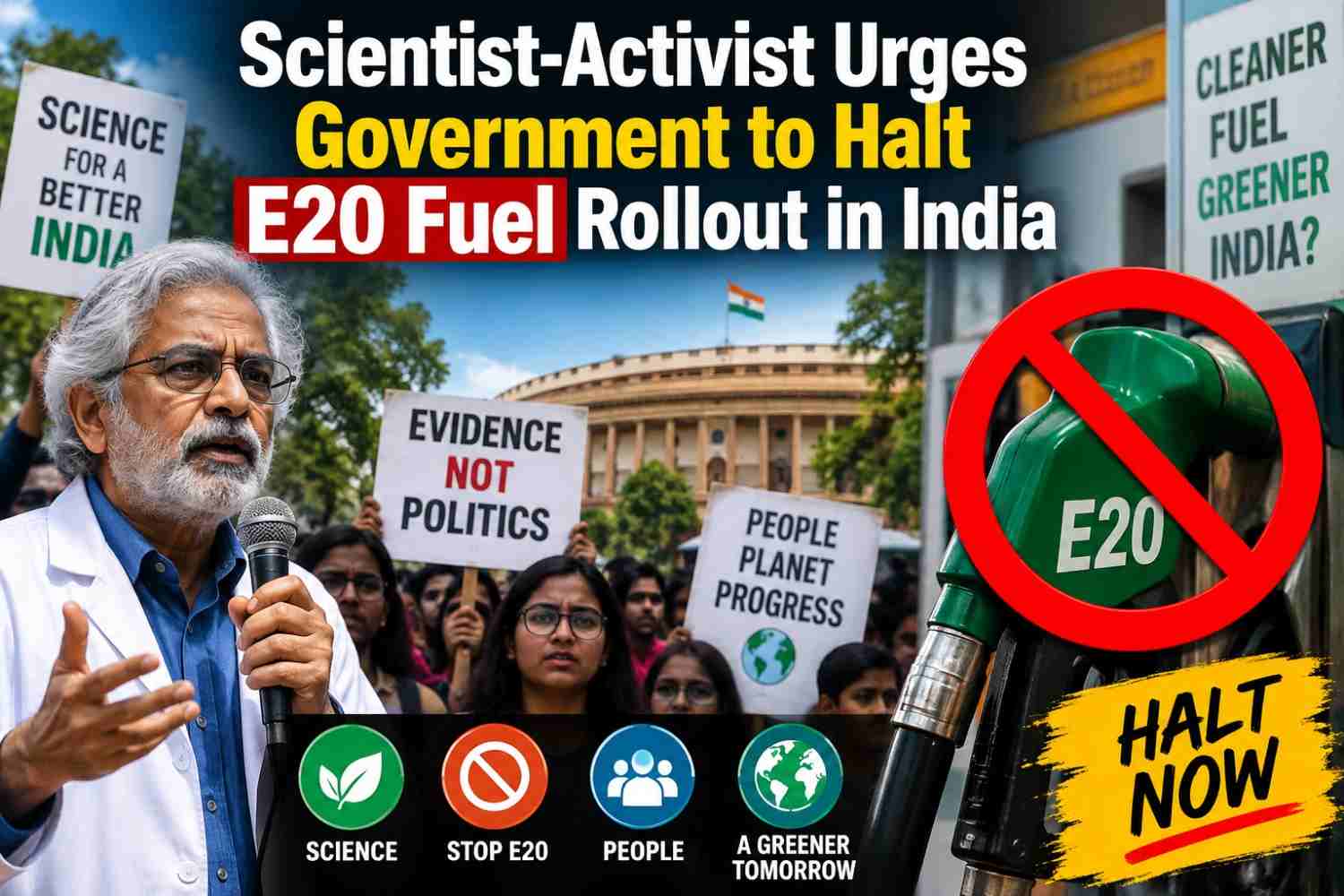
Scientist-Activist Urges Government to Halt E20 Fuel Rollout in India: A group of prominent scientists, academics and activists has urged the government to halt the E20 fuel rollout, abolish the National Testing Agency (NTA) and introduce a nationwide law against black magic.
The demands were raised through a joint appeal issued during the India March for Science in Mumbai, with participants calling for government policies to be guided by scientific evidence and rational decision-making.
The signatories also raised concerns about what they described as the promotion of pseudoscience, insufficient consideration of scientific evidence in policymaking and declining public investment in education and scientific research.
🔬 Scientists and Academics Join the Appeal
The joint appeal carries the names of several scientists, academics and public figures.
Among the signatories are Padma Bhushan awardee Prof. M.S. Raghunathan of CEBS, Mumbai; SSB awardee and Breakthrough Science Society President Prof. S.G. Dani; Prof. Aniket Sule of HBCSE-TIFR; Prof. B.M. Arora, associated with Mumbai University and formerly with TIFR; Dr. N. Krishnan, formerly of TIFR; and Anil Kumar Singh, Secretary of the Mumbai Press Club.
Their broader message focuses on strengthening scientific thinking and ensuring that major public policies are evaluated using evidence.
⛽ Why Are Scientists Calling for a Halt to E20 Fuel?
One of the major demands highlighted in the appeal concerns India’s E20 fuel policy.
E20 petrol is a blend containing 20% ethanol and 80% petrol.
The group called for an immediate halt to the policy, citing concerns including what it described as a lack of a comprehensive life-cycle environmental assessment and insufficient supporting infrastructure.
A life-cycle assessment examines environmental impacts across different stages of a product or fuel’s life, rather than evaluating only emissions produced during its final use.
The scientists and activists argue that such evidence should play a central role in decisions concerning large-scale changes to India’s fuel system.
Their position represents the group’s demand and should not be interpreted as an official government finding that E20 fuel is unsafe or environmentally harmful.
🏛️ Opposition Parties Have Also Criticised E20 Policy
The E20 rollout has previously faced political criticism as well.
Opposition parties including the Aam Aadmi Party (AAP) and Shiv Sena (UBT) have raised objections to aspects of the government’s ethanol-blended petrol policy.
The scientists’ appeal, however, places its criticism within a broader call for evidence-based public policy, environmental assessment and scientific scrutiny.
📝 Scientists Call for Abolition of NTA
The National Testing Agency (NTA) was another major focus of the appeal.
Referring to controversies involving examination paper leaks and protests surrounding the NEET examination system, the group called for the abolition of the NTA and reforms to India’s examination framework.
The appeal reflects concerns about the integrity and administration of large-scale competitive examinations.
The demand to abolish the agency is the position of the signatories and does not mean that such a policy decision has been adopted by the government.
🚫 Nationwide Law Against Black Magic Demanded
The scientists and activists also called for a nationwide law against black magic and harmful superstitious practices.
The demand forms part of their broader campaign promoting scientific temper, rational thinking and opposition to pseudoscientific practices.
According to the organizers’ message, scientific thinking should extend beyond laboratories and research institutions and play a larger role in everyday society and public decision-making.
🌍 Climate Change and Environmental Concerns Raised
Environmental issues were another major part of the appeal.
The scientists highlighted concerns surrounding melting glaciers, rising sea levels, ecosystem degradation and accelerating species extinction.
These issues, they argued, reinforce the importance of basing environmental and development policies on scientific evidence.
The campaign seeks greater involvement of scientists and researchers in discussions surrounding policies with significant environmental consequences.
🎓 Scientists Demand Higher Education Spending
The appeal also calls for substantially greater public investment in education.
The scientists demanded that at least:
- 10% of the Central government’s budget be allocated to education.
- 30% of state government budgets be allocated to education.
The proposal represents the funding targets sought by the campaigners rather than currently approved government allocations.
Organizers argue that stronger investment in education is essential for improving scientific literacy, developing skilled human resources and strengthening India’s long-term research capabilities.
🧪 Research Spending Should Rise to 3% of GDP, Group Says
The appeal also seeks a significant increase in India’s expenditure on scientific research.
The campaigners said research expenditure should increase from around 0.7% of GDP to at least 3% of GDP.
Increasing research investment, they argue, could help expand scientific infrastructure, support researchers and strengthen India’s capacity for innovation.
🚶 What Is the India March for Science?
The March for Science movement emerged internationally in 2017, with events taking place across hundreds of cities around the world.
Indian chapters have subsequently organized marches and related campaigns advocating scientific temper, evidence-based policymaking and greater investment in education and research.
The movement brings together scientists, academics, teachers, students and citizens concerned about the role of science in society and government decision-making.
🔑 Key Takeaways
The latest appeal from scientists and activists focuses on several major demands: halting the E20 fuel rollout pending greater scientific scrutiny, abolishing the NTA and reforming competitive examinations, introducing nationwide legislation against black magic, increasing education funding and substantially raising India’s investment in scientific research.
The campaign also highlights climate change, biodiversity loss, scientific temper and evidence-based policymaking as key national priorities.
Under the slogan “Embrace Science, Secure the Future,” organizers called on scientists, teachers, students and citizens to promote the scientific method and rational thinking.
❓ Frequently Asked Questions (FAQ)
What is E20 fuel?
E20 is petrol blended with 20% ethanol and 80% petrol. India’s ethanol-blending strategy aims to increase the proportion of ethanol used in automotive fuel.
Why are scientists asking the government to halt E20 fuel?
The group behind the India March for Science appeal cited concerns about the need for life-cycle environmental assessment and supporting infrastructure. These are concerns raised by the campaigners, not a finding that E20 fuel has officially been declared unsafe.
Have scientists demanded the abolition of NTA?
Yes. The signatories to the appeal called for the abolition of the National Testing Agency and reforms to the examination system, referring to controversies surrounding examination administration and paper leaks.
What education funding are the scientists demanding?
The campaigners are calling for at least 10% of the Central budget and 30% of state budgets to be allocated to education.
How much research spending are they demanding?
The group wants research expenditure to reach at least 3% of India’s GDP, compared with the approximately 0.7% figure cited in its appeal.
What is the India March for Science?
It is part of a broader movement advocating scientific thinking, evidence-based policymaking, research investment and greater public understanding of science.
What other issues did the scientists raise?
Their appeal highlighted climate change, melting glaciers, rising sea levels, ecosystem degradation, species extinction, pseudoscience and the need to promote rational and scientific thinking.