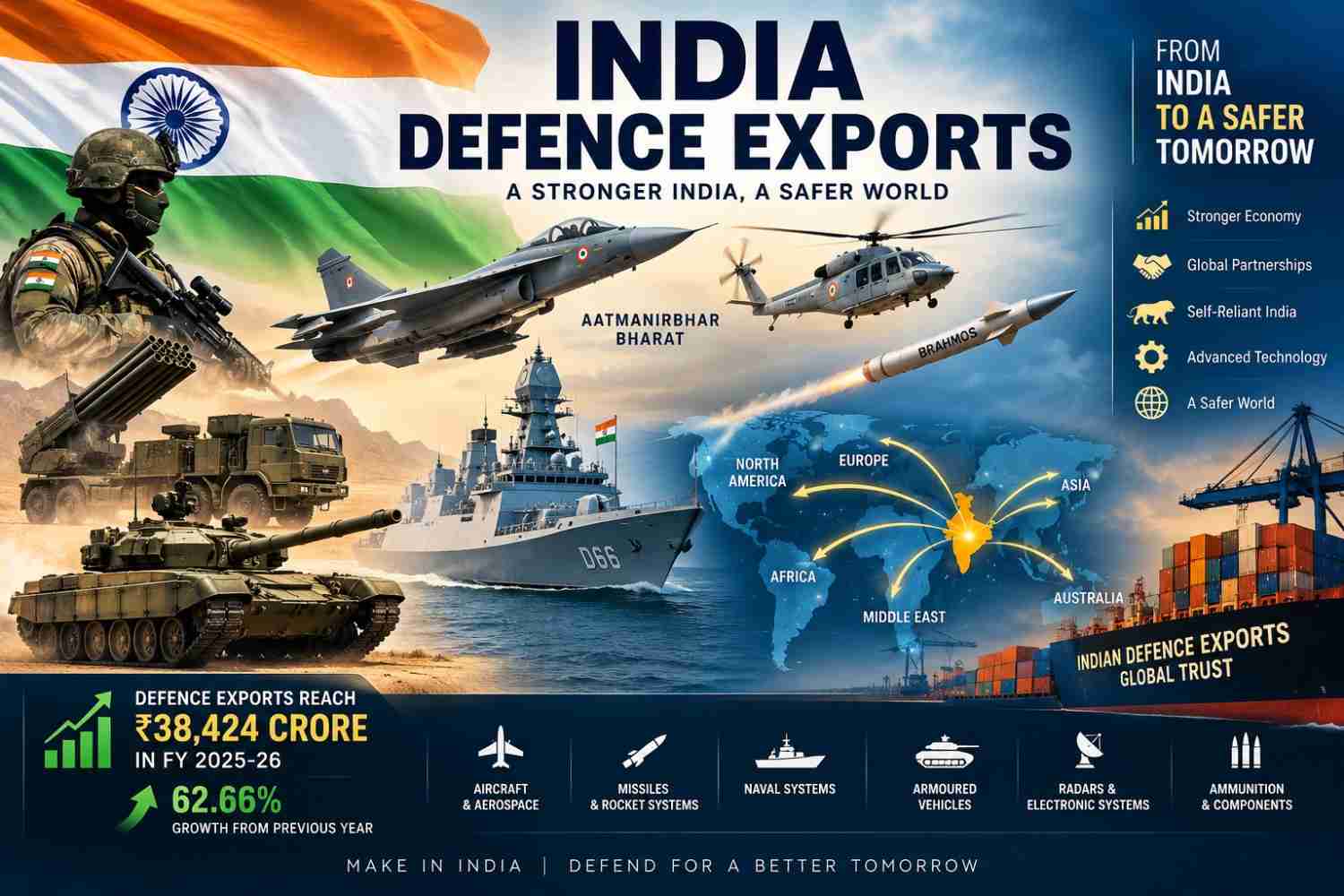
India Defence Exports: India’s defence export ambitions have entered a new phase.
Defence exports surged to an all-time high of ₹38,424 crore in FY 2025-26, jumping 62.66% from ₹23,622 crore in the previous financial year. The achievement is particularly striking when compared with FY 2013-14, when India’s defence exports stood at just ₹686 crore.
But there is a much bigger question behind the headline numbers:
Can India turn this rapid growth into a sustained position as one of the world’s leading defence exporters? 🛡️
The answer depends not simply on selling more weapons, but on India’s ability to develop globally competitive defence platforms, expand production capacity, secure long-term overseas customers, strengthen private-sector participation and reduce its own dependence on imported military equipment.
📈 India Defence Exports Reach Record ₹38,424 Crore
India recorded its highest-ever defence exports in FY 2025-26.
According to the Ministry of Defence, exports increased by ₹14,802 crore in a single year, representing growth of 62.66%.
The composition of those exports also reveals an important shift in India’s defence industrial ecosystem.
| Indicator | FY 2025-26 |
|---|---|
| 🇮🇳 Total defence exports | ₹38,424 crore |
| 🏭 DPSU contribution | ₹21,071 crore |
| 💼 Private-sector contribution | ₹17,353 crore |
| DPSU share | 54.84% |
| Private-sector share | 45.16% |
| Annual export growth | 62.66% |
Defence Public Sector Undertakings recorded particularly strong growth, with their exports rising 151% year-on-year. Private-sector defence exports also increased by around 14%.
The near-even division between public and private companies is significant because India’s long-term defence export ambitions are unlikely to be achieved by state-owned manufacturers alone.
🚀 From ₹686 Crore to ₹38,424 Crore: India’s Defence Export Transformation
The long-term growth is even more dramatic.
India’s defence exports have increased from only ₹686 crore in FY 2013-14 to ₹38,424 crore in FY 2025-26.
That represents an increase of more than 5,500% in roughly a dozen years.
India is also exporting defence equipment to more than 80 countries, while the number of exporters increased from 128 to 145 in FY26.
The country’s export basket now extends beyond basic components and ammunition. Indian companies are increasingly associated with complete or sophisticated defence systems, including:
• BrahMos supersonic cruise missiles
• Akash air-defence systems
• Pinaka rocket systems
• Dornier-228 aircraft
• Artillery systems
• Radars and electronic systems
• Armoured vehicles
• Ammunition, components and sub-systems
This evolution is crucial. Becoming a major defence exporter requires moving up the value chain from components and sub-systems toward high-value platforms and long-term defence programmes.
🌍 The Global Arms Market Is Becoming More Competitive
India’s export push comes as international demand for military equipment is increasing amid geopolitical tensions, military modernization and conflicts across multiple regions.
According to SIPRI, the volume of international transfers of major arms during 2021-25 increased 9.2% compared with 2016-20.
The United States remained overwhelmingly dominant, accounting for 42% of global exports of major arms during 2021-25.
The world’s five largest suppliers—the United States, France, Russia, Germany and China—together accounted for roughly 70% of global major-arms exports.
For India, this presents both an opportunity and a warning.
Demand is expanding, but the countries competing for contracts include some of the world’s most technologically advanced defence industries.
⚠️ Why India’s Defence Export Numbers Need Careful Comparison
There is an important statistical distinction that is frequently overlooked when India’s defence exports are compared with other countries.
India’s ₹38,424 crore figure represents the financial value of defence exports reported by the Indian government.
SIPRI, by contrast, measures international transfers of major conventional weapons using its Trend-Indicator Value (TIV) methodology. TIV is designed to measure the volume of transferred military capability and is not the financial price of an arms deal.
Therefore, India’s rupee-denominated defence export value should not be directly compared with a country’s SIPRI percentage or ranking as though they measure exactly the same thing.
This distinction is particularly important when comparing India with Pakistan, China, the United States or European arms exporters.
What can confidently be said is that India’s domestic defence exports are growing extremely rapidly—but India has not yet reached the scale, global customer base or market influence of the world’s established major arms suppliers.
🇮🇳 India Is Still the World’s Second-Largest Arms Importer
Here lies one of the biggest contradictions in India’s defence story.
While exports are hitting records, India remains heavily dependent on imported major weapons.
According to SIPRI data for 2021-25, India was the world’s second-largest importer of major arms, accounting for approximately 8.2% of global imports.
Ukraine ranked first.
The five biggest recipients of major arms during the period were:
- Ukraine
- India
- Saudi Arabia
- Qatar
- Pakistan
India’s position reflects the enormous modernization requirements of its armed forces and its security challenges involving both China and Pakistan.
There has nevertheless been progress.
Indian arms imports declined approximately 4% between 2016-20 and 2021-25, while the country’s ability to design and manufacture weapons domestically continued to expand.
🇷🇺 India’s Dependence on Russian Weapons Is Declining
Another major transformation is occurring within India’s import portfolio.
Russia historically dominated Indian arms imports. However, SIPRI data shows Russia’s share of Indian major-arms imports declining from:
70% in 2011-15 → 51% in 2016-20 → 40% in 2021-25.
India has increasingly diversified toward suppliers including France, Israel and the United States while simultaneously trying to expand indigenous manufacturing.
This diversification can reduce dependence on a single overseas supplier, but true strategic autonomy will ultimately depend on India’s ability to design and manufacture more critical systems domestically.
🏭 India’s Defence Production Hits Record ₹1.78 Lakh Crore
Exports are only one side of the story.
India’s annual defence production reached a record ₹1.78 lakh crore in FY 2025-26, increasing 15.6% from approximately ₹1.54 lakh crore a year earlier.
The longer-term transformation is substantial.
Defence production has risen from ₹43,746 crore in FY 2013-14 to ₹1.78 lakh crore in FY26—almost a fourfold increase.
Public-sector defence companies and other PSUs accounted for approximately 76% of production, while the private sector contributed about 24%.
Private-sector production reached roughly ₹42,000 crore, its highest level so far.
This expanding manufacturing base is essential because India cannot become a sustainable defence export power without first building sufficient domestic industrial capacity.
💰 Could More Foreign Investment Accelerate India’s Defence Industry?
Foreign investment represents another important piece of the strategy.
Under India’s current FDI framework, foreign investment of up to 74% is permitted through the automatic route for defence companies seeking new industrial licences.
FDI beyond 74% and up to 100% can be permitted through the government route, subject to applicable conditions.
Greater foreign participation could potentially bring:
• Advanced manufacturing technology
• Global supply-chain integration
• Capital for new production facilities
• Joint ventures with established defence companies
• Technology transfer
• Access to international customers
However, attracting investment alone will not create an export powerhouse. India also needs domestic intellectual property, research capabilities, skilled engineering talent and control over critical technologies.
🛡️ India’s Biggest Defence Companies
India already possesses a substantial network of public and private defence manufacturers.
Major public-sector companies include Hindustan Aeronautics Limited (HAL), Bharat Electronics Limited (BEL), Bharat Dynamics Limited (BDL) and Mazagon Dock Shipbuilders Limited (MDL).
The private sector is also becoming increasingly important, with companies such as Tata Advanced Systems, Larsen & Toubro, Mahindra Defence Systems and Adani Defence & Aerospace participating across aerospace, naval systems, artillery, electronics, vehicles and other defence segments.
A stronger private sector could become particularly important for innovation, cost competitiveness and faster product development.
🇨🇳 China Shows Why Domestic Defence Manufacturing Matters
China provides an important strategic lesson for India.
Over several decades, Beijing has invested heavily in domestic military research, aerospace, shipbuilding, missiles, electronics and weapons manufacturing.
One consequence is a sharp reduction in China’s dependence on imported major weapons.
SIPRI reported that Chinese arms imports fell 72% between 2016-20 and 2021-25, largely as the country continued expanding its capacity to produce major weapons domestically.
For India, the lesson is straightforward:
A country cannot achieve full strategic autonomy simply by replacing one foreign supplier with another.
It needs domestic capability across design, engines, electronics, sensors, propulsion, materials, weapons, manufacturing and software.
🎯 What India Must Do to Become a Defence Export Superpower
Record export growth gives India momentum, but maintaining that momentum will require structural changes.
1. Develop More Export-Ready Weapons
India needs a larger portfolio of proven platforms that foreign militaries can purchase with confidence.
Successful systems can become reference products that open doors to additional contracts.
2. Invest More Aggressively in Defence R&D
Future military markets will increasingly revolve around artificial intelligence, autonomous systems, drones, electronic warfare, cyber capabilities, advanced missiles, sensors and space-based systems.
India must compete technologically—not merely on price.
3. Strengthen the Private Sector
Private companies need sufficient access to major programmes, testing infrastructure, capital and export opportunities.
Greater competition can accelerate innovation and shorten development cycles.
4. Build Complete Defence Ecosystems
Customers buying sophisticated military equipment also expect training, maintenance, spare parts, upgrades and long-term technical support.
India therefore needs to sell defence ecosystems, not merely individual platforms.
5. Accelerate Export Approvals
Defence deals can take years to negotiate.
Faster and more predictable government-to-government approvals could improve India’s competitiveness when customers are comparing multiple suppliers.
6. Expand Defence Diplomacy 🌍
Defence exports are closely connected to foreign policy.
India can deepen relationships across Southeast Asia, Africa, Latin America, the Middle East and friendly Indian Ocean states through training, joint exercises, financing arrangements and industrial partnerships.
7. Reduce Critical Import Dependence
Increasing exports while remaining one of the world’s largest arms importers creates a strategic imbalance.
The ultimate test of India’s defence industrial policy will therefore be whether the country can simultaneously increase exports and reduce dependence on imported critical technologies.
📊 India’s Defence Export Story at a Glance
| Metric | Latest Position |
|---|---|
| Defence exports FY26 | ₹38,424 crore |
| YoY export growth | 62.66% |
| Defence production FY26 | ₹1.78 lakh crore |
| Private share of exports | 45.16% |
| DPSU share of exports | 54.84% |
| Global arms-import share, 2021-25 | 8.2% |
| Global arms-import rank, 2021-25 | No. 2 |
| US share of global major-arms exports | 42% |
🔮 Can India Become a Global Defence Export Power?
India’s defence sector has clearly moved beyond the stage where its export ambitions can be dismissed as marginal.
Reaching ₹38,424 crore in annual defence exports represents a major milestone, particularly considering exports stood at only ₹686 crore in FY 2013-14.
But the next phase will be considerably harder.
India must convert rapid percentage growth into sustainable global market share. That requires internationally competitive weapons, indigenous technology, dependable delivery schedules, financing, after-sales support and long-term relationships with overseas militaries.
At the same time, India’s position as the world’s second-largest importer of major arms demonstrates that the country’s defence transformation remains incomplete.
The real measure of success will therefore not simply be how many billions of rupees India exports.
It will be whether India can become a country that designs, manufactures, deploys and exports advanced military technology at global scale.
If that transition succeeds, today’s record ₹38,424 crore export figure could eventually be remembered not as the peak of India’s defence export story—but as its take-off point. 🚀🇮🇳
❓ Frequently Asked Questions (FAQs)
What are India’s defence exports in 2025-26?
India’s defence exports reached a record ₹38,424 crore in FY 2025-26, an increase of 62.66% compared with ₹23,622 crore in FY 2024-25.
How much have India’s defence exports grown since 2013-14?
India’s defence exports increased from ₹686 crore in FY 2013-14 to ₹38,424 crore in FY 2025-26, representing growth of more than 5,500%.
Is India a major arms exporter?
India is a rapidly growing defence exporter, but it is not yet comparable in scale with the world’s dominant suppliers of major weapons. The United States alone accounted for 42% of global exports of major arms during 2021-25 under SIPRI’s methodology.
Is India the world’s largest arms importer?
No. According to SIPRI, India was the second-largest recipient of major arms during 2021-25, accounting for approximately 8.2% of global imports. Ukraine ranked first.
What is India’s defence production in 2025-26?
India’s defence production reached a record ₹1.78 lakh crore in FY 2025-26, up 15.6% from the previous financial year.
How much FDI is allowed in India’s defence sector?
Up to 74% FDI is permitted through the automatic route for companies seeking new defence industrial licences. Investment beyond 74% and up to 100% may be permitted through the government route, subject to applicable rules.
Which Indian companies manufacture defence equipment?
Major companies include HAL, BEL, Bharat Dynamics, Mazagon Dock Shipbuilders, Tata Advanced Systems, Larsen & Toubro, Mahindra Defence Systems and Adani Defence & Aerospace.
Can India become a defence export superpower?
India has the manufacturing base, domestic market and geopolitical relationships required to become a much larger defence exporter. Achieving top-tier status, however, will require stronger indigenous R&D, globally competitive platforms, faster deliveries, deeper private-sector participation and reduced reliance on imported critical technologies.