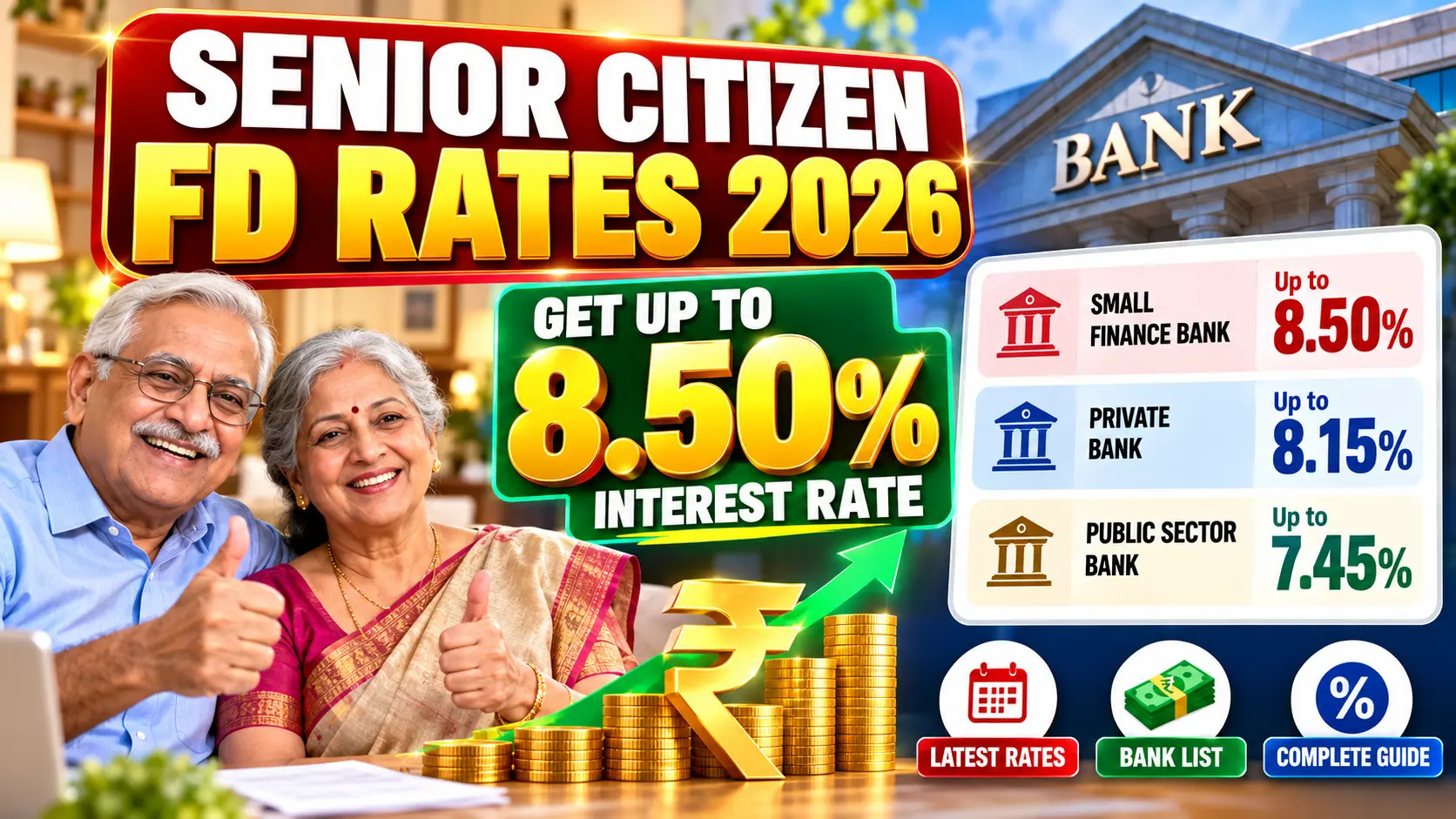
Senior Citizen FD Rates 2026: 💰 Senior citizens in India can find fixed deposit (FD) interest rates of up to 8.50% per annum at selected banks in October 2026. Small finance banks are offering some of the highest advertised rates, while private and public sector banks provide additional options for retirees seeking predictable returns.
For senior citizens who depend on their savings to support retirement expenses, choosing the right fixed deposit can make a meaningful difference to their interest income. However, the highest advertised rate does not automatically make a deposit the best choice. Investors should also consider the investment period, withdrawal conditions, deposit insurance, and the bank’s financial strength.
Here is a closer look at senior citizen FD rates, the banks offering competitive returns, and the factors to consider before investing.
🏦 Senior Citizen FD Rates in October 2026: Highlights
Here are the key points to know before comparing fixed deposits:
- Highest advertised rate: Selected banks offer up to 8.50% per annum on eligible fixed deposits.
- Small finance banks: Several small finance banks feature among the institutions offering the highest rates.
- Private banks: Some private sector banks offer rates of around 8% or more on selected tenures.
- Public sector banks: Government-owned banks generally offer lower maximum rates than the highest-rate small finance banks.
- Senior citizen benefit: Many banks provide an additional interest rate for eligible senior citizens, commonly around 0.50 percentage points above their standard rate.
- Important consideration: The maximum advertised rate may apply only to a particular tenure and deposit category.
Rates can change at any time. The figures below are indicative maximum rates reported in October 2026 comparisons, not a guarantee that every investor will qualify for them.
🏦 Senior Citizen FD Rates 2026
Compare selected banks offering competitive fixed deposit interest rates to senior citizens in India.
Important: Rates shown are reported maximum annual rates for selected eligible deposit tenures. They are not guaranteed rates for every FD. Confirm the current rate and eligibility with the bank before investing.
| Bank Category | Bank Name | Maximum Rate |
|---|---|---|
| Small Finance Bank | Equitas Small Finance Bank | 8.50% p.a. |
| Small Finance Bank | ESAF Small Finance Bank | 8.50% p.a. |
| Small Finance Bank | Suryoday Small Finance Bank | 8.50% p.a. |
| Small Finance Bank | Jana Small Finance Bank | 8.30% p.a. |
| Small Finance Bank | Ujjivan Small Finance Bank | 8.30% p.a. |
| Small Finance Bank | Shivalik Small Finance Bank | 8.25% p.a. |
| Small Finance Bank | Utkarsh Small Finance Bank | 8.25% p.a. |
| Private Bank | SBM Bank India | 8.15% p.a. |
| Private Bank | DCB Bank | 8.00% p.a. |
| Private Bank | Bandhan Bank | 7.95% p.a. |
| Public Sector Bank | Bank of India | 7.45% p.a. |
| Public Sector Bank | Punjab & Sind Bank | 7.35% p.a. |
| Public Sector Bank | Bank of Baroda | 7.25% p.a. |
| Public Sector Bank | Central Bank of India | 7.25% p.a. |
| Public Sector Bank | Indian Bank | 7.15% p.a. |
Disclaimer: This table is for general information only and is not investment advice. Rates, eligibility, deposit limits, and tenure conditions may change. Verify the latest terms with the relevant bank.
📊 Which Banks Offer the Highest FD Interest Rates to Senior Citizens?
Small finance banks are among the leading options for senior citizens seeking higher FD returns. Some private banks also offer competitive rates, while public sector banks may appeal to customers who prefer established government-owned institutions.
The following comparison summarises selected banks and their reported maximum rates for eligible deposits below ₹3 crore.
| Bank category | Bank | Reported maximum rate |
|---|---|---|
| Small finance bank | Equitas Small Finance Bank | 8.50% |
| Small finance bank | ESAF Small Finance Bank | 8.50% |
| Small finance bank | Suryoday Small Finance Bank | 8.50% |
| Small finance bank | Jana Small Finance Bank | 8.30% |
| Small finance bank | Ujjivan Small Finance Bank | 8.30% |
| Small finance bank | Shivalik Small Finance Bank | 8.25% |
| Small finance bank | Utkarsh Small Finance Bank | 8.25% |
| Private bank | SBM Bank India | 8.15% |
| Private bank | DCB Bank | 8.00% |
| Private bank | Bandhan Bank | 7.95% |
| Public sector bank | Bank of India | 7.45% |
| Public sector bank | Punjab & Sind Bank | 7.35% |
| Public sector bank | Bank of Baroda | 7.25% |
| Public sector bank | Central Bank of India | 7.25% |
| Public sector bank | Indian Bank | 7.15% |
Please note: These are reported maximum rates across eligible deposit tenures, not rates available on every FD. The applicable rate depends on the bank’s latest schedule, deposit duration, amount, customer eligibility, and scheme conditions.
💵 How Much Interest Can Senior Citizens Earn on a ₹1 Lakh FD?
The interest earned depends on the principal, annual interest rate, tenure, and interest payment method.
For example, suppose a senior citizen invests ₹1,00,000 in a fixed deposit offering 8.50% annual interest.
Illustrative calculation:
- Deposit amount: ₹1,00,000
- Annual interest rate: 8.50%
- Approximate simple interest for one year: ₹8,500
- Approximate principal plus interest after one year: ₹1,08,500
This calculation assumes simple interest without compounding, taxes, or other adjustments. Actual maturity proceeds can differ depending on the bank’s compounding frequency, payout option, and deposit terms.
For a cumulative FD, interest may be compounded and reinvested. For a non-cumulative FD, interest may be paid monthly, quarterly, half-yearly, or annually, depending on the scheme. Monthly payouts may also be calculated using a discounted rate rather than simply dividing the annual interest by 12.
Before investing, use the bank’s official FD calculator to check the expected maturity value or periodic income.
👴 Why Are Senior Citizen FD Rates Often Higher?
Many Indian banks offer additional interest to senior citizens, generally defined as customers aged 60 or above.
The additional interest is intended to make fixed deposits more attractive to older customers who may prioritise predictable income and capital preservation.
However, the benefit is subject to each bank’s eligibility rules. Certain special deposit schemes may have different conditions, and the additional rate may not apply to every product or customer category.
Senior citizens should confirm their eligibility and the applicable rate before opening an account.
🔍 Small Finance Banks vs Private Banks vs Public Sector Banks
Choosing between bank categories involves more than comparing interest rates.
1. Small finance banks
Small finance banks often advertise higher fixed deposit rates than larger commercial banks. They may be worth considering for investors who want to increase their interest income.
However, compare the bank’s deposit insurance coverage, financial disclosures, withdrawal conditions, and customer service before committing a large amount.
2. Private sector banks
Private banks offer a wide range of FD tenures, digital services, and payout options. Some offer competitive rates on selected deposit periods.
For customers who already bank with a private institution, convenience and account access may also influence the decision.
3. Public sector banks
Public sector banks may offer lower maximum rates than some small finance banks. Nevertheless, senior citizens may prefer them because of established branch networks, familiarity, and the convenience of managing existing accounts.
No bank category should be selected solely on its name or headline interest rate. Compare the actual product and understand the risks.
🛡️ Is Your Fixed Deposit Safe? Understand DICGC Insurance
Deposit safety is especially important for retirees who cannot easily replace their savings.
Eligible deposits with insured banks are covered by the Deposit Insurance and Credit Guarantee Corporation (DICGC), subject to its rules and limits.
The standard insurance limit is ₹5 lakh per depositor per insured bank, including principal and interest, in the same right and capacity.
This means that a deposit balance exceeding ₹5 lakh at one insured bank may not be fully covered by deposit insurance.
For example, if a person holds several eligible deposit accounts at the same bank in the same capacity, those balances are generally aggregated when calculating the insurance limit.
Senior citizens with substantial savings may consider distributing deposits across separate insured banks to manage their exposure. They should verify the applicable insurance rules rather than assume that separate branches or multiple accounts increase the limit.
Deposit insurance does not eliminate every possible delay or inconvenience associated with a bank failure, and it should not replace careful financial planning.
📅 How to Choose the Right FD Tenure
The best FD tenure depends on when you expect to need the money.
Short-term FD: A shorter deposit may suit investors who expect upcoming medical, household, or family expenses.
Medium-term FD: A medium-term deposit may help balance predictable interest income with access to funds over the next few years.
Long-term FD: A longer deposit may suit money that is unlikely to be needed soon. However, investors should consider the possibility of premature withdrawal and changes in interest rates before locking in funds.
A practical approach is to divide savings into deposits with different maturity dates rather than placing all available money into one long-term FD. This strategy, often called an FD ladder, can help create periodic access to funds.
Before choosing a tenure, check the premature withdrawal penalty, minimum deposit requirement, auto-renewal rules, and maturity instructions.
🧾 What About Tax on Senior Citizen FD Interest?
FD interest is generally taxable under the applicable Indian income-tax rules. The actual tax payable depends on the investor’s total income, applicable tax regime, deductions, and other circumstances.
Banks may deduct tax at source (TDS) when the relevant legal conditions are met. TDS is not necessarily the same as the final tax liability.
Eligible senior citizens may be able to claim a deduction on qualifying interest income under Section 80TTB, subject to the applicable law and tax regime. Eligibility for this deduction should be checked for the relevant financial year.
Investors should also verify the applicable TDS thresholds and documentation requirements with their bank or tax adviser.
✅ Checklist Before Opening a Senior Citizen FD
Before committing your savings, review these essential points:
- Confirm the current interest rate for your exact tenure.
- Check whether the quoted rate includes the senior citizen benefit.
- Compare cumulative and periodic interest payout options.
- Review premature withdrawal penalties.
- Understand the bank’s minimum and maximum deposit limits.
- Check DICGC eligibility and insurance limits.
- Consider the tax implications of interest income.
- Keep enough money available for emergencies.
- Compare the final maturity amount, not just the headline rate.
A slightly lower interest rate may be a reasonable choice if the deposit better matches your financial needs and access requirements.
❓ Frequently Asked Questions About Senior Citizen FD Rates
1. Which bank offers the highest FD interest rate to senior citizens in October 2026?
Selected small finance banks, including Equitas Small Finance Bank, ESAF Small Finance Bank, and Suryoday Small Finance Bank, have reported rates of up to 8.50% on eligible deposits. The exact rate depends on the tenure and current bank schedule.
2. Do all senior citizens receive 8.50% interest on their FDs?
No. The 8.50% rate is a maximum advertised rate available on selected products or tenures. It does not apply to every deposit or every senior citizen.
3. Do senior citizens receive extra interest on fixed deposits?
Many banks offer an additional interest rate to eligible senior citizens, commonly around 0.50 percentage points above the standard rate. The benefit varies by bank and scheme.
4. How much interest will a ₹1 lakh FD earn at 8.50%?
At a simple annual rate of 8.50%, a ₹1 lakh deposit earns approximately ₹8,500 in interest over one year before tax. The actual payout depends on the bank’s calculation and compounding rules.
5. Are fixed deposits insured in India?
Eligible deposits at insured banks are generally covered by DICGC insurance up to ₹5 lakh per depositor per insured bank, including principal and interest, subject to the applicable rules.
6. Can a senior citizen withdraw an FD before maturity?
Most banks permit premature withdrawal subject to their terms. A penalty or a reduced interest rate may apply. Some special deposits may have restrictions, so check the conditions before investing.
7. Is FD interest taxable for senior citizens?
Generally, yes. Tax treatment depends on the applicable income-tax rules and the investor’s circumstances. Eligible senior citizens may qualify for deductions on certain interest income, subject to the law and tax regime.
8. Should senior citizens choose the bank with the highest FD rate?
Not necessarily. Investors should consider deposit insurance, tenure, liquidity, withdrawal rules, tax treatment, and personal cash-flow requirements alongside the interest rate.
📝 Final Takeaway
Senior citizen FD rates in October 2026 reach up to 8.50% at selected banks, making it worthwhile to compare available options before investing.
However, the highest advertised rate may apply only to a particular tenure or scheme. Senior citizens should verify the latest rate directly with the bank, understand deposit insurance limits, consider tax implications, and keep sufficient funds available for emergencies.
The best fixed deposit is not simply the one with the highest interest rate. It is the one that balances suitable returns, access to money, and the investor’s financial needs.