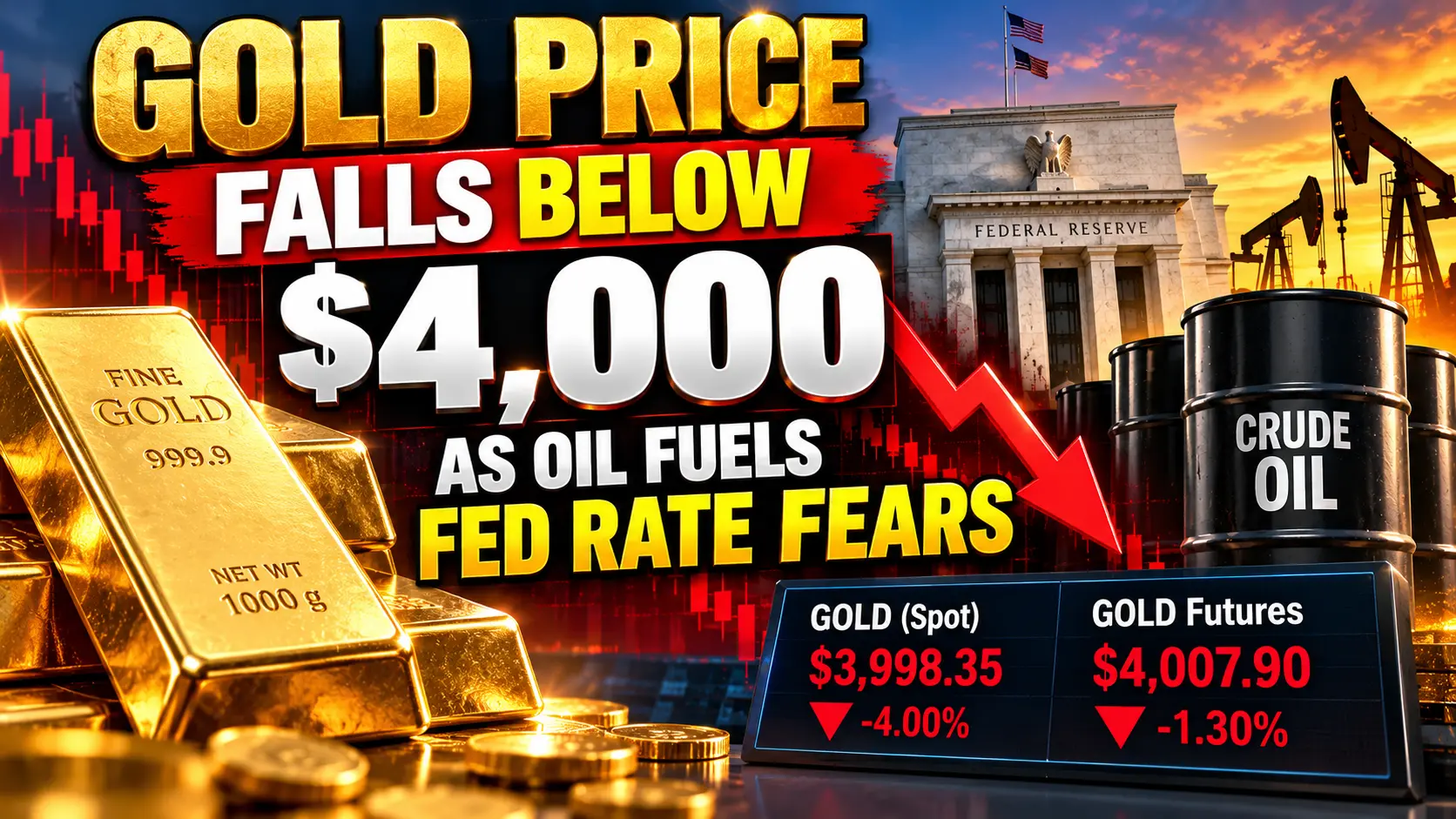
Gold Price: Gold prices came under heavy selling pressure on Friday, October 23, 2026, falling below the crucial $4,000-per-ounce level as surging crude oil prices raised inflation concerns and strengthened expectations that US interest rates could remain higher for longer. The decline put the precious metal on course for its steepest weekly loss in more than four months.
Spot gold fell to approximately $3,998.35 per ounce, touching its lowest level since mid-July. At the time of the reported market update, bullion was down around 4% for the week. US gold futures for December delivery also declined, settling 1.3% lower at $4,007.90 per ounce.
The sell-off highlights a challenging combination for precious metals: rising energy prices, persistent inflation risks, uncertainty over Federal Reserve policy, and pressure from wider financial-market volatility.
📉 Why Did Gold Prices Fall Below $4,000?
One of the biggest reasons behind the gold price decline was the sharp rise in crude oil prices.
Brent crude climbed to a more than five-month high after attacks involving Houthi forces in Saudi Arabia increased concerns about potential disruptions to global energy supplies. Higher oil prices can make transportation, manufacturing, and other business activities more expensive, raising the risk that inflation will remain elevated.
This creates a difficult environment for gold. Although investors often buy bullion during periods of uncertainty, higher interest-rate expectations can reduce its appeal relative to assets that generate interest.
Gold does not pay interest or dividends. When investors expect interest rates and bond yields to remain elevated, the opportunity cost of holding bullion increases.
The break below $4,000 therefore became an important psychological development for traders watching the international gold market.
However, a move below a round-number price does not automatically mean that gold will continue falling. Future movements will depend on inflation data, central-bank decisions, currency trends, and investor demand.
🥇 Gold Price Market Update
International gold market | October 23, 2026
Gold prices fluctuate. This information is for educational purposes and is not investment advice.
🛢️ Rising Crude Oil Prices Fuel Inflation Fears
The relationship between crude oil and gold is central to understanding the latest market movement.
Oil is an essential input for transportation, logistics, manufacturing, and numerous other economic activities. When energy prices rise sharply, businesses may face higher operating expenses, some of which can eventually be passed on to consumers.
Persistent increases in energy costs can make it more difficult for central banks to bring inflation under control.
For the United States, renewed inflation concerns could influence the Federal Reserve’s approach to monetary policy. If policymakers believe price pressures will remain elevated, they may keep interest rates higher for longer or consider additional tightening.
That possibility can weigh on gold prices.
The situation is particularly sensitive when oil prices rise because of geopolitical tensions. Such developments can increase uncertainty about energy supplies while simultaneously complicating the inflation outlook.
For gold investors, the critical question is whether higher oil prices will create a lasting inflation problem or prove to be a temporary shock.
🏦 Federal Reserve Rate Expectations Put Pressure on Gold
Investors were also preparing for the US Federal Reserve’s October 27–28 policy meeting.
At the time of the reported market update, traders largely expected the Fed to leave interest rates unchanged at that meeting. However, expectations of a possible December rate increase had strengthened following higher-than-expected US inflation readings.
Market pricing indicated approximately a 78% probability of a December rate hike, according to the figures reported on October 23. These probabilities represent market expectations rather than a confirmed policy decision.
Higher interest rates can influence gold through several channels.
First, they can make interest-bearing assets more attractive relative to bullion. Second, tighter monetary policy can support the US dollar under certain conditions, making dollar-denominated gold more expensive for buyers using other currencies.
Third, expectations of higher rates can increase bond yields, adding to the opportunity cost of holding a non-yielding asset.
Nevertheless, the relationship is not always straightforward. Gold can also benefit from financial instability, declining confidence in currencies, and strong demand for safe-haven assets.
The direction of US monetary policy will therefore remain a major factor for the precious metal.
💵 What Happens When Gold Breaks Below $4,000?
The $4,000-per-ounce level had become an important psychological reference point for market participants.
When gold moves below a widely watched price, some traders may reassess their positions. Others may use technical indicators, stop-loss orders, or risk-management rules when deciding whether to buy or sell.
A sustained move below this level could increase bearish sentiment, particularly if accompanied by a stronger dollar and rising bond yields.
However, gold could also recover if investors begin anticipating lower interest rates, geopolitical risks intensify, or physical demand strengthens.
A single price level should not be treated as a guaranteed floor or ceiling. Investors should consider the broader economic environment rather than making decisions based only on a round-number threshold.
🇮🇳 Gold Prices in India: What Buyers Should Know
International gold prices can influence domestic bullion prices in India, but the relationship is not one-to-one.
Indian gold prices also depend on the rupee-dollar exchange rate, import duties, local taxes, domestic premiums, transportation expenses, and dealer margins.
A decline in international gold prices may make buying more attractive for Indian consumers, provided currency movements and local costs do not offset the reduction.
The October 23 market report noted that lower international prices had supported physical gold buying in India during the Dussehra period, with premiums increasing. Chinese jewellery demand, meanwhile, remained subdued amid cautious consumer spending.
For jewellery buyers, it is important to distinguish between international spot prices and the final retail price. Making charges, taxes, purity, and local market conditions can all affect the amount paid.
Consumers should check current local rates before purchasing gold.
🥈 Silver, Platinum and Palladium Also Face Pressure
The weakness in gold extended to other precious metals.
Silver prices declined alongside bullion, while platinum and palladium also recorded losses. The reported market session showed silver falling to around $53.97 per ounce, while platinum and palladium faced pressure amid uncertainty over interest rates and investor positioning.
Although precious metals often move in the same direction, their individual market drivers differ.
Silver has both investment and industrial uses, making it sensitive to manufacturing demand as well as financial conditions. Platinum and palladium are influenced by industrial applications, particularly in the automotive sector, along with supply and demand developments.
Consequently, weakness across the precious-metals market does not necessarily mean that every metal will experience the same recovery or decline.
🔎 Gold Price Outlook: What Should Investors Watch Next?
The near-term outlook for gold will depend on several important developments.
1. Federal Reserve Policy
The October 27–28 meeting could influence expectations for interest rates. Investors will pay attention to the policy statement and any indications about future decisions.
2. US Inflation Data
The US Personal Consumption Expenditures price index, scheduled for October 29, was another important event on the market calendar. As the Fed’s preferred inflation gauge, it could influence expectations about future monetary policy.
3. Crude Oil Prices
Further increases in oil prices could reinforce inflation concerns, while easing energy costs might reduce pressure on interest-rate expectations.
4. The US Dollar and Bond Yields
A stronger dollar and higher yields can weigh on gold, although the relationship depends on broader market conditions.
5. Physical and Investment Demand
Jewellery purchases, central-bank activity, exchange-traded fund flows, and demand for safe-haven assets may influence prices in different ways.
Gold could remain volatile as traders assess these competing forces. A sustained recovery would require supportive market conditions, while continued inflation concerns and expectations of tighter monetary policy could create further headwinds.
📝 Final Takeaway
Gold’s fall below $4,000 per ounce reflects a shift in market attention toward inflation and interest-rate risks. Rising crude oil prices have complicated the outlook for monetary policy, while expectations of tighter US financial conditions have reduced the appeal of non-yielding bullion.
The upcoming Federal Reserve meeting and US inflation data will be important catalysts for the market.
For investors and jewellery buyers, the key lesson is to distinguish short-term price volatility from longer-term financial objectives. Gold can play a role in a diversified portfolio, but its price can fall sharply even during periods of geopolitical uncertainty.
The next direction for gold will depend on how oil prices, inflation expectations, interest rates, and safe-haven demand evolve in the coming days.
5. SEO-Friendly FAQ Section
1. Why did gold prices fall below $4,000 on October 23, 2026?
Gold prices declined as rising crude oil prices increased inflation concerns and strengthened expectations that US interest rates could remain higher for longer. Higher yields can reduce the relative attractiveness of gold.
2. What was the international gold price on October 23, 2026?
Spot gold fell to approximately $3,998.35 per ounce during the reported market update, while December gold futures settled at $4,007.90 per ounce.
3. How do crude oil prices affect gold prices?
Higher oil prices can increase inflation expectations and reduce the likelihood of interest-rate cuts. If interest rates and bond yields rise, gold may become less attractive compared with interest-bearing assets.
4. Will gold prices rise or fall in the coming days?
The direction is uncertain. Gold prices will depend on Federal Reserve policy, US inflation data, crude oil prices, the US dollar, bond yields, and demand for safe-haven assets.
5. How does the Federal Reserve influence gold prices?
The Federal Reserve influences borrowing costs and financial conditions. Higher interest rates can increase the opportunity cost of holding gold, while lower rates may support demand, depending on currency movements and other market factors.
6. How does falling international gold affect gold prices in India?
Lower international prices can reduce domestic gold prices, but the final Indian rate also depends on the rupee-dollar exchange rate, import duties, taxes, local premiums, and jewellery-making charges.
7. Is gold still considered a safe-haven asset?
Gold is widely regarded as a potential safe-haven asset, but it does not always rise during periods of uncertainty. Interest-rate expectations, liquidity needs, currency movements, and investor positioning can cause sharp price declines.
8. What should gold investors watch next?
Investors should monitor the Federal Reserve’s October 27–28 meeting, the US Personal Consumption Expenditures inflation report scheduled for October 29, crude oil prices, and movements in the US dollar and bond yields.