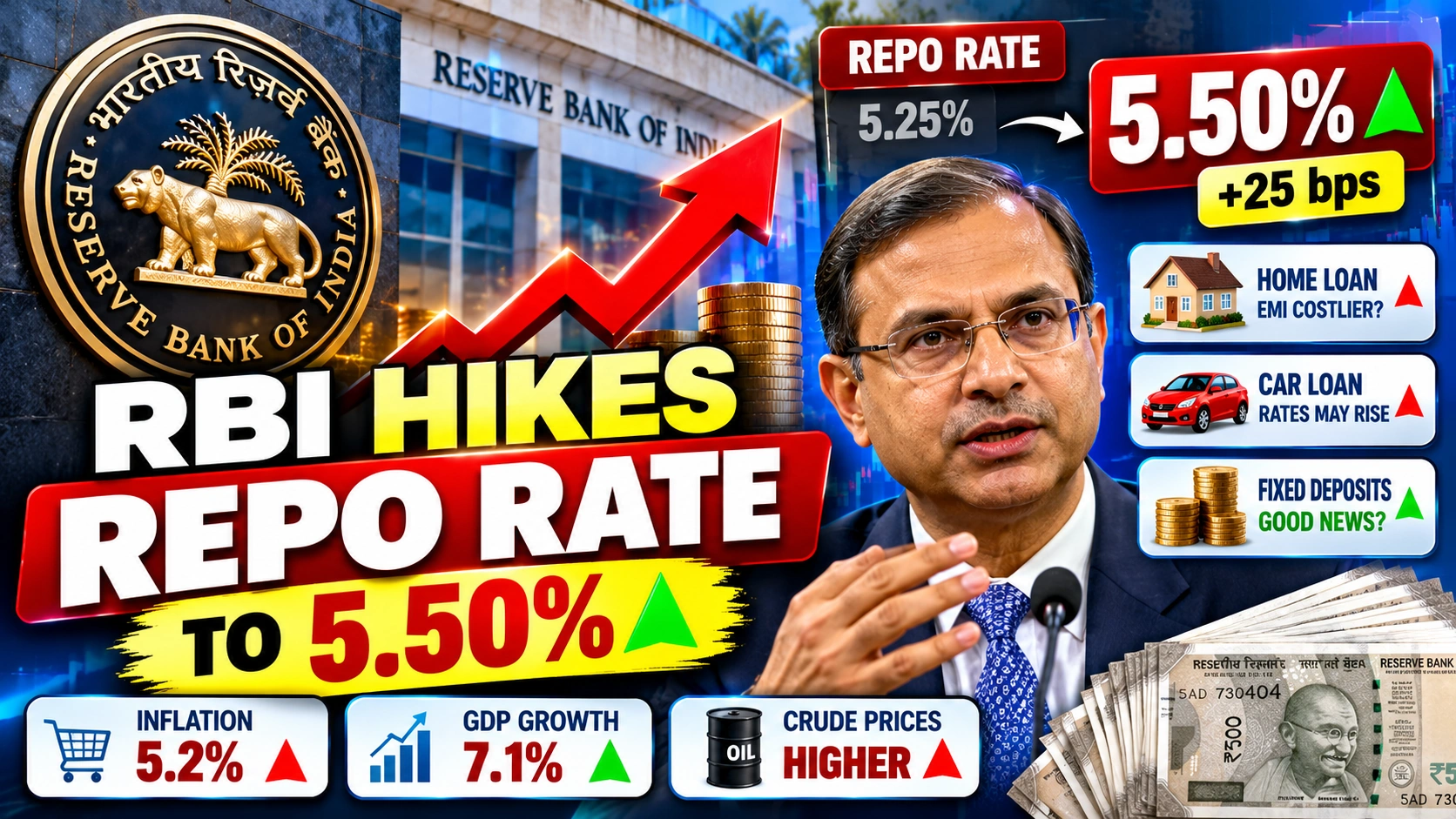
RBI Repo Rate Hike 2026: The Reserve Bank of India (RBI) has raised the repo rate by 25 basis points to 5.50%, marking its first rate increase since February 2023 and signalling a significant change in India’s monetary-policy direction. The six-member Monetary Policy Committee unanimously backed the rate increase on October 7, 2026.
The decision takes the repo rate from 5.25% to 5.50% as the central bank responds to broader inflationary pressure, higher energy costs and a challenging global environment. At the same time, India’s economy remains resilient enough for the RBI to raise its FY27 GDP growth forecast to 7.1%.
For households, the decision matters because a higher policy rate can eventually affect home loans, car loans, business borrowing and deposit rates. The important question is therefore not simply why RBI raised rates, but what the new cycle could mean for borrowers and savers.
📌 RBI Monetary Policy October 2026: Key Takeaways
The headline repo rate has increased by 25 basis points, or 0.25 percentage point, to 5.50%. RBI also moved away from its earlier neutral policy position toward “calibrated tightening.” The Standing Deposit Facility rate moved to 5.25%, while the Marginal Standing Facility and Bank Rate increased to 5.75%.
RBI also raised its FY27 CPI inflation projection from 5.0% to 5.2%, while increasing its GDP growth projection from 6.7% to 7.1%.
That combination—higher inflation expectations alongside stronger growth—helps explain why the central bank believes the economy can absorb somewhat tighter monetary conditions.
RBI Raises Repo Rate to 5.50%
A complete snapshot of India’s latest monetary-policy decision, inflation outlook, GDP forecast and the potential impact on home loans, EMIs, deposits and borrowers.
Up from 5.25%
▲ +25 bpsBefore October decision
PreviousRBI projection
Previously 5.0%RBI projection
Previously 6.7%Repo Rate: Before vs After
100 basis points equal 1 percentage point. Therefore, a 25-basis-point hike equals 0.25 percentage point, taking the repo rate from 5.25% to 5.50%.
Key RBI Policy Rates
| Policy Indicator | Current | Direction | Why It Matters |
|---|---|---|---|
| Repo Rate | 5.50% | ▲ 25 bps | Main policy rate influencing borrowing conditions |
| Standing Deposit Facility | 5.25% | Policy Rate | Rate available to banks for parking eligible funds with RBI |
| MSF Rate | 5.75% | Policy Rate | Emergency overnight borrowing facility for eligible banks |
| Bank Rate | 5.75% | Policy Rate | Important benchmark within RBI’s monetary framework |
Why Did RBI Raise the Repo Rate?
Persistent price pressures can threaten household purchasing power and make inflation harder to control.
Higher crude-oil costs can feed into transport, manufacturing and broader domestic prices.
Geopolitical and financial uncertainty can increase imported inflation and market volatility.
Stronger economic activity gives policymakers more room to focus on inflation control.
Global financial conditions and currency movements can affect India’s imported costs.
Weather and supply conditions remain important variables for India’s inflation outlook.
Inflation Up, But Growth Outlook Improves
RBI raised its inflation projection amid broader price pressures.
RBI simultaneously upgraded its growth outlook for the economy.
How a Repo Rate Hike Can Reach Your Pocket
Who Could Gain and Who Could Pay More?
Home Loans
Potentially Costlier ▲Floating-rate borrowers could face higher rates, increased EMIs or a longer repayment period.
Car & New Loans
Rates May Rise ▲New borrowing may become more expensive if lenders transmit higher policy rates.
Fixed Deposits
Potential Benefit ▲Some banks may offer higher deposit rates as funding conditions change.
Personal Loans
Watch Lending RatesUnsecured borrowing costs depend on lender pricing, credit profile and product structure.
Borrower
- 01 Check whether your loan is fixed or floating rate.
- 02 Check which external or internal benchmark applies.
- 03 Monitor your next interest-rate reset date.
- 04 Check whether your lender changes EMI or tenure.
Saver
- 01 Watch for changes in bank fixed-deposit rates.
- 02 Compare rates across different FD maturities.
- 03 Don’t assume every bank will raise rates equally.
- 04 Consider liquidity needs before locking money away.
RBI Is Trying to Balance Inflation and Growth
The 25-basis-point repo-rate hike to 5.50% represents tighter monetary conditions as inflation risks rise. At the same time, RBI’s stronger GDP forecast indicates confidence in India’s economic momentum. For consumers, the biggest areas to monitor are floating-rate loans, EMI resets and deposit rates.
🏦 What Is the Repo Rate?
The repo rate is the interest rate at which the Reserve Bank of India lends short-term funds to commercial banks against eligible securities.
It is one of the RBI’s most important monetary-policy tools.
When inflation becomes a concern, RBI can increase the repo rate. Higher borrowing costs can flow through the financial system, making credit more expensive and discouraging excessive demand.
Conversely, when economic growth needs support and inflation allows it, the central bank can reduce rates to encourage borrowing and spending.
A 25-basis-point increase means an increase of 0.25 percentage point. Therefore, moving from 5.25% to 5.50% represents a 25-bps hike.
📈 Why Did RBI Raise the Repo Rate to 5.5%?
Inflation is at the centre of the decision. India’s consumer-price inflation reached 4.82% in August, remaining above the RBI’s 4% medium-term target for a third consecutive month. Core inflation also accelerated, while the central bank pointed to pressures from food, fuel, weak rainfall and volatile international oil prices.
ThePrint’s editorial argues that the move can be viewed more as a monetary-policy “repair” than an aggressive squeeze, noting that the real cost of borrowing had fallen as inflation increased.
Oil is particularly important for India because higher crude prices can affect transportation, manufacturing and numerous other costs throughout the economy.
The RBI said the Indian crude basket averaged $116.1 per barrel in September, compared with $82 in July, according to ThePrint’s PTI report.
🌍 Global Risks Add to Inflation Pressure
Domestic conditions are only part of the story.
Renewed geopolitical tensions in West Asia have contributed to higher and more volatile crude prices. The global environment also includes trade uncertainty and tighter financial conditions.
India is particularly sensitive to major energy-price movements because higher imported energy costs can feed through to domestic inflation and put pressure on the currency.
Monetary policy cannot produce more crude oil or fix a poor monsoon. However, tighter policy can attempt to stop temporary supply shocks from spreading into broader inflation expectations and corporate pricing behaviour.
That distinction is crucial to understanding RBI’s move.
💰 Will Home Loan EMIs Increase After the RBI Rate Hike?
For borrowers, this is likely to be the most important question.
A repo-rate increase can raise banks’ funding and lending benchmarks, although the exact transmission varies by loan type and lender.
For an eligible floating-rate loan linked to an external benchmark, an increase in the applicable benchmark can eventually result in a higher interest rate. Depending on the loan contract and lender, that may mean a higher EMI, a longer repayment tenure, or some combination of the two.
Existing fixed-rate borrowers may not experience the same immediate impact because their interest rate is contractually fixed for the applicable period.
This means borrowers should check their individual loan terms instead of assuming every EMI will automatically rise by the same amount.
🚗 What About Car Loans and Personal Loans?
New borrowers may also encounter somewhat higher financing costs if banks and non-bank lenders pass the policy increase through to lending rates.
Car loans, business loans and certain personal-loan products could therefore become more expensive.
The actual change will depend on the lender, credit profile, loan structure and benchmark used.
A 25-bps RBI increase does not necessarily translate into an immediate 25-bps increase for every retail loan.
💵 Could Fixed Deposits Benefit?
The other side of higher interest rates is potentially better news for savers.
Banks competing for deposits may raise fixed-deposit rates or offer more attractive rates on selected maturities as monetary conditions tighten.
However, deposit-rate changes are not automatic either. Individual banks determine their deposit pricing based on liquidity, funding requirements, competition and their balance-sheet strategy.
Savers should therefore compare actual rates rather than assuming all FDs will immediately offer higher returns.
🚀 Why Did RBI Raise Its GDP Growth Forecast?
The rate hike might appear especially surprising because the central bank simultaneously became more optimistic about growth.
RBI raised its FY27 GDP growth forecast to 7.1% from 6.7%. India’s economy had expanded 7.8% in the April–June quarter, while manufacturing, services, credit and consumption indicators remained supportive.
Strong economic activity gives RBI more room to concentrate on controlling inflation.
That is why the October decision should not necessarily be interpreted as a sign that RBI believes India’s economy is weak. Instead, the central bank is trying to contain inflation while growth remains resilient.
🔮 Will RBI Raise Interest Rates Again?
Further rate increases are possible, but they are not guaranteed.
Governor Sanjay Malhotra indicated that near-term rate cuts are effectively off the table under current conditions, leaving a future pause or another increase as the more plausible policy choices depending on incoming data.
Some private economists expect further increases. Reuters reported commentary from economists expecting additional tightening, but these are forecasts—not confirmed RBI decisions.
The direction will depend heavily on inflation, crude oil, food prices, the rupee, economic growth and global financial conditions.
⚖️ RBI Faces a Difficult Balancing Act
The October policy illustrates the central bank’s challenge.
Raise interest rates too aggressively and borrowing costs can slow investment and household demand. Keep monetary policy too loose while inflation spreads, and persistent price increases can damage purchasing power and eventually require much harsher tightening.
The RBI appears to be choosing early, measured tightening while economic growth remains relatively strong.
For households, that means borrowers should pay closer attention to loan benchmarks and interest-rate resets, while savers may want to monitor deposit rates.
For the wider economy, the next few inflation readings will be critical in determining whether the October increase proves sufficient—or becomes the beginning of a longer tightening cycle.
❓ Frequently Asked Questions
What is the RBI repo rate now?
Following the October 7, 2026 Monetary Policy Committee decision, the policy repo rate is 5.50%, up from 5.25%.
How much did RBI increase the repo rate?
RBI increased the repo rate by 25 basis points, equivalent to 0.25 percentage point.
Why did RBI hike the repo rate?
Rising and broadening inflation pressures, higher energy costs and global uncertainty were important factors. Retail inflation had reached 4.82% in August.
Will my home-loan EMI increase?
It can, particularly for floating-rate loans whose applicable benchmark rises. However, the effect depends on your lender, benchmark and loan agreement. Some lenders may adjust the tenure rather than only increasing the EMI.
Is a repo-rate hike good for fixed deposits?
It can create conditions for banks to offer higher deposit rates, but individual banks decide their own FD pricing.
What is RBI’s FY27 GDP growth forecast?
RBI raised its FY27 GDP growth projection to 7.1%, from its previous forecast of 6.7%.
Will RBI hike rates again?
Another hike is possible but not confirmed. RBI has indicated that future action will depend on inflation, growth and other evolving economic conditions.