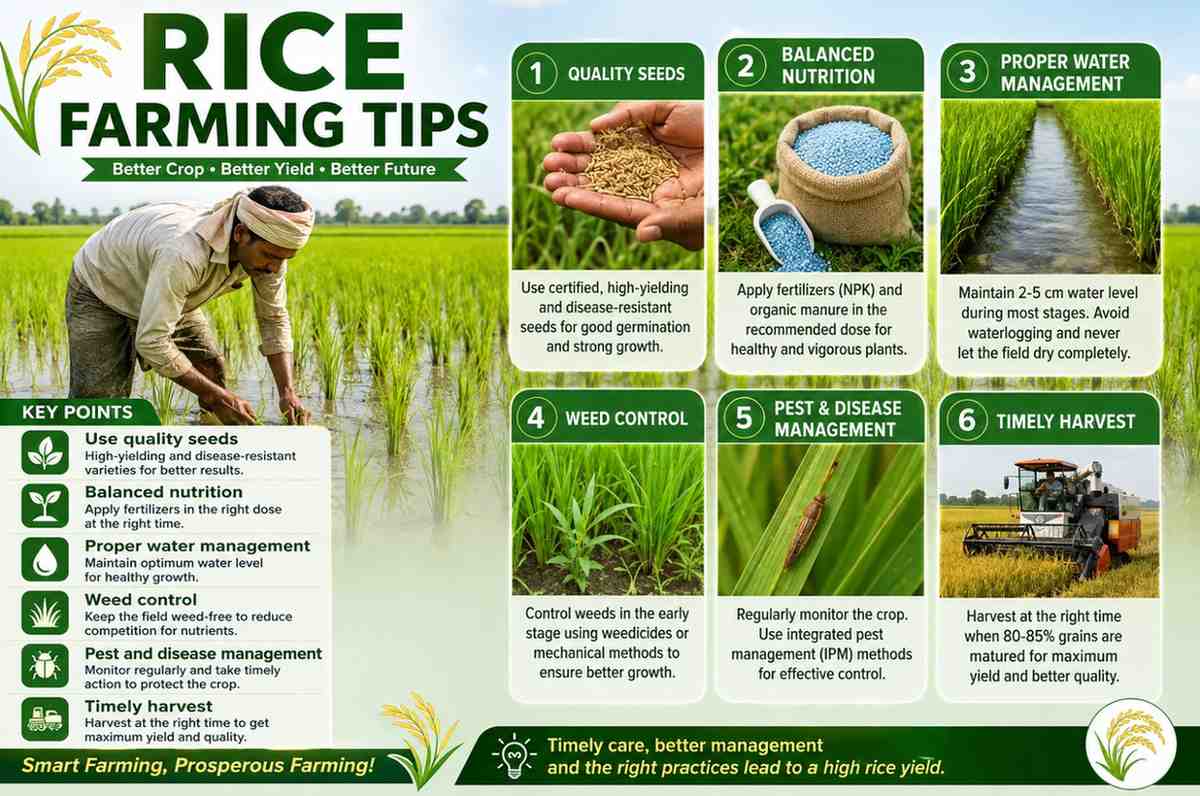
Rice Farming Tips: Sterile tillers in paddy can reduce the number of productive panicles and ultimately affect rice yield. Excessive nitrogen, poor water management, nutrient deficiencies, overcrowding, weeds, and pest or disease pressure can all contribute to weak or non-productive tillers.
The 30–40 day stage after transplanting is particularly important because the rice plant is actively producing and developing tillers. Proper fertilizer management, adequate water, weed control, and regular crop monitoring during this period can help farmers maintain healthy, productive tillers.
So, how can farmers control sterile or barren tillers in paddy? Here are practical rice farming tips to manage the problem and support better panicle development. 👇
🌾 What Are Sterile Tillers in Paddy?
Tillers are side shoots that develop from the base of a rice plant. A healthy rice plant produces several tillers, but not every tiller becomes productive.
A productive tiller develops a panicle and contributes to grain yield. A sterile, barren, or non-productive tiller remains weak or fails to produce a useful panicle.
A few non-productive tillers can occur naturally. However, when their number becomes excessive, the crop may have fewer productive panicles and poor utilization of nutrients and sunlight.
How to identify weak or sterile tillers?
Farmers should watch for:
- 🌱 Very weak or thin tillers
- 🌿 Excessive vegetative growth without good tiller development
- 🍃 Pale or abnormal leaves
- 💧 Uneven crop growth across the field
- 🌾 Fewer productive tillers compared with the overall plant population
- 🐛 Tillers damaged by insects or diseases
- 🌾 Poor panicle emergence later in crop development
Identifying the problem early is important because management becomes more difficult once the crop has progressed too far.
1. Avoid Excessive Nitrogen Fertilizer 🚜
One of the most common mistakes in paddy cultivation is applying more nitrogen than the crop requires in an attempt to obtain a darker green crop and more tillers.
Nitrogen is essential for rice growth, but excessive nitrogen can encourage vigorous vegetative growth and may create an imbalance between plant growth and reproductive development.
The result can be a crop with:
- Excessive foliage
- Tall, soft growth
- Dense tillering
- Greater susceptibility to lodging
- Increased pest and disease pressure
- A higher proportion of weak or non-productive tillers
What should farmers do?
Apply urea or another nitrogen fertilizer according to the recommended dose for the rice variety, soil condition, crop establishment method, and local recommendation.
Do not increase the urea dose simply because the crop appears less green than expected. A soil test and local agricultural recommendation can help determine the appropriate nutrient requirement.
👉 Remember: More fertilizer does not automatically mean more rice yield.
2. Maintain a Balanced Supply of Potassium and Other Nutrients 🌱
Nitrogen should not be considered separately from the other essential nutrients.
Potassium (potash) plays an important role in plant strength, water regulation, stress tolerance, and grain development. A nutrient imbalance can affect overall crop performance even when nitrogen is adequate.
Farmers should therefore follow a balanced fertilizer program rather than relying heavily on urea.
Depending on soil fertility, symptoms, and local recommendations, attention may also be required for nutrients such as:
- Potassium
- Zinc
- Sulfur
- Phosphorus
- Other micronutrients
Why is balanced nutrition important?
A well-nourished rice plant is better able to develop healthy tillers and support panicle and grain development.
However, farmers should avoid applying micronutrients or fertilizers blindly. Soil testing and locally recommended nutrient-management practices are preferable, especially where deficiency symptoms are unclear.
3. Pay Attention to Zinc Deficiency 🧪
Zinc is an important micronutrient in rice production. Zinc deficiency can affect plant growth and may result in weak, stunted, or poorly developing plants.
Possible signs can include:
- Stunted growth
- Poor tillering
- Discoloration or bronzing of leaves
- Uneven crop development
If zinc deficiency is suspected, farmers should first confirm the problem through soil testing, plant diagnosis, or advice from a local agricultural expert.
Zinc sulfate or another zinc source may be recommended where a deficiency is confirmed. The product concentration, application method, and dose should follow the label and local agricultural recommendations.
⚠️ Avoid applying zinc or other micronutrients at unnecessarily high rates.
4. Manage Irrigation Properly 💧
Water management has a major influence on rice growth and root health.
Keeping the field continuously deep-flooded is not always necessary and can create unfavorable root conditions. At the same time, severe water stress can also damage the crop.
During the tillering period, farmers should maintain water according to the soil type, crop establishment method, rainfall, rice variety, and local water-management recommendations.
Consider controlled water management
Where appropriate, allowing the field to drain and re-aerate periodically can improve root-zone conditions and encourage healthier crop growth.
However, farmers should not deliberately dry a field to the point of causing moisture stress.
💡 Simple rule: Avoid both extremes—unnecessary continuous deep flooding and severe moisture shortage.
5. Control Weeds at the Right Time 🌿
Weeds compete directly with rice plants for:
- Nutrients
- Water
- Sunlight
- Space
Heavy weed competition during the early and active tillering stages can weaken rice plants and reduce crop uniformity.
A field that looks green from a distance may still have significant weed competition underneath the rice canopy.
Better weed management
Farmers should:
- Monitor the field regularly.
- Identify the dominant weed species.
- Use mechanical, cultural, or chemical control methods as appropriate.
- Follow the correct herbicide label and application timing when herbicides are used.
- Avoid excessive or repeated herbicide applications.
🌾 Early weed management is generally more effective than waiting until weeds become large and well established.
6. Monitor Stem Borers and Other Pests 🐛
Not every weak tiller is caused by fertilizer imbalance.
Insect pests can damage rice tillers and prevent them from producing normal panicles.
For example, stem borer damage can cause dead hearts during the vegetative stage and whiteheads at the reproductive stage.
Farmers should regularly inspect the crop for:
- Dead or drying central shoots
- Whiteheads
- Stem damage
- Insect larvae or eggs
- Unusual patches of weak plants
Do not spray an insecticide simply because some tillers appear weak.
👉 Identify the pest first and use control measures according to locally recommended integrated pest-management practices and economic thresholds.
7. Prevent and Manage Diseases 🦠
Root and stem problems, fungal diseases, and other crop diseases can also cause poor growth and weak tillers.
Disease problems may become more serious when crops are:
- Over-fertilized with nitrogen
- Grown too densely
- Poorly ventilated
- Exposed to prolonged favorable conditions for pathogens
- Subjected to improper irrigation
Farmers should regularly inspect both the leaves and lower portions of the plants.
If disease symptoms appear, identify the disease before selecting a fungicide or other treatment. Using the wrong product can waste money and may not solve the problem.
🌾 Why Does Paddy Produce Too Many Barren Tillers?
There is usually no single cause of sterile tillers.
Common contributing factors include:
1. Excess nitrogen
Too much nitrogen can encourage excessive vegetative growth.
2. Nutrient imbalance
Deficiencies or imbalances involving potassium, zinc, phosphorus, sulfur, or other nutrients can affect crop development.
3. Poor water management
Both prolonged waterlogging and moisture stress can negatively affect rice growth.
4. Excessive plant density
Overcrowded plants compete for sunlight, nutrients, water, and space.
5. Weed competition
Heavy weed pressure reduces the resources available to rice plants.
6. Pest damage
Insects such as stem borers can destroy developing tillers.
7. Disease
Disease-affected plants may produce weak or poorly developed tillers.
8. Variety and environmental conditions
Rice varieties differ in tillering ability and response to nutrients, temperature, water, and other environmental conditions.
⏰ Why Is the 30–40 Day Stage Important?
The period around 30–40 days after transplanting is an important stage for many transplanted rice crops because active tillering is taking place.
But farmers should not treat 35 days as a universal fertilizer date for every paddy crop.
The correct timing depends on factors such as:
- Rice variety
- Direct-seeded or transplanted rice
- Crop duration
- Soil fertility
- Weather
- Previous fertilizer applications
- Local recommendations
Therefore, the best approach is to manage nutrients according to the crop stage and recommended nutrient schedule, rather than applying fertilizer based only on the number of days after planting.
🚜 A Practical Paddy Tiller Management Plan
Farmers can use the following checklist during the active tillering period:
✅ Check the crop
Look for weak, abnormal, pest-damaged, or diseased tillers.
✅ Review nitrogen use
Do not apply additional urea simply to make the crop darker green.
✅ Maintain balanced nutrition
Ensure the crop receives the required major and micronutrients based on soil conditions and recommendations.
✅ Check for zinc deficiency
If symptoms are present, confirm the deficiency before applying zinc.
✅ Manage irrigation
Avoid unnecessary deep flooding while preventing severe moisture stress.
✅ Control weeds
Keep weed competition under control during the critical early crop stages.
✅ Scout for pests
Inspect stems and tillers regularly for stem borers and other insects.
✅ Watch for disease
Investigate unusual patches, discoloration, wilting, or drying tillers.
✅ Consider plant population
Avoid excessive plant density and follow the recommended spacing or seed rate for the cultivation system.
🌾 Can Every Paddy Tiller Produce a Panicle?
No.
Rice naturally produces more tillers than the number that ultimately become productive panicles. Some tillers may die or remain non-productive as the crop develops.
The goal of good crop management is therefore not to force every tiller to produce a panicle.
Instead, farmers should aim for an adequate and healthy population of productive tillers with good panicle development and grain filling.
This is an important distinction when evaluating paddy yield.
🌱 5 Mistakes Farmers Should Avoid
❌ Applying extra urea without checking crop requirements
❌ Keeping the field continuously flooded without considering crop and soil conditions
❌ Applying zinc or other micronutrients without confirming a deficiency
❌ Spraying pesticides whenever a few weak tillers are observed
❌ Waiting until severe weed, pest, or disease damage appears before taking action
Good rice farming is based on timely observation and balanced management, not simply increasing fertilizer or pesticide use.
❓ Frequently Asked Questions About Sterile Tillers in Paddy
What are sterile tillers in rice?
Sterile tillers are tillers that fail to develop into productive panicles or contribute little to final grain yield. Some non-productive tillers are normal, but excessive numbers may indicate crop-management or environmental problems.
Why are my paddy plants producing too many tillers?
Excess nitrogen, high plant density, variety characteristics, favorable vegetative conditions, and management practices can contribute to excessive tillering. Not all additional tillers become productive.
Does excess urea cause barren tillers in paddy?
Excess nitrogen can promote excessive vegetative growth and may contribute to an imbalance between vegetative and reproductive development. However, barren tillers can have several other causes, so farmers should not assume nitrogen is always responsible.
Is potash useful for paddy tiller management?
Potassium is an essential nutrient for rice and supports several physiological functions, including water regulation, plant strength, and grain development. It should be applied according to soil fertility and recommended nutrient-management practices.
Is zinc important for rice cultivation?
Yes. Zinc is an essential micronutrient for rice. Where zinc deficiency occurs, correcting it can improve crop growth. However, farmers should confirm suspected deficiency and follow locally recommended application practices.
Should farmers drain the paddy field at 35 days?
Water management should not be based on a fixed 35-day rule. The appropriate practice depends on soil, weather, rice establishment method, variety, and local recommendations. Where suitable, controlled wetting and drying or periodic drainage can improve water-use efficiency and root-zone conditions.
How can I increase productive tillers in paddy?
Focus on balanced nutrition, suitable plant population, proper water management, timely weed control, and regular monitoring for pests and diseases. The objective is to maintain healthy productive tillers, not simply maximize the total number of tillers.
🌾 Final Takeaway: Focus on Productive Tillers, Not Just More Tillers
Sterile or barren tillers can become a concern when a large proportion of the rice crop produces weak or non-productive shoots. Excess nitrogen is one possible contributor, but it is not the only cause.
The best approach is integrated crop management:
Balanced fertilizer + proper water management + timely weed control + pest and disease monitoring + appropriate plant population = healthier productive tillers. 🌾
Farmers should avoid the common mistake of judging crop health only by how green or dense the field looks. A healthy-looking crop with excessive vegetative growth does not necessarily produce the highest grain yield.
👉 The real target is a well-managed crop with an adequate number of strong, productive tillers, healthy panicles, and good grain filling.
For fertilizer, zinc, herbicide, fungicide, or insecticide use, always follow the product label and recommendations from your local agricultural department or qualified agronomist, as rates and timings vary by crop, soil, variety, and region.