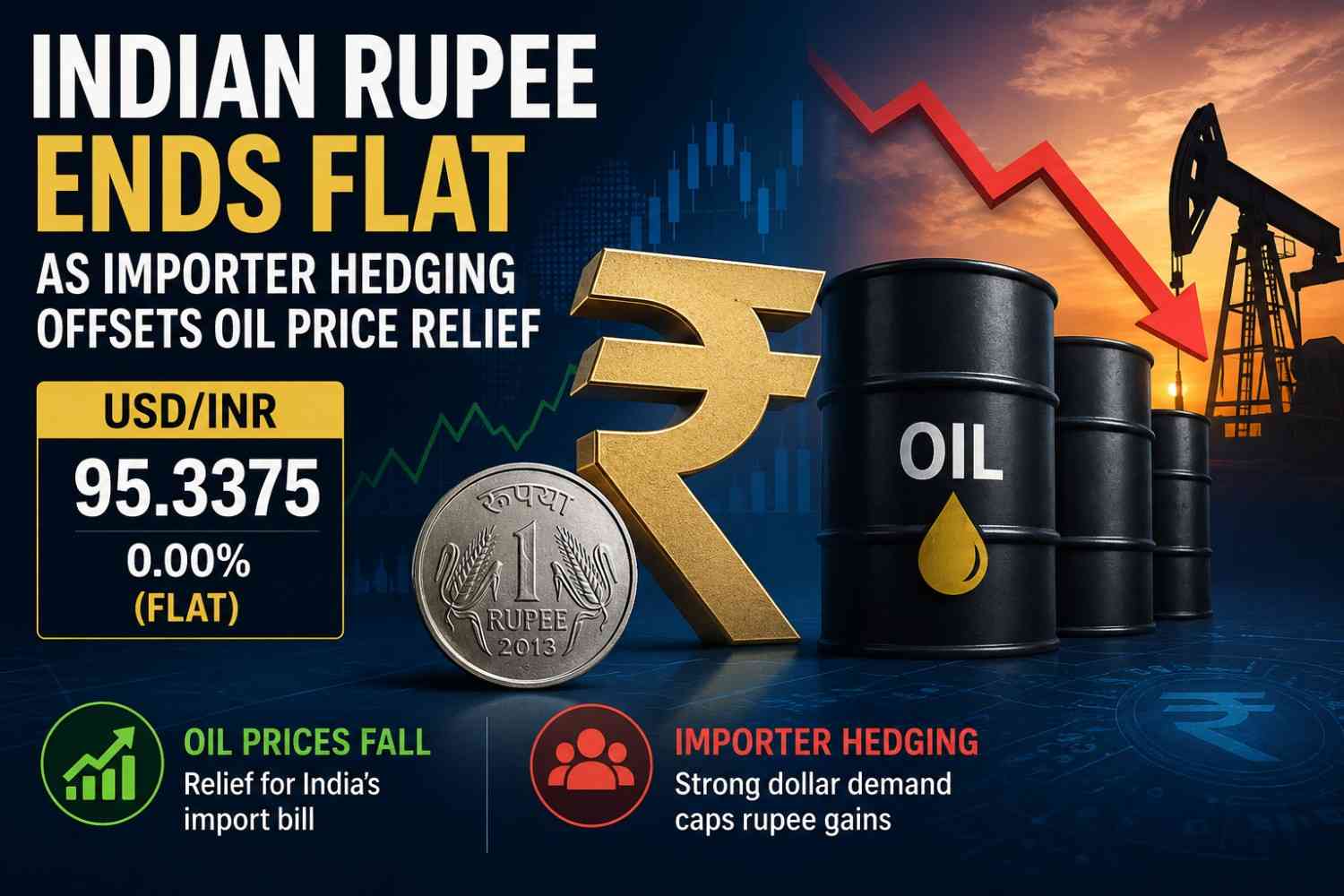
Indian rupee: The Indian rupee ended nearly unchanged against the U.S. dollar on Monday after briefly climbing to a three-week high, as strong dollar demand from importers and state-run banks erased much of the benefit from sharply lower oil prices.
The rupee closed at 95.3375 per U.S. dollar, compared with 95.38 in the previous session. Earlier in the day, the currency strengthened to 95.1275, its strongest level in three weeks.
The move came as global oil prices fell sharply after U.S. President Donald Trump called off an imminent attack in the hope of making progress toward a deal with Iran. Lower crude prices are generally positive for India because the country relies heavily on imported oil.
However, the rupee’s gains were capped by persistent demand for dollars from importers and state-run banks.
📌 Why did the Indian rupee fail to hold its gains?
The decline in oil prices initially gave the Indian rupee a boost by easing concerns over India’s import bill and demand for U.S. dollars.
But that support was quickly offset by strong dollar buying.
A Mumbai-based bank trader said there were very strong dollar bids around the 95.15 level from state-run banks, which were likely acting on behalf of clients.
This demand prevented the rupee from holding its strongest intraday levels.
Key factors affecting the rupee on Monday
- 🛢️ Lower oil prices: Falling crude prices offered relief to India’s import bill.
- 💵 Strong importer dollar demand: Importers continued to buy dollars and hedge their currency exposure.
- 🏦 State-run bank activity: Large dollar bids around 95.15 limited the rupee’s recovery.
- 🌍 Geopolitical developments: U.S.-Iran talks remained a major driver of market sentiment.
- 📊 RBI policy decision: Traders are now turning their attention to the Reserve Bank of India’s upcoming policy announcement.
🛢️ Falling oil prices provide relief for India
Oil prices have become an important driver of the rupee as geopolitical tensions have increased volatility in global energy markets.
A sustained decline in crude prices can support the Indian currency because cheaper oil reduces the amount of dollars Indian companies need to purchase for energy imports.
Monday’s sharp fall in oil prices therefore provided an important positive signal for the rupee.
However, the currency market showed that lower crude prices alone may not be enough to trigger a sustained rupee rally when importers are actively hedging their dollar exposure.
💵 Importer hedging keeps pressure on the rupee
Importer hedging is playing an important role in the currency market.
When companies expect to make payments in U.S. dollars, they can hedge their exposure by locking in exchange rates in advance. This can increase demand for dollars even when the rupee is strengthening.
Recent market data has shown that Indian importers have been particularly active in hedging their foreign-exchange exposure, adding another layer of demand for dollars.
For traders, this means the rupee’s direction is being determined by more than just oil prices. Dollar demand, capital flows, RBI intervention and geopolitical developments are also important.
🌏 Dollar and Asian currencies
The U.S. dollar index was broadly steady at around 99.7, while most Asian currencies strengthened.
The Japanese yen also firmed to a three-month high after the United States and Japan confirmed joint intervention to support the Japanese currency. Data indicated that Japan may have spent as much as $36.58 billion buying yen during the latest intervention.
The broader strength in Asian currencies provided some support for the rupee, although domestic dollar demand limited the impact.
🏦 RBI policy decision in focus
The next major domestic trigger for the Indian rupee is the Reserve Bank of India’s policy decision, due on Wednesday.
Economists expect the RBI to keep policy rates unchanged, according to the market view cited in the latest report.
Traders will closely watch the RBI’s assessment of inflation, growth, liquidity and currency-market conditions.
The central bank’s approach to foreign-exchange volatility could also remain important after recent periods of pressure on the rupee.
📈 What traders are watching next
The rupee’s near-term direction is likely to depend on several competing factors.
Lower crude oil prices could provide further support if the decline is sustained. At the same time, strong importer hedging and dollar demand could continue to limit the currency’s upside.
Geopolitical developments between the United States and Iran will also remain critical because any renewed escalation could push oil prices higher and put fresh pressure on the rupee.
Traders will therefore be watching the RBI policy decision, crude oil prices, USD/INR demand and developments in U.S.-Iran talks for the next major market signal.
🔑 Key takeaways
- 🇮🇳 Indian rupee closed at 95.3375 per dollar, compared with 95.38 previously.
- 📈 The rupee briefly touched 95.1275, a three-week high.
- 🛢️ A sharp fall in oil prices initially supported the currency.
- 💵 Strong dollar demand from importers and state-run banks capped gains.
- 🏦 The RBI policy decision is the next major domestic event for currency traders.
- 🌍 U.S.-Iran developments and oil prices remain important risks for the rupee.
Bottom line
The Indian rupee received a boost from falling oil prices but could not sustain its early gains as importer hedging and strong dollar demand emerged around key levels. With the RBI policy decision and geopolitical developments ahead, traders are likely to remain cautious about the rupee’s next move.