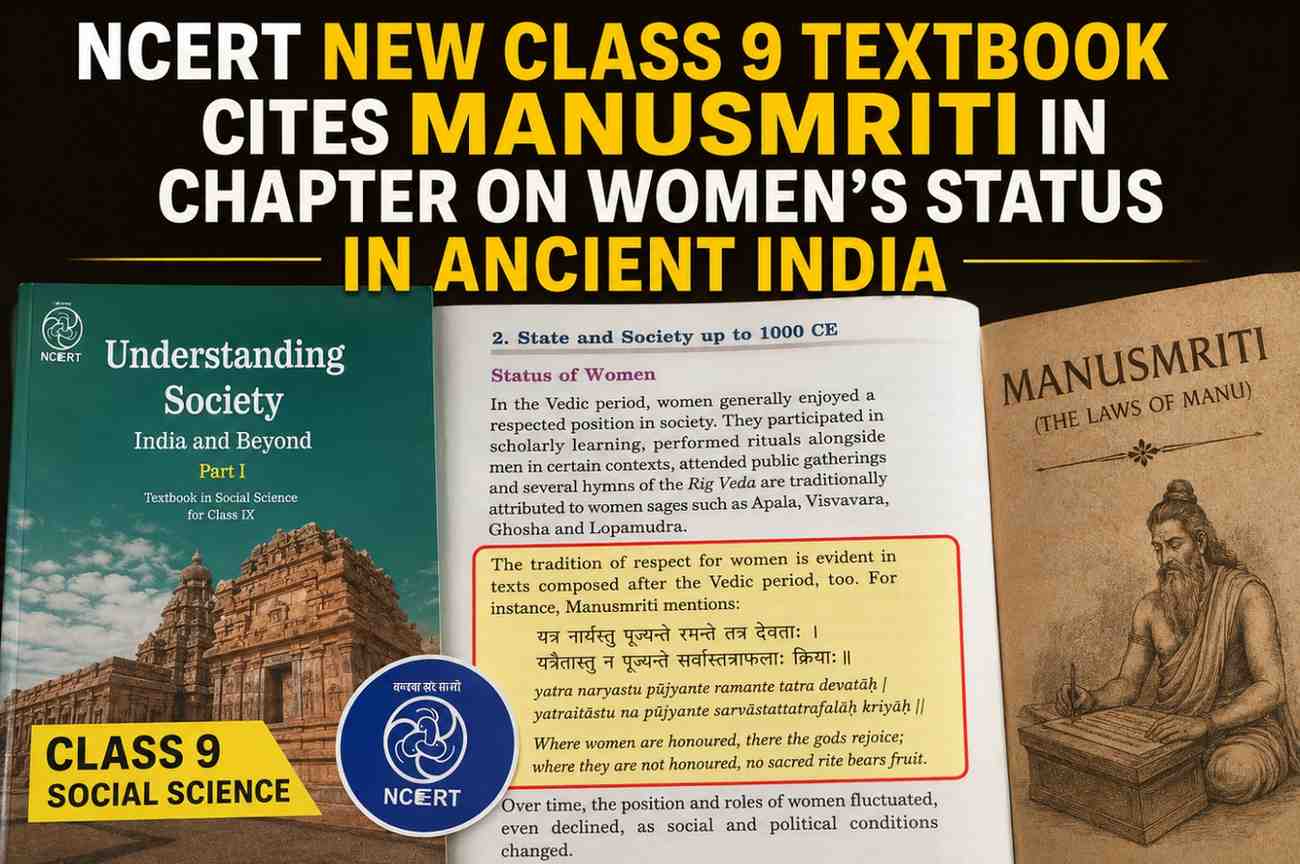
NCERT New Class 9 Textbook : The newly released NCERT Class 9 Social Science textbook, Understanding Society: India and Beyond – Part 1 has sparked widespread discussion across India. After drawing attention for introducing a chapter on the Emergency and describing India’s electoral process as “unparalleled,” the textbook is now in the spotlight for citing the Manusmriti while discussing the status of women in ancient India.
The reference has triggered fresh debate on social media and among academics. However, a closer reading of the chapter shows that the textbook presents the citation within a broader historical context rather than as an endorsement.
📖 What Does the NCERT Class 9 Textbook Say About Women?
According to an ANI report, the chapter titled “State and Society up to 1000 CE” explains that women generally held a respected position during the Vedic period.
The textbook highlights that women:
- 👩🎓 Participated in scholarly learning.
- 🕉️ Performed religious rituals alongside men in certain contexts.
- 🏛️ Attended public assemblies and gatherings.
- ✍️ Composed Vedic hymns.
It also mentions that several hymns of the Rig Veda are traditionally attributed to women sages such as:
- 🌸 Apala
- 🌸 Visvavara
- 🌸 Ghosha
- 🌸 Lopamudra
The chapter then introduces a verse from the Manusmriti, stating:
“The tradition of respect for women is evident in texts composed after the Vedic period, too.”
The quotation is used to illustrate historical perspectives found in ancient Sanskrit literature.
📉 NCERT Also Mentions the Decline in Women’s Status
Importantly, the textbook does not suggest that women’s position remained the same throughout history.
Immediately after quoting the verse, it states:
“Over time, the position and roles of women fluctuated, even declined, as social and political conditions changed.”
The chapter explains that despite changing social conditions, women continued to make significant contributions in various fields, including:
- 🌾 Agriculture
- 🏡 Household management
- 🎨 Crafts and handicrafts
- 🛕 Religious practices
NCERT also cites historical examples such as Prabhavati Gupta, who served as regent of the Vakataka Kingdom, highlighting women’s continued participation in governance and public life.
The textbook further references literature from the Gupta-Vakataka period and Sangam literature to demonstrate women’s roles in administration, arts and economic activities.
🏛️ What Does the Book Say About Varna and Jati?
The revised Class 9 textbook also revisits the concepts of varna and jati.
According to the chapter:
- 📚 In the early Vedic period, social identity was not determined solely by birth.
- ⚖️ The four varnas were initially viewed as functional social categories rather than rigid hereditary divisions.
- 🔄 The more complex jati system evolved gradually through intermarriage, regional differences and the emergence of new occupations.
To support this explanation, the textbook quotes the Buddhist text Sutta Nipata, which states:
“No outcaste is such by birth but only by his deeds. A brahmana is such by his deeds.”
The quotation is presented to illustrate the idea that a person’s actions, rather than birth, determine social standing.
🤔 Why Is the Manusmriti Controversial?
The Manusmriti is one of the most debated ancient Sanskrit texts in Indian history.
Many historians regard it as an important source for understanding ancient legal and social traditions. At the same time, numerous scholars, social reformers and Dalit organisations have criticised several passages dealing with:
- ⚠️ Caste hierarchy
- ⚠️ Women’s status
- ⚠️ Social inequality
- ⚠️ Patriarchal norms
Because of these differing interpretations, references to the text often generate public debate.
🎓 Previous Controversies Over the Manusmriti
The Manusmriti has appeared in academic controversies before.
In 2025, its inclusion as recommended reading for a Sanskrit Department paper at the University of Delhi drew objections from students and faculty members. Following the controversy, the university clarified that the text would not be part of the course curriculum.
📚 NCERT’s Revised Class 9 Books
The Social Science textbook is among the final revised NCERT Class 9 books released for the current academic session.
Its publication followed delays in the rollout of the revised curriculum, prompting concerns from several schools over the late availability of textbooks.
With its chapters on the Emergency, Indian democracy, varna and jati, and now the Manusmriti, the revised textbook has become one of the most discussed educational publications of the year.
🔑 Key Highlights
✅ NCERT’s new Class 9 textbook cites a verse from the Manusmriti while discussing women’s status in ancient India.
✅ The book states that women enjoyed respect during the Vedic period but also says their status later fluctuated and declined due to changing social and political conditions.
✅ The chapter highlights women scholars, rulers and contributors to ancient Indian society.
✅ NCERT also explains that varna was originally linked to social functions rather than birth and discusses the later development of the jati system.
✅ The inclusion of the Manusmriti has reignited public debate because of the text’s long-standing historical controversies.
Keypoint : NCERT Class 9 textbook, NCERT Manusmriti, NCERT Social Science book, Manusmriti controversy, Women’s status in ancient India, Vedic women, NCERT Class 9 Social Science, Understanding Society India and Beyond Part 1, Varna and Jati, NCERT latest news, Education News India, Class 9 NCERT News.